
Why Food Delivery Data Matters in 2026
Food delivery is a high-velocity market where menus, prices, and promotions change daily across thousands of restaurants. According to Statista's 2025 data, the global online food delivery market is projected to exceed $1.4 trillion in revenue by 2026, with platform competition intensifying across the US and Asia. Decisions about pricing, coverage, and menu strategy now depend on data that is fresh and complete.
Manual tracking cannot keep pace. A single city can hold tens of thousands of restaurant listings, each with a full menu that shifts with demand and promotions. The teams that win (restaurant chains, delivery platforms, quick-commerce operators, and investors) run on continuously extracted data rather than periodic spot checks.
How to Scrape Food Delivery Data
Scraping food delivery data means collecting structured records from platform pages and apps on a schedule, then validating and delivering them. The hard part is not the first extraction; it is keeping it running as apps change and defenses tighten. The workflow has four stages.
Define sources and fields
Decide which platforms, cities, and data points (menus, prices, ratings, ETAs, coverage) you need, and at what frequency.
Collect from web and app
Extract from platform websites where possible and from mobile apps for data that is app-only, routing through infrastructure that looks like ordinary traffic.
Structure and validate
Turn raw listings into clean records, validate prices against historical ranges, and flag anomalies before delivery.
Deliver on schedule
Push structured data to your warehouse, S3, or API at the cadence each use case requires.
For a focused walkthrough of platform extraction, see our guide on how to scrape restaurant data from delivery platforms.
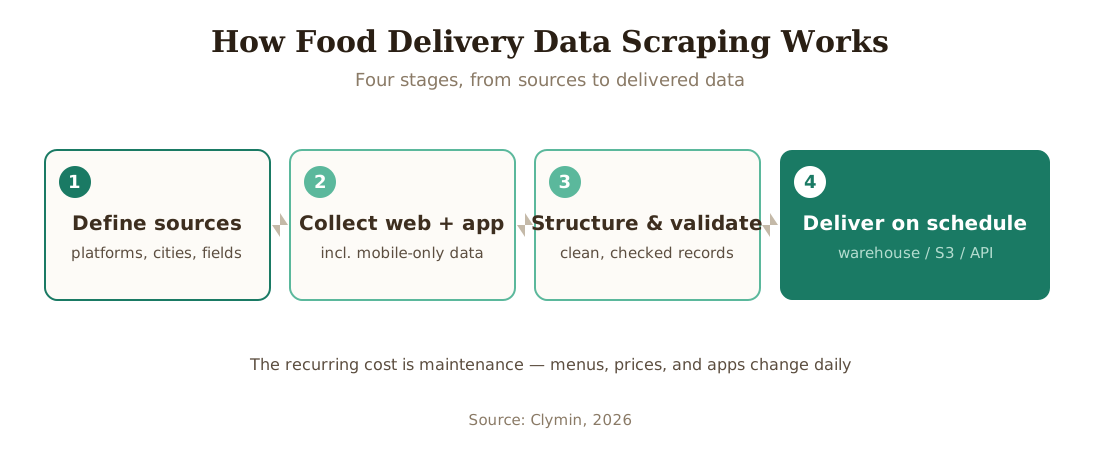 Food delivery data scraping in four stages. The recurring cost is maintenance as apps and defenses change.
What Data Can You Extract From Food Delivery Apps?
Food delivery platforms expose a rich set of fields, but coverage varies by platform and much of it is app-only. The table below maps the most valuable data points to common use cases.
| Data point | Example use case |
|---|---|
| Menus and item prices | Competitor pricing and menu benchmarking |
| Promotions and discounts | Tracking competitor offers and timing |
| Ratings and reviews | Sentiment and quality benchmarking |
| Delivery fees and ETAs | Service-level and pricing analysis |
| Store availability | Demand and outage monitoring |
| Delivery coverage areas | Expansion and white-space analysis |
For the full breakdown, see what data you can scrape from food delivery apps, and for offers specifically, food delivery promotion and discount tracking.
Platforms and Sources
Coverage strategy depends on which platforms dominate your market. In the US, DoorDash, Uber Eats, and Grubhub lead; in India, Swiggy and Zomato; in grocery and quick commerce, Instacart and regional apps. Each platform structures data differently and defends it differently.
Clymin maintains extraction across these sources, including dedicated coverage for Uber Eats data scraping and Swiggy and Zomato data scraping. Platform-specific parsers matter because a generic scraper that works on one app usually fails on the next.
How the major platforms differ in practice:
- DoorDash. The US market leader by share, with deep menu and store data and strong anti-bot defenses. Coverage and store-availability data are especially valuable for white-space analysis.
- Uber Eats. Global footprint across food and grocery, with ETA and delivery-fee data that shifts dynamically by location and time, making frequency important.
- Grubhub. Strong in specific US metros; useful for regional benchmarking where its share is concentrated.
- Swiggy and Zomato. The dominant Indian platforms, rich in restaurant, rating, and promotion data, with heavy app-side rendering that often requires app-level extraction.
- Instacart and quick commerce. Grocery and convenience catalogs with SKU-level pricing and availability; see Instacart grocery data extraction for that adjacent use case.
A coverage plan should weight platforms by share in each target market rather than trying to scrape everything everywhere, which raises cost without adding insight.
Common Use Cases by Team
Food delivery data serves distinct goals depending on who uses it. Restaurant chains benchmark menus and pricing; delivery platforms monitor competitor coverage and service levels; investors size markets and track share.
The highest-value applications include menu and price benchmarking, promotion tracking, delivery-coverage mapping, and market-share analysis. For the analytical playbook, see our guide on how to analyze the food delivery market with data.
Restaurant Chains and Brands
Restaurant chains use food delivery data to benchmark their menus, prices, and ratings against direct competitors in each city. Tracking competitor promotions reveals when and how rivals discount, so a chain can time its own offers instead of reacting late. Menu-item gaps, dishes competitors carry that the chain does not, surface white space for new products.
Delivery Platforms and Aggregators
Delivery platforms monitor competitor coverage areas, delivery fees, and ETAs to find under-served zones and price their service competitively. Tracking which restaurants are exclusive to a rival platform informs partnership and acquisition strategy. Continuous menu and availability data also helps detect outages and quality issues across the network.
Quick Commerce and Grocery Operators
Quick-commerce operators extract SKU-level pricing and availability from grocery and convenience apps to set competitive prices and spot stockouts. Assortment comparison shows which products competitors stock in each dark store or region, guiding range decisions. Promotion tracking captures the fast-moving discounts that define the category.
Investors and Market Researchers
Investors size markets and track share shifts using delivery data as an alternative signal. Counts of active restaurants, coverage expansion over time, and pricing trends provide a read on platform momentum that quarterly filings miss. The same data supports diligence on cloud-kitchen and delivery-tech targets.
Data Formats, Frequency, and Delivery
How food delivery data arrives matters as much as what it contains. Most teams want structured records, JSON, CSV, or direct database writes, that drop into a warehouse or BI tool without reshaping. Raw HTML or screenshots create downstream work that erases the value of automation.
Frequency should match the decision, not the maximum the platform allows. Price and promotion tracking for active repricing benefits from daily or intraday refreshes; market-structure and share analysis may need only weekly snapshots. Over-collecting raises cost and detection risk without improving insight.
Geographic granularity is the third dimension. Delivery data is local: prices, coverage, and availability vary by city and even by neighborhood. A useful feed is keyed by location so analysts can compare like-for-like across markets rather than averaging away the differences that matter. Clymin configures format, frequency, and geographic scope per use case so the delivered dataset fits the workflow it feeds.
Challenges of Scraping Food Delivery Data
Food delivery is one of the harder extraction targets. According to Imperva's 2024 Bad Bot Report, automated traffic made up nearly half of all internet traffic in 2023, and high-value platforms respond with strong anti-bot defenses. Three challenges recur.
The obstacles that break most in-house efforts:
- App-only data. Menus, ETAs, and coverage often live only in native apps, requiring app-level extraction rather than web scraping.
- Aggressive anti-bot defenses. Platforms detect and block automated collection, so extraction needs continuous adaptation.
- Constant change. Menus and prices shift daily and apps redesign often, so parsers need ongoing maintenance.
Managed Service vs DIY for Food Delivery
Building food delivery extraction in-house means owning proxy infrastructure, app reverse-engineering, parser maintenance, and anti-bot adaptation, work that rarely matches the strategic value of the data. A managed service absorbs all of it and delivers clean records.
Clymin runs this as a managed pipeline, billed on one metric: cost per record delivered. For the build-versus-buy comparison specific to this sector, see managed food delivery scraping vs DIY.
How Clymin Fits In
Clymin is a managed data extraction service operating from offices in San Francisco and Hyderabad, serving customers across the United States, India, and globally. With 12+ years on the hardest sources, including mobile apps that block conventional scraping, Clymin delivers food delivery datasets at 99.9% pipeline uptime. To start with a commercial overview, see the food delivery data scraping service.
As of 2026, the limiting factor in food delivery analytics is rarely the analysis; it is getting accurate, current data from apps that resist collection. Clymin handles that collection end to end so your team works with the data, not the plumbing.
Ready to Get Food Delivery Data Without the Engineering?
Tell us the platforms, cities, and fields you need. Clymin will run a free pilot and deliver clean food delivery records before you pay anything. Email contact@clymin.com or start a free pilot, one metric, cost per record delivered, no setup fees.