The Real Cost of DIY Food Delivery Scraping
Building food delivery data extraction internally sounds straightforward, until you encounter the engineering complexity that food delivery platforms deliberately create to prevent automated access.
Engineering headcount: Reliable multi-platform extraction requires 2-4 dedicated engineers. DoorDash alone demands advanced anti-detection engineering due to sophisticated browser fingerprinting, dynamic page rendering, and aggressive rate limiting. Each additional platform (Uber Eats, Grubhub, Postmates) adds extraction adapter development and maintenance burden. At $150,000-200,000 per engineer fully loaded, headcount alone costs $300,000-800,000 annually.
Infrastructure costs: Browser rendering at scale requires cloud compute instances running headless Chrome or Playwright sessions. Add residential proxy rotation ($2,000-8,000/month for quality providers), CAPTCHA solving services ($500-2,000/month), and data storage/processing infrastructure ($1,500-5,000/month). Total infrastructure runs $50,000-180,000 annually.
Opportunity cost: Engineers building scrapers are not building your core product. For food delivery companies and restaurant technology firms, every engineering month spent on data infrastructure is a month not spent on features that differentiate your business.
Hidden costs: Failed extractions, data quality issues requiring manual review, platform blocking requiring emergency engineering response, and knowledge concentration risk when scraping engineers leave. These costs rarely appear in initial estimates but dominate the total cost of ownership.
Why Food Delivery Platforms Are Especially Hard to Scrape
Food delivery platforms rank among the most technically challenging extraction targets because:
Frequent UI changes: DoorDash updates its front-end structure approximately every 2-3 weeks. Each change can break CSS selectors, XPath queries, and data parsing logic. A DIY team must detect breakage, diagnose the change, update extraction code, test, and deploy, a cycle that takes hours to days per incident.
Advanced anti-bot detection: Major delivery platforms use commercial anti-bot solutions (Cloudflare, PerimeterX, DataDome) that analyze browser fingerprints, mouse movement patterns, request timing, and behavioral signals. Simple Selenium or Puppeteer scripts fail within minutes.
Dynamic pricing: Delivery fees, surge pricing, and promotional discounts change in real time based on demand, time of day, and user location. Capturing accurate pricing requires extraction from multiple geographic viewpoints simultaneously.
Mobile-first architecture: Delivery platforms increasingly serve different data to mobile web, desktop web, and native app clients. Complete data extraction may require multiple extraction paths per platform.
Geographic restrictions: Menu availability, pricing, and restaurant selection vary by delivery address. Nationwide extraction requires proxy infrastructure that can simulate orders from thousands of distinct locations.
Clymin's engineering team maintains extraction adapters for each platform as their primary job function. When DoorDash pushes a UI update at 2 AM, Clymin's monitoring detects the breakage and engineers have extraction running again before your team arrives in the morning.
Head-to-Head Comparison
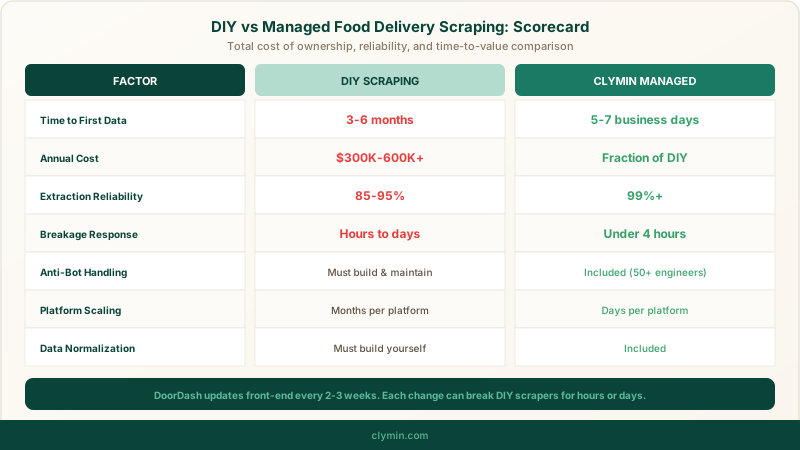
| Factor | DIY Scraping | Clymin Managed |
|---|---|---|
| Time to first data | 3-6 months (single platform) | 5-7 business days |
| Multi-platform coverage | 9-18 months | Included from day one |
| Annual cost | $300,000-600,000+ | Fraction of DIY cost |
| Extraction reliability | 85-95% (best case) | 99%+ uptime |
| Breakage response time | Hours to days | Under 4 hours |
| Data normalization | Must build yourself | Included |
| Proxy infrastructure | Must source and manage | Included |
| Anti-detection engineering | Must develop and maintain | Included |
| Scaling to new platforms | Months per platform | Days per platform |
| Engineering dependency | Key-person risk | 50+ engineer team |
When DIY Makes Sense
DIY scraping may be the right choice in specific situations:
You have existing scraping expertise. If your engineering team already maintains web extraction systems for other data sources, adding food delivery platforms leverages existing infrastructure and knowledge.
You need on-premise data processing. Regulatory requirements in some jurisdictions mandate that data processing occurs within specific geographic boundaries or on controlled infrastructure. Managed services may not satisfy these constraints.
Your data requirements are highly unusual. If you need data fields or extraction patterns that no managed service supports, such as real-time order flow modeling or driver supply analysis, custom development may be necessary.
Data volume is minimal. Monitoring a handful of restaurants on one platform in one city does not justify managed service costs. A simple script with manual monitoring may suffice for very small-scale needs.
For most food delivery companies, restaurant chains, and investors seeking competitive intelligence, the managed approach provides better data at lower cost with dramatically less engineering distraction.
What Clymin's Managed Service Includes
Multi-platform extraction across DoorDash, Uber Eats, Grubhub, Postmates, and 15+ additional delivery platforms. Each platform adapter is maintained by engineers specializing in that platform's specific anti-detection and rendering requirements.
Data normalization transforms raw extracted data into a consistent schema. Restaurant names, addresses, cuisine categories, and menu items are standardized across platforms so a single restaurant appearing on DoorDash and Uber Eats produces one merged record with platform-specific pricing attached.
Geographic coverage across all US metros with international coverage available. Proxy infrastructure simulates orders from any delivery address, capturing location-specific menus, pricing, and availability.
Delivery options: API access for real-time integration, scheduled file delivery (CSV, JSON, Parquet) for batch processing, and dashboard access for visual analysis. Choose the delivery method that fits your existing data infrastructure.
Quality monitoring includes automated validation of extraction completeness, accuracy checks against known reference data, and anomaly detection that flags unusual patterns (menu price spikes, restaurant disappearances, coverage gaps) before they reach your analysis pipeline.
Dedicated account management means you have a named contact who understands your business requirements and proactively suggests optimization opportunities as your data needs evolve.
Migration Path From DIY to Managed
If you are currently running DIY scraping and considering migration to Clymin's managed service:
Phase 1 (Week 1-2): Clymin configures extraction for your target platforms, markets, and data fields. Your existing DIY system continues running in parallel.
Phase 2 (Week 2-3): Data comparison between DIY and Clymin outputs validates coverage and accuracy. Any gaps or discrepancies are resolved before switchover.
Phase 3 (Week 3-4): Production switchover to Clymin's data feed. Your engineering team transitions scraping infrastructure resources to core product development.
Phase 4 (Ongoing): Clymin delivers data continuously. Your team consumes data through API, file delivery, or dashboard, no extraction maintenance required.
Start Getting Reliable Food Delivery Data
Clymin deploys managed food delivery data extraction within 5-7 business days. No engineering hires, no proxy contracts, no anti-detection research, just clean, reliable data delivered on your schedule.
Contact the team at contact@clymin.com or book a meeting to discuss your food delivery data requirements.