
Why Food Delivery Market Analysis Requires Structured Data
Food delivery is one of the most data-intensive industries in the world, yet most operators make strategic decisions based on fragmented, outdated information. Competitor menus and pricing change daily across DoorDash, Uber Eats, Grubhub, Swiggy, and Zomato. Promotions appear and disappear within hours. Delivery zones expand and contract based on driver availability and demand patterns.
According to Statista's 2025 Online Food Delivery report, the global online food delivery market reached $387 billion in revenue and is projected to hit $501 billion by 2029. The United States alone accounts for $96 billion, with DoorDash commanding approximately 67% market share, Uber Eats holding 23%, and Grubhub at 8%, according to Bloomberg Second Measure's transaction data.
Operators that rely on manual spot-checks of competitor platforms miss the velocity of change that defines food delivery. A restaurant chain adjusting menu prices on DoorDash in San Francisco may see competitor responses within 24-48 hours. Without automated data collection, these competitive signals arrive too late to act on.
Structured data extraction transforms this chaos into a systematic advantage. By collecting menu items, prices, delivery fees, ratings, and promotional offers across platforms on a daily cadence, operators build a real-time competitive picture that informs pricing strategy, market entry decisions, and promotional planning.
What Data Points Matter for Food Delivery Market Analysis?
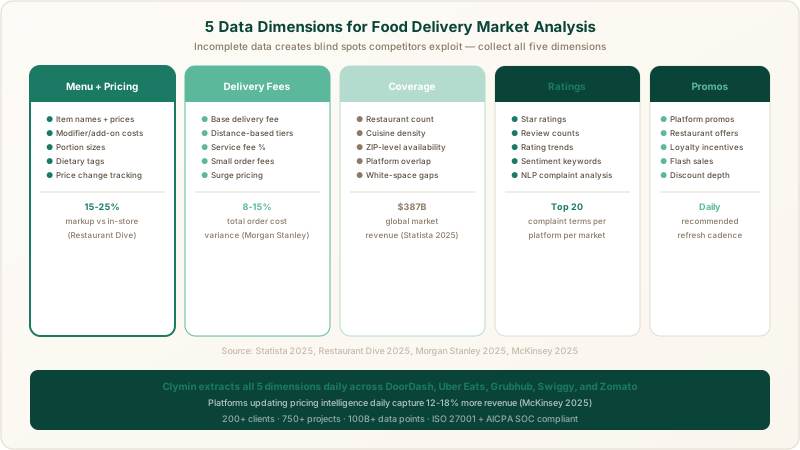
Food delivery market analysis requires data across five core dimensions. Collecting incomplete data leads to blind spots that competitors exploit, so defining your data requirements before building extraction pipelines is essential.
Menu and Pricing Data
Menu data forms the foundation of competitive intelligence in food delivery. Key fields include restaurant name, cuisine category, individual menu item names, item descriptions, base prices, modifier/add-on prices, portion sizes, and dietary tags (vegan, gluten-free, halal). Tracking price changes over time reveals competitor pricing strategies and seasonal adjustments.
According to Restaurant Dive's 2025 industry survey, menu prices on delivery platforms average 15-25% higher than in-store prices, with markups varying significantly by platform and cuisine type. Capturing platform-specific pricing for the same restaurant exposes these markup differentials.
Delivery Fees and Service Charges
Delivery fees, service fees, small order fees, and surge pricing directly impact consumer choice. Track the base delivery fee, distance-based fee tiers, service fee percentages, minimum order thresholds, and any dynamic pricing applied during peak hours. Clymin's clients in the food delivery segment track these fees across competitors to identify pricing optimization opportunities in their own fee structures.
Restaurant Density and Coverage
Restaurant count by cuisine type, neighborhood, and platform reveals market saturation and white-space opportunities. A market with 500 pizza restaurants on DoorDash but only 12 Ethiopian restaurants signals a potential expansion opportunity for underrepresented cuisines.
Geographic coverage data, which ZIP codes and neighborhoods each platform serves, and which restaurants are available in each zone, maps the competitive landscape spatially. Overlaying restaurant density with demographic data (population density, median household income, age distribution) sharpens targeting for new restaurant acquisition or market entry.
Ratings and Reviews
Customer ratings, review counts, and review text provide quality signals that correlate with order volume. Track average star ratings, total review counts, rating trends over time, and common keywords in review text (speed, quality, accuracy, temperature). Sentiment analysis on review text at scale reveals systemic issues like late deliveries in specific zones or quality complaints about particular cuisine categories.
Promotional Activity
Promotions drive a disproportionate share of food delivery orders. Track platform-wide promotions (free delivery over $25, 20% off first order), restaurant-specific offers (buy-one-get-one, percentage discounts), and loyalty program incentives. Mapping promotional frequency and discount depth by competitor and market reveals how aggressively competitors are buying market share.
How to Collect Food Delivery Data at Scale
Collecting food delivery data presents unique technical challenges compared to other industries. Delivery platforms use dynamic JavaScript rendering, location-based content personalization, and aggressive anti-bot measures that break conventional scraping approaches.
Platform-Specific Extraction Challenges
DoorDash renders menu content dynamically through React components and requires location context (latitude/longitude or ZIP code) to display restaurant availability. Prices and delivery fees vary by user location, meaning extraction must simulate requests from specific geographic coordinates to capture accurate local data.
Uber Eats implements rate limiting tied to session tokens and uses GraphQL APIs that require reverse-engineering to access structured menu data. Menu item availability changes based on time of day (breakfast items disappear at 11 AM), adding a temporal dimension to extraction scheduling.
Grubhub presents simpler extraction targets but fragments data across multiple API endpoints. A complete restaurant profile requires combining menu data, ratings, delivery details, and promotional offers from separate requests.
For platforms operating in India, Swiggy and Zomato add language localization, regional payment method data, and India-specific regulatory compliance requirements. Clymin operates from both San Francisco and Hyderabad, with dedicated teams experienced in scraping delivery platforms across both US and Indian markets.
Building a Custom Data Pipeline vs. Using a Managed Service
Building a custom extraction pipeline for food delivery data requires a team familiar with headless browser automation, proxy rotation, CAPTCHA solving, and API reverse-engineering. According to Gartner's 2025 Data Engineering report, organizations spend an average of 40% of their data engineering budget maintaining extraction infrastructure rather than analyzing the data it produces.
A managed scraping service handles the entire extraction lifecycle. Clymin's AI-agentic scraping approach deploys intelligent agents that learn platform structures and adapt automatically when layouts change. For food delivery clients, this means menu and pricing data arrives in structured JSON or CSV format daily, without engineering overhead for maintenance.
The managed approach reduces time-to-first-data from 6-10 weeks (custom build) to under 10 business days. For strategy teams that need competitive intelligence quickly to inform quarterly planning or market entry decisions, this speed advantage is decisive.
Data Extraction Best Practices for Delivery Platforms
Regardless of whether you build or buy your extraction capability, follow these practices:
- Simulate realistic user behavior. Delivery platforms detect bot traffic through behavioral patterns. Vary request timing, rotate user agents, and include realistic session flows (browse restaurants, view menus, check delivery estimates) rather than hitting menu endpoints directly.
- Extract by geography systematically. Divide your target market into ZIP code or neighborhood grids. Extract restaurant and menu data for each grid cell independently, then deduplicate restaurants that appear in overlapping zones.
- Capture timestamps on every data point. Menu prices at 11 AM may differ from 8 PM due to dinner surge pricing. Recording extraction time enables time-of-day analysis that reveals dynamic pricing patterns.
- Store raw API responses. Preserve the original JSON or HTML alongside extracted fields. Schema changes on platforms happen frequently, and having raw data lets you re-parse historical extractions when your data model evolves.
How to Analyze Menu Pricing Across Competitors
Menu pricing analysis is the highest-value use case for food delivery market data. Pricing directly impacts order conversion, average order value, and platform take rates. A structured approach to pricing analysis reveals opportunities that manual monitoring cannot capture.
Building a Price Index by Cuisine Category
Create a price index that tracks average menu item prices by cuisine category across platforms and markets. Start by standardizing menu categories (pizza, sushi, Mexican, Indian, Chinese, American, healthy/salads) and mapping each restaurant to its primary cuisine.
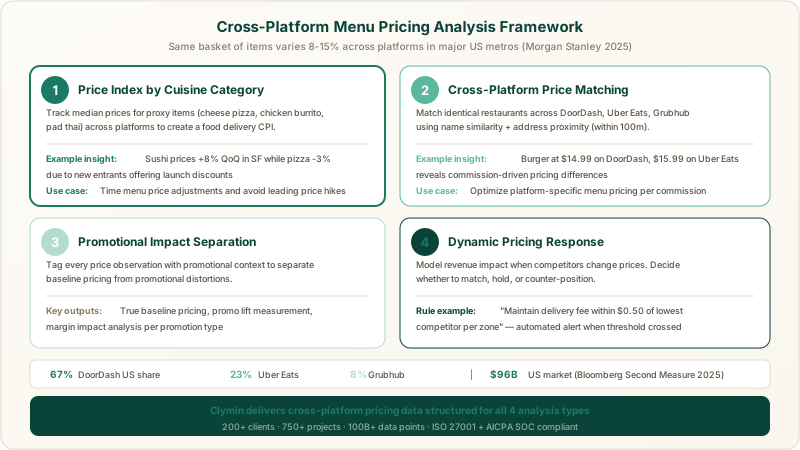
Calculate the median price for common item types within each cuisine: a standard cheese pizza, a chicken burrito, a pad thai, a butter chicken with rice. Tracking these proxy items over time creates a food delivery equivalent of a consumer price index, revealing which cuisines are experiencing inflation, deflation, or competitive price wars.
For example, a pricing analysis across DoorDash and Uber Eats in San Francisco might reveal that sushi prices increased 8% quarter-over-quarter on both platforms, while pizza prices dropped 3% due to new entrants offering aggressive launch discounts. Operators use these signals to time menu price adjustments and avoid being the first to raise prices in deflationary categories.
Cross-Platform Price Comparison
The same restaurant often lists different prices on different platforms. A restaurant may price a burger at $14.99 on DoorDash and $15.99 on Uber Eats to account for different commission structures. Systematically comparing identical menu items across platforms reveals platform-specific pricing strategies.
Build a matching algorithm that identifies the same restaurant across platforms using name similarity, address proximity (within 100 meters), and menu overlap. Once matched, compare item-level pricing, delivery fees, and estimated delivery times to quantify the total cost difference a consumer faces across platforms.
According to a 2025 Morgan Stanley analysis, the average order total (food plus fees) for the same basket of items varies by 8-15% across platforms in major US metros. Exposing this variance to restaurant operators helps them optimize platform-specific pricing to maximize orders without sacrificing margins.
Detecting Promotional Impact on Pricing
Promotions distort baseline pricing data unless tracked separately. When DoorDash runs a "25% off orders over $25" promotion, observed average order values drop temporarily. Without separating promotional from non-promotional pricing, trend analysis produces misleading signals.
Tag every price observation with its promotional context: no promotion active, platform-wide promotion (type and discount), or restaurant-specific promotion (type and discount). Analyze promotional and non-promotional periods independently to establish true baseline pricing, then measure promotional lift (volume increase during promotions) and margin impact separately.
How to Map Delivery Coverage and Market Saturation
Geographic analysis transforms food delivery market data from a spreadsheet exercise into a spatial strategy tool. Understanding where competitors operate, where gaps exist, and how coverage evolves over time drives market expansion and restaurant acquisition decisions.
Building a Coverage Heat Map
Extract delivery zone boundaries from each platform by querying restaurant availability across a grid of coordinates. For each coordinate point, record which platforms serve the area, how many restaurants are available, average delivery time estimates, and delivery fee ranges.
Aggregate this data into heat maps that visualize market intensity. High-density zones with all platforms present and hundreds of restaurants represent saturated markets where differentiation matters more than coverage. Low-density zones with limited platform presence or few restaurant options represent expansion opportunities.
Overlay demographic data from the US Census Bureau's American Community Survey to correlate coverage gaps with population characteristics. A neighborhood with 50,000 residents, median household income above $70,000, and only 15 restaurants on delivery platforms represents a significantly underserved market compared to a similar neighborhood with 200 available restaurants.
Tracking Competitor Expansion Patterns
Monitor restaurant count and coverage boundaries weekly to detect competitor expansion. When Uber Eats adds 50 new restaurants in a suburban market over four weeks, that signals a targeted acquisition push that you may want to match or counter.
Calculate expansion velocity metrics: new restaurants added per week by platform and market, coverage area growth (square miles served), and average time from restaurant onboarding to first review (a proxy for operational readiness). Clymin has delivered hundreds of data extraction projects, and the expansion tracking frameworks our food delivery clients use depend on consistent, high-frequency data feeds that capture these weekly changes reliably.
Identifying White-Space Opportunities
White-space analysis combines coverage gaps with demand signals. A ZIP code with high food delivery search volume on Google Trends but low restaurant density on delivery platforms indicates unmet demand. Cross-reference delivery platform data with Google search interest for "[cuisine type] delivery near [location]" queries to quantify demand-supply gaps.
Restaurant density per capita is another useful metric. If a market averages 1 delivery restaurant per 200 residents across established zones but a target zone shows 1 per 800 residents, the target zone is likely underserved relative to demand.
How to Track Delivery Performance and Customer Experience
Delivery performance data separates market leaders from also-rans. Customers choose platforms based on speed, reliability, and food quality on arrival, all measurable through systematic data collection.
Estimated vs. Actual Delivery Times
Platforms display estimated delivery times at the point of ordering. Track these estimates across restaurants, time periods, and platforms. While actual delivery times require access to order-level data (which most competitive analysis cannot capture directly), estimated times serve as a public proxy for operational capacity.
Restaurants with consistently shorter estimated delivery times attract more orders. If your competitor shows 25-minute delivery for a burger restaurant while your platform shows 40 minutes, the customer experience gap costs you orders regardless of food quality.
Monitor estimated delivery time changes as demand shifts. During lunch (11 AM - 1 PM) and dinner (6 PM - 9 PM) peaks, platforms with sufficient driver supply maintain stable estimates while capacity-constrained platforms see estimates spike. Tracking these patterns reveals operational weaknesses you can exploit with targeted driver incentives.
Rating and Review Trend Analysis
Aggregate customer ratings by platform, market, cuisine, and time period to identify systemic quality trends. A platform showing declining average ratings across multiple markets may be experiencing operational issues (driver shortages, routing problems) that create competitive openings.
Natural language processing on review text at scale reveals specific pain points. Extract the 20 most frequent complaint terms per platform per market each month. Complaints about "cold food" may indicate packaging or routing issues. Complaints about "wrong items" signal order accuracy problems at the restaurant or fulfillment level. These insights inform operational improvements that directly impact customer retention.
How to Build a Food Delivery Market Analysis Dashboard
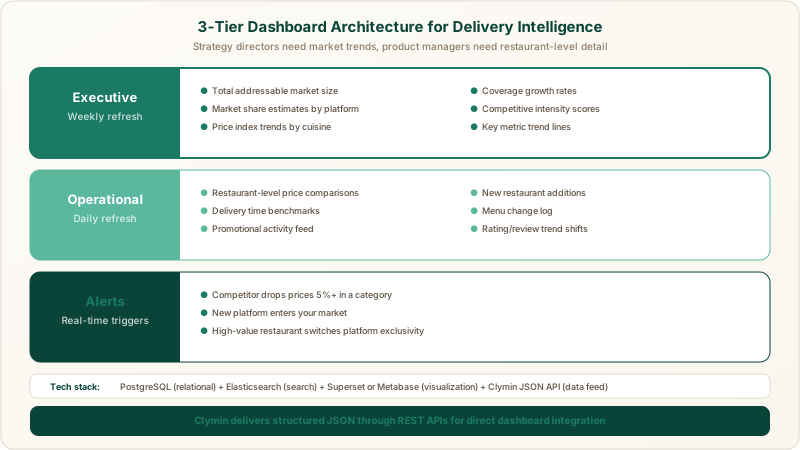
Transforming raw food delivery data into actionable intelligence requires a dashboard that presents insights at the right level of aggregation for different stakeholders. Strategy directors need market-level trends, while product managers need restaurant-level competitive detail.
Recommended Dashboard Architecture
Use a three-tier structure. The executive tier shows market-level KPIs: total addressable market size, market share estimates by platform, price index trends by cuisine, and coverage growth rates. Update these metrics weekly.
The operational tier shows competitive detail: restaurant-level price comparisons, delivery time benchmarks, promotional activity feeds, and new restaurant additions. Update these metrics daily.
The alert tier pushes notifications when competitive thresholds are crossed: a competitor drops prices by more than 5% in a category, a new platform enters your market, or a high-value restaurant switches platform exclusivity. Configure alerts based on business-critical triggers defined by your strategy team.
Technology Stack for Delivery Analytics
PostgreSQL handles the structured relational data (menus, prices, restaurants) while Elasticsearch powers free-text search across menu items and reviews. Apache Superset or Metabase serve as open-source BI layers for dashboard visualization. For teams preferring commercial tools, Tableau and Looker both integrate well with the data warehouse layer.
The data ingestion pipeline from Clymin delivers structured JSON through REST APIs or direct database integration, fitting cleanly into standard analytics stacks. Having extracted over 100 billion data points across its client base, Clymin formats food delivery datasets specifically for analytics consumption, with pre-normalized schemas that reduce dashboard development time.
Automating Competitive Reports
Automate weekly competitive intelligence reports that synthesize dashboard data into narrative insights. A typical report includes: top 5 pricing changes by competitor, new restaurant additions by market, promotional activity summary, delivery time trend shifts, and rating changes for tracked competitors.
Schedule these reports to distribute to strategy, product, and operations teams every Monday morning. Automated reporting ensures competitive intelligence reaches decision-makers consistently rather than depending on ad-hoc analyst availability.
How to Use Food Delivery Market Data for Strategic Decisions
Raw data becomes valuable only when it drives decisions. Food delivery market analysis supports four strategic use cases that directly impact revenue and growth.
Market Entry and Expansion Planning
Before entering a new city or expanding into adjacent neighborhoods, use market data to quantify the opportunity. Calculate total restaurant density on existing platforms, estimate order volumes from review counts and rating velocity, assess competitive intensity from the number of active platforms and their promotional spend, and identify cuisine gaps that your restaurant portfolio could fill.
Operators that use data-driven market entry frameworks achieve 30-40% faster time-to-profitability in new markets compared to those relying on executive intuition alone, according to a 2025 McKinsey report on quick commerce scaling strategies.
Dynamic Pricing Optimization
Cross-platform pricing data enables dynamic pricing models that adjust menu prices and delivery fees based on competitive context. When a competitor raises burger prices by 10%, your analytics system flags the change and models the revenue impact of a matching increase versus holding prices to capture volume.
Implement pricing rules that reference competitive benchmarks: "Maintain delivery fee within $0.50 of the lowest competitor in each zone" or "Set menu prices at the 75th percentile for our cuisine category." Automated monitoring ensures these rules trigger alerts when competitive changes require pricing reviews.
Promotional Strategy
Analyzing competitor promotional patterns reveals optimal timing and structure for your own promotions. If competitors consistently run heavy discounts on Tuesdays (historically a low-order day), you can either compete directly or shift promotional spending to less contested days like Wednesday or Thursday where your discount achieves higher visibility.
Track promotion ROI by comparing order volume lifts during promotional periods against discount costs. Food delivery market data from platforms like DoorDash and Grubhub reveals competitive promotional patterns that inform your own promotional calendar.
Restaurant Partner Acquisition
Market data identifies high-performing restaurants that are active on competitor platforms but absent from yours. Sort competitor restaurants by rating, review count, and estimated order volume, then target the top performers for acquisition outreach. Knowing a restaurant's pricing, cuisine, and customer sentiment before making a pitch dramatically improves conversion rates for partnership development teams.
Ready to Build Your Food Delivery Market Intelligence Stack?
Analyzing the food delivery market requires reliable, structured data extracted from platforms that actively resist automated access. Clymin's AI-agentic scraping service extracts menu pricing, delivery fees, restaurant data, and promotional offers from DoorDash, Uber Eats, Grubhub, Swiggy, Zomato, and other platforms, delivered in analysis-ready formats on daily schedules. Contact us at contact@clymin.com or schedule a free consultation to discuss your food delivery data requirements.