
Why Restaurant Data From Delivery Platforms Matters in 2026
The food delivery market reached $218 billion globally in 2025, according to Statista's Food Delivery Worldwide report. Platforms like DoorDash, Uber Eats, and Grubhub now host millions of restaurant listings with constantly shifting menus, prices, and promotions. For restaurant chains, ghost kitchen operators, and food delivery aggregators, this data is a competitive goldmine.
Restaurant data scraped from delivery platforms reveals pricing strategies competitors use, which cuisine categories dominate specific neighborhoods, and how delivery fees vary across zones. According to McKinsey's 2025 State of Grocery report, 70% of food delivery operators now use competitive data to inform their pricing decisions, up from 42% in 2022.
Without automated extraction, teams spend dozens of hours manually checking competitor menus and delivery zones. Clymin eliminates that manual overhead by deploying AI agents that adapt to platform layout changes and anti-bot protections automatically.
What Data Points Can You Extract From Delivery Platforms?
Restaurant data on delivery platforms falls into several structured categories that serve different analytical purposes. Each platform stores data differently, but the core fields remain consistent across DoorDash, Uber Eats, Grubhub, and regional players.
Menu and pricing data includes item names, descriptions, prices, modifiers, portion sizes, and category groupings. Pricing is particularly valuable because delivery platforms allow restaurants to set prices independently from their in-store menus, often at a 15-30% markup according to a 2025 National Restaurant Association survey.
Restaurant metadata covers business name, address, cuisine type, operating hours, platform ratings, review counts, and years on the platform. Ratings and review volumes serve as proxies for restaurant popularity and customer satisfaction within specific delivery zones.
Delivery logistics data encompasses delivery fees, estimated delivery times, minimum order thresholds, delivery radius, and surge pricing indicators. According to Bloomberg Second Measure's 2025 food delivery analysis, delivery fee structures account for up to 25% of customer ordering decisions.
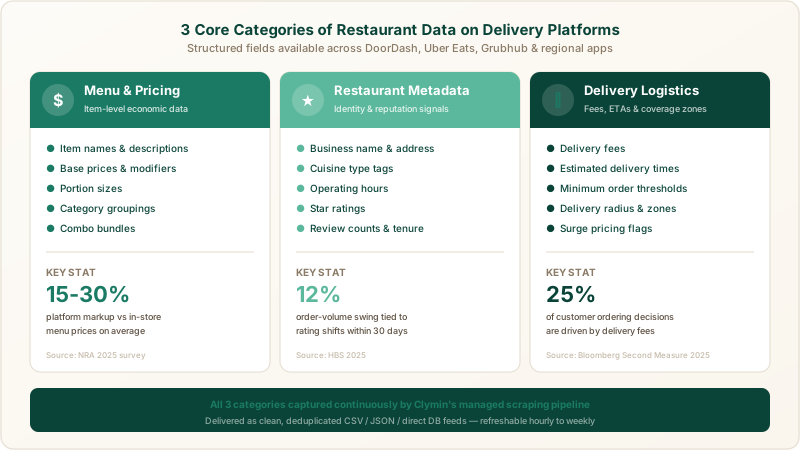
Three core categories of restaurant data available on food delivery platforms
How to Scrape Restaurant Data: Step-by-Step Approach
Extracting restaurant data from delivery platforms requires a structured methodology that accounts for platform-specific challenges. Here is a practical framework used by data teams in 2026.
Define your target scope. Start by identifying which platforms, cities, and cuisine categories you need to cover. A restaurant chain benchmarking competitors in Chicago needs a very different extraction scope than a market research firm mapping all restaurants across 50 US metros. Narrowing the scope upfront reduces costs and improves data quality.
Map the platform's data structure. Each delivery platform organizes restaurant listings differently. DoorDash groups restaurants by neighborhoods and cuisine tags. Uber Eats uses a location-radius model with personalized ranking. Grubhub relies on ZIP code-based filtering. Understanding each platform's structure determines how your scraper navigates and paginates through listings.
Handle anti-bot protections. Delivery platforms invest heavily in bot detection. Cloudflare challenges, rate limiting, fingerprinting, and dynamic JavaScript rendering are standard defenses in 2026. Clymin's AI-agentic approach solves this by rotating proxies, rendering JavaScript headlessly, and adapting request patterns in real time to avoid detection.
Structure and cleanse the output. Raw scraped data contains duplicates, encoding issues, and inconsistent formatting. Menu items from different platforms may describe the same dish in completely different ways. Automated data cleansing normalizes names, standardizes price formats, deduplicates listings, and validates geographic coordinates before delivery.
Common Challenges When Scraping Delivery Platform Data
Delivery platforms present unique scraping challenges that differ significantly from standard ecommerce or travel sites. Understanding these obstacles helps you choose the right extraction approach.
Dynamic pricing and real-time updates make snapshots unreliable. A restaurant's menu prices on Uber Eats may change during lunch rush hours or based on demand algorithms. According to Technomic's 2025 Delivery Intelligence report, 38% of restaurant operators on major delivery platforms use dynamic pricing features. Capturing accurate pricing requires timed, repeated extractions rather than single snapshots.
Location-dependent content means the same platform URL shows different restaurants based on the user's detected location. Scraping DoorDash from a San Francisco IP returns completely different listings than scraping from Dallas. Multi-market extraction requires geo-targeted proxy infrastructure that simulates local users in each target city.
Platform layout changes happen frequently. Delivery apps redesign their web and mobile interfaces every few weeks, breaking traditional CSS-selector-based scrapers. Clymin addresses this with AI agents that learn page structures adaptively rather than relying on hardcoded selectors, ensuring continuous data flow even when platforms update their frontend code.
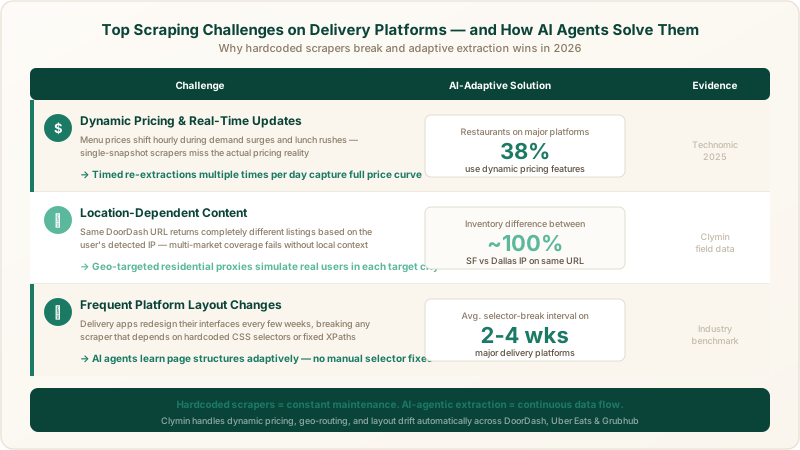
Key challenges in delivery platform scraping and how AI-adaptive extraction addresses each one
How to Use Scraped Restaurant Data for Competitive Intelligence
Clean restaurant data becomes actionable intelligence when applied to specific business decisions. Here are four high-impact use cases that food delivery operators and restaurant chains rely on in 2026.
Competitive menu pricing analysis lets you benchmark your prices against direct competitors within the same delivery zone. By tracking competitor price changes daily, restaurant chains can adjust their own platform pricing to stay competitive without sacrificing margins. A managed food delivery scraping service automates this process and delivers structured comparison reports.
Market coverage mapping reveals which neighborhoods are underserved by specific cuisine categories. Ghost kitchen operators use delivery zone data to identify gaps where launching a new virtual brand would face minimal competition. Clymin clients have used this analysis to select locations for new ghost kitchen concepts across US metros.
Promotional strategy tracking captures competitor coupons, free delivery thresholds, and bundle deals in real time. Understanding when and how competitors run promotions informs your own promotional calendar and helps predict demand shifts during competitor campaigns.
Platform performance benchmarking compares your restaurant's ratings, delivery times, and visibility ranking against competitors on each platform. Tracking these metrics over time reveals whether operational improvements are translating into better platform positioning. For deeper platform-level comparisons, see our analysis of Grubhub vs DoorDash market share data.
How Clymin Simplifies Restaurant Data Extraction
Clymin's managed scraping service removes the technical complexity of extracting restaurant data from delivery platforms. Rather than building and maintaining scrapers in-house, food delivery operators outsource the entire pipeline to Clymin's AI-agentic infrastructure.
The service covers everything from initial platform analysis through ongoing data delivery. Clymin has completed hundreds of data extraction projects across industries including food delivery, and the AI agents handle anti-bot protections, layout changes, and multi-market geo-targeting without manual intervention. Datasets are delivered in your preferred format, CSV, JSON, or direct database integration, on a schedule that matches your analytical needs.
For a detailed overview of our end-to-end extraction methodology, see how Clymin's AI-agentic approach works.