
Why Food Delivery App Data Matters in 2026
The global online food delivery market reached $350 billion in 2025, according to Statista's Digital Market Outlook. With platforms like DoorDash, Uber Eats, and Grubhub competing aggressively on pricing and delivery speed, access to structured competitive data has become a strategic necessity for every player in the food delivery ecosystem.
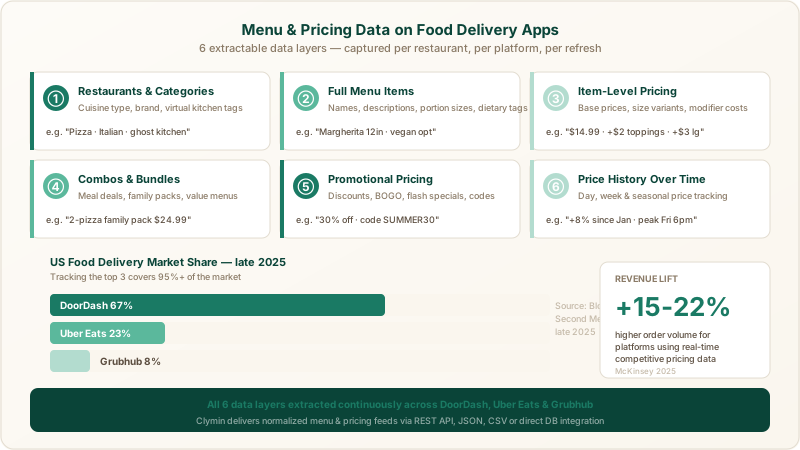
According to McKinsey's 2025 report on quick commerce, food delivery platforms that leverage real-time competitive data achieve 15-22% higher order volumes compared to those relying on manual market research. Menu prices, delivery zones, and promotional strategies shift daily, sometimes hourly, making manual tracking impossible at scale.
Clymin works with food delivery platforms, restaurant chains, and quick commerce operators who need reliable, structured data to stay competitive. The challenge is not whether data exists on these apps, but how to extract it consistently and transform it into actionable intelligence.
What Menu and Pricing Data Can You Extract?
Menu and pricing data forms the core of food delivery app scraping. Clymin's AI agents extract granular data points that reveal exactly how competitors price, package, and promote their offerings.
Key menu and pricing data points include:
- Restaurant names and categories, cuisine type, brand affiliation, virtual kitchen labels
- Full menu items, dish names, descriptions, portion sizes, dietary tags (vegan, gluten-free)
- Item-level pricing, base prices, size variants, add-on/modifier pricing
- Combo and bundle pricing, meal deal structures, family packs, value menus
- Promotional pricing, discounts, BOGO offers, limited-time specials, coupon codes
- Price history over time, tracking how menu prices change across days, weeks, and seasons
According to Bloomberg Second Measure, DoorDash held 67% of U.S. food delivery market share in late 2025. Monitoring pricing data across the top 3-4 platforms covers the vast majority of the market and reveals pricing patterns that inform competitive strategy.
What Delivery and Logistics Data Is Available?
Delivery logistics data provides insight into operational performance and geographic coverage, two factors that directly impact customer experience and market share.
Extractable delivery data points include:
- Estimated delivery times, per restaurant, per zone, and by time of day
- Delivery fees, base fees, distance-based surcharges, small order fees, service fees
- Delivery radius and zones, which restaurants deliver to which ZIP codes or neighborhoods
- Driver availability indicators, surge pricing triggers, "busy area" flags
- Minimum order thresholds, the minimum spend required for delivery from each restaurant
Delivery fee structures differ significantly across platforms. Uber Eats, for instance, uses dynamic delivery pricing that fluctuates based on demand and distance, while DoorDash offers a tiered subscription model through DashPass. Extracting this data systematically helps platforms and restaurants benchmark their own delivery economics.
Clymin delivers delivery logistics data in structured JSON or CSV formats, refreshed on the schedule your business needs, from hourly snapshots during peak hours to daily summaries for trend analysis.
What Ratings, Reviews, and Reputation Data Can You Collect?
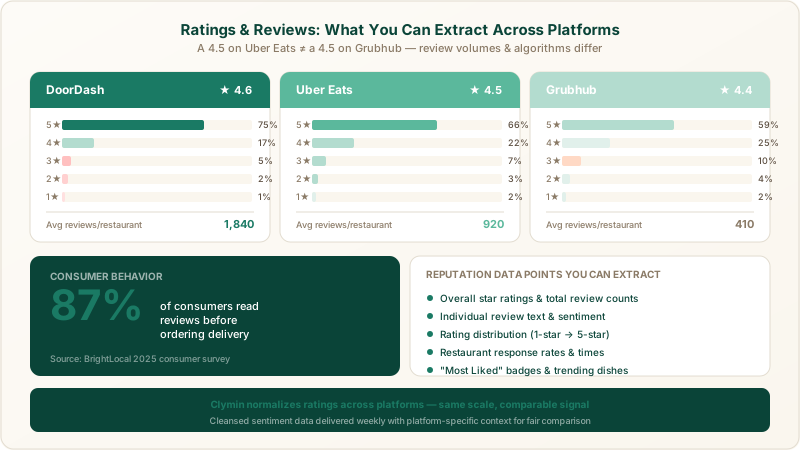
Customer sentiment data from food delivery apps provides a rich signal for competitive positioning and quality benchmarking. Every major platform displays ratings and reviews publicly, making this data accessible for extraction.
Reputation data points include:
- Overall restaurant ratings, star ratings, total review counts
- Individual review text, customer comments, complaint patterns, praise themes
- Rating distribution, breakdown of 1-star through 5-star reviews
- Response rates and times, how and when restaurants respond to reviews
- Popular items and tags, "Most Liked" badges, trending dishes, customer photos
According to a 2025 BrightLocal survey, 87% of consumers read online reviews before ordering food delivery. Restaurants and platforms that track competitor review sentiment can identify quality gaps and marketing opportunities that directly drive order volume.
Clymin's data cleansing pipeline normalizes rating scales across platforms, a 4.5 on Uber Eats does not mean the same thing as a 4.5 on Grubhub due to different review volume thresholds and display algorithms.
What Promotional and Marketing Data Can You Track?
Promotional strategies on food delivery apps change rapidly and vary by market. Tracking these promotions at scale reveals competitor marketing spend priorities and seasonal patterns.
Extractable promotional data includes:
- Platform-level promotions, free delivery thresholds, percentage-off codes, new user offers
- Restaurant-specific deals, happy hour pricing, limited-time menus, loyalty rewards
- Sponsored placement data, which restaurants appear in featured or promoted positions
- Banner ads and featured collections, seasonal campaigns, themed collections, partnership promotions
- Subscription benefits, DashPass, Uber One, and Grubhub+ perks and pricing
Tracking sponsored placements is particularly valuable. Research from Edison Trends shows that restaurants in promoted positions on DoorDash receive 3-5x more visibility than organic listings. Knowing when and where competitors invest in paid placement helps allocate your own marketing budget more effectively.
Clymin monitors promotional data across platforms continuously, flagging new competitor campaigns within hours of launch so your team can respond quickly.
How Businesses Use Scraped Food Delivery Data
Raw data extraction is only the starting point. The real value comes from how food delivery businesses transform this data into competitive advantages.
Competitive pricing optimization. Restaurant chains use Clymin's pricing data feeds to adjust their own menu prices in near real-time, maintaining competitive positioning without sacrificing margins. A national pizza chain, for example, can monitor pricing for comparable items across 50+ competitor restaurants in each metro area.
Market expansion analysis. Before entering a new city or neighborhood, delivery platforms analyze restaurant density, cuisine gaps, delivery fee structures, and consumer demand signals scraped from existing platforms. Understanding the competitive landscape in a new market reduces launch risk significantly.
Delivery performance benchmarking. Platforms compare their estimated delivery times and actual performance against competitors zone by zone. Identifying areas where competitors consistently deliver faster highlights operational improvement opportunities.
Menu engineering insights. Restaurants use competitor menu data to identify trending items, optimal price points for new dishes, and gaps in local cuisine offerings that represent revenue opportunities.
How Clymin Delivers Food Delivery App Data
Clymin's AI-agentic scraping approach handles the unique challenges of food delivery app data extraction, including mobile-first architectures, dynamic content loading, and aggressive anti-bot protections, without requiring any technical setup from your team.
Data is delivered clean and structured via REST API, CSV, JSON, or direct database integration. With hundreds of projects delivered and 100 billion data points extracted across industries, Clymin brings proven scale to food delivery data collection. Explore how managed scraping compares to building in-house for a detailed breakdown of the build-versus-buy decision.