
Why Food Delivery Platforms Need Automated Data Extraction
Food delivery generated $340 billion globally in 2024, according to Statista's Online Food Delivery market report, and the sector is projected to exceed $500 billion by 2028. Competition among platforms has intensified as DoorDash, Uber Eats, and regional operators battle for restaurant partnerships and consumer wallet share.
Manual competitor monitoring fails at the scale food delivery demands. A single metro area contains thousands of restaurant listings, each with menus that change weekly, promotional offers that rotate daily, and delivery fees that fluctuate by time of day. Product teams relying on spreadsheets and manual checks capture a fraction of available competitive signals.
According to McKinsey's 2024 report on food delivery economics, platforms that leverage real-time competitive data achieve 12-18% higher order frequency than those relying on quarterly market reports. Automated extraction transforms food delivery intelligence from a lagging indicator into a real-time decision engine.
What Data Points Drive Food Delivery Competitive Intelligence?
Effective food delivery market analysis data requires extraction across multiple dimensions that manual monitoring cannot cover simultaneously.
Menu and pricing intelligence forms the foundation. Clymin captures item-level pricing, portion sizes, modifier costs, and combo meal structures across every restaurant listing on target platforms. Price changes are tracked at the SKU level, enabling precise competitive benchmarking, not just aggregate price comparisons.
Delivery economics data includes delivery fees, service charges, small order fees, free delivery thresholds, and estimated delivery times by zone. Platforms adjust these variables dynamically based on demand, driver availability, and competitive pressure. Capturing fee structures hourly reveals pricing strategies invisible to occasional manual checks.
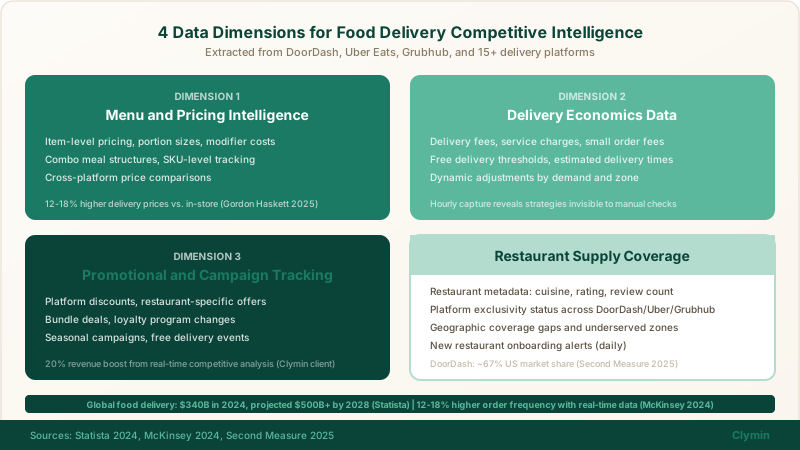
Key data dimensions extracted from food delivery platforms for competitive intelligence.
Promotional and campaign tracking captures platform-wide discounts, restaurant-specific offers, bundle deals, loyalty program changes, and seasonal campaigns. Sarah T., a Marketing Manager at an E-Commerce client, noted that "Clymin's data insights helped us boost revenue by 20% through real-time market trend and competitor pricing analysis", the same promotional tracking methodology applies directly to food delivery competitive campaigns.
How to Track Restaurant Supply and Coverage Gaps
Restaurant supply is the primary battleground for food delivery platforms. Knowing which restaurants are exclusive to a competitor, which are multi-platform, and which neighborhoods lack adequate coverage creates direct growth opportunities.
Clymin's delivery app data extraction captures restaurant-level metadata including cuisine type, rating, review count, operating hours, and platform exclusivity status. Cross-referencing this data across DoorDash, Uber Eats, and Grubhub reveals partnership gaps where your platform can recruit high-demand restaurants before competitors lock them into exclusive deals.
Geographic coverage mapping identifies underserved delivery zones. According to Second Measure's 2025 analysis, DoorDash holds approximately 67% of US food delivery market share, but coverage density varies dramatically by metro area and neighborhood. Platforms that identify and fill coverage gaps in high-demand zones capture disproportionate order volume. Explore our detailed Grubhub vs DoorDash market share data analysis for city-level competitive breakdowns.
Clymin's restaurant data extraction service monitors new restaurant onboarding across platforms daily, flagging when competitors add popular local restaurants that your platform has not yet signed.
Food Delivery Pricing Optimization With Real-Time Data
Dynamic pricing separates high-margin food delivery operations from those competing solely on volume. Real-time competitor data provides the inputs that pricing algorithms need to maximize revenue per order without losing price-sensitive customers.
Delivery fee optimization requires knowing competitor fee structures at the zone and time-of-day level. Clymin extracts fee data across all monitored platforms hourly, revealing when competitors drop fees to drive volume and when they raise fees during peak demand. Product managers use this intelligence to set competitive fee tiers that balance order volume against delivery economics.
Menu price benchmarking at the restaurant level uncovers pricing inconsistencies. The same restaurant often lists different prices across DoorDash, Uber Eats, and its own ordering system. Tracking these differences platform-by-platform helps negotiate commission structures and identify restaurants where price adjustments could increase conversion rates.
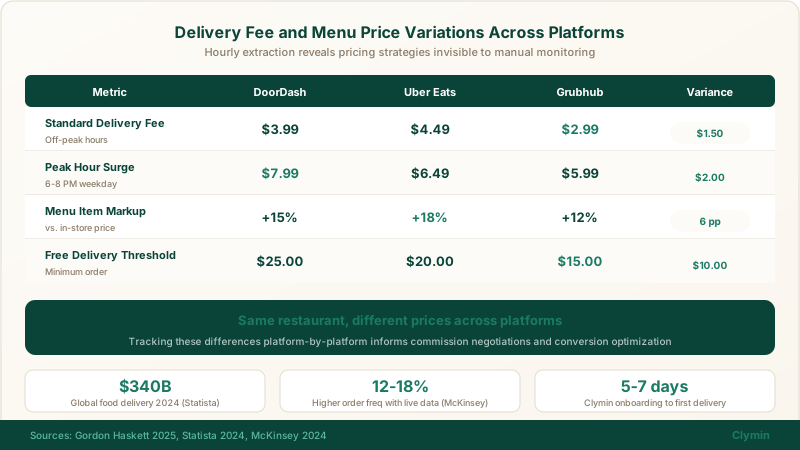
Sample delivery fee and menu price variations across competing platforms by time of day.
Clymin's AI-agentic scraping approach adapts automatically when delivery platforms change their page structures or introduce new fee types, eliminating the maintenance burden that breaks DIY scraping pipelines within weeks. Understanding the trade-offs between managed scraping and building in-house helps product teams allocate engineering resources toward product development rather than data infrastructure.
Building a Food Delivery Intelligence Pipeline in 2026
Deploying a production-grade food delivery intelligence service requires more than raw extraction. Data from DoorDash, Uber Eats, and Grubhub arrives in different formats with inconsistent naming, duplicate listings, and platform-specific quirks that make direct comparison impossible without normalization.
Clymin handles end-to-end data processing, extraction, deduplication, schema normalization, and structured delivery via API, S3, or direct database integration. The managed service model means zero engineering overhead on your side. Clymin has served 40+ customers across industries with this fully managed approach, and food delivery platforms benefit from the same ISO 27001 certified, AICPA SOC compliant, and GDPR-ready infrastructure that protects sensitive commercial data.
Onboarding takes 5-7 business days from initial consultation to first data delivery. Clymin's team configures extraction targets, maps data fields to your schema requirements, sets refresh frequency, and validates output quality before going live.
Ready to Gain a Food Delivery Data Advantage?
Food delivery competition moves faster than quarterly reports can capture. Real-time extraction of menu pricing, delivery fees, promotional campaigns, and restaurant supply data gives your product team the intelligence edge needed to win market share in 2026.
Contact Clymin at contact@clymin.com or schedule a free consultation to discuss your food delivery data requirements. With over a decade of extraction expertise and hundreds of successful projects, Clymin delivers structured, ready-to-use competitive data, so your team focuses on product decisions, not data pipelines.