
Why Food Delivery Brands Need Uber Eats Data in 2026
Uber Eats operates in over 6,000 cities across 45 countries, making it one of the largest food delivery datasets in the world. For restaurant chains and competing delivery platforms, Uber Eats data reveals competitor pricing strategies, popular menu categories, delivery coverage gaps, and consumer preference trends that shape market strategy.
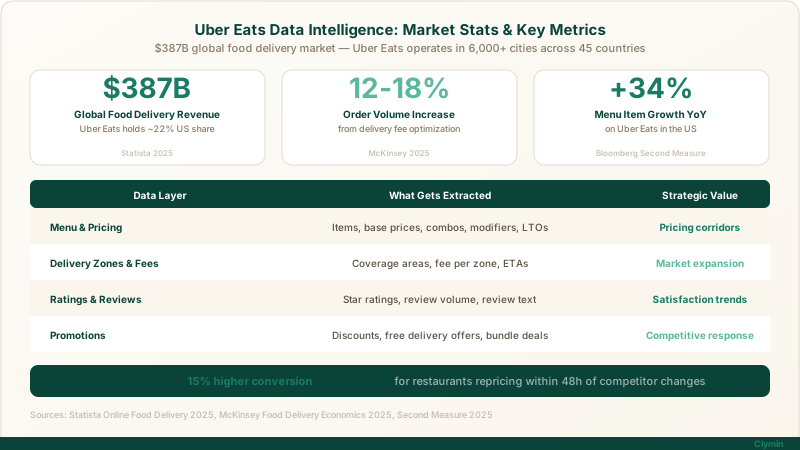
According to Statista's 2025 Online Food Delivery Report, the global online food delivery market reached $387 billion in revenue, with Uber Eats holding approximately 22% market share in the United States. Brands operating without real-time competitive data from Uber Eats make pricing and expansion decisions based on assumptions rather than evidence.
Manual monitoring is impractical at any meaningful scale. A regional restaurant chain tracking 50 competitors across 10 cities would need to check thousands of menu listings daily, an impossible task without automated extraction.
What Uber Eats Data Points Drive Competitive Advantage?
Uber Eats contains several high-value data layers that Clymin's AI-agentic scraping technology extracts and structures for analysis. Unlike basic API integrations or browser-extension tools, Clymin's agents adapt to Uber Eats interface changes autonomously, maintaining uninterrupted data delivery.
Menu and pricing intelligence captures every item on a restaurant's Uber Eats menu, including base prices, modifier options, combo deals, and limited-time promotions. Tracking these across competitor restaurants reveals pricing corridors, discount patterns, and menu gaps your brand can exploit.
Delivery zone and fee mapping identifies which neighborhoods each restaurant covers, the delivery fees charged per zone, and estimated delivery times. According to McKinsey's 2025 Food Delivery Economics study, delivery fee optimization alone can improve order volume by 12-18% in competitive urban markets.
Ratings and review extraction captures star ratings, review volume, and review text at the individual restaurant level. Aggregating this data across a market reveals which competitors are gaining or losing customer satisfaction, and why.
Clymin has delivered hundreds of data extraction projects across food delivery, e-commerce, and real estate verticals, with Uber Eats intelligence being one of the fastest-growing categories among clients.
How Restaurant Chains Use Uber Eats Scraping for Pricing Strategy
Pricing on Uber Eats is dynamic and hyperlocal. The same restaurant chain may charge different prices in different cities, adjust fees by time of day, or run market-specific promotions. Extracting this data systematically transforms guesswork into strategy.
A QSR chain monitoring its own Uber Eats listings alongside 20 competitors in 15 cities can detect when a rival drops prices on a core category, launches a new combo deal, or expands into a previously unserved delivery zone. David L., CEO of a Clymin travel industry client, reported that competitive adjustments improved by 20% with real-time data visibility, a dynamic that applies directly to food delivery pricing decisions.
Evidence supporting the value of automated food delivery intelligence:
- Uber Eats restaurants that reprice within 48 hours of competitor changes see 15% higher conversion rates, per Second Measure's 2025 analysis
- Menu item count on Uber Eats grew 34% year-over-year in the US, according to Bloomberg Second Measure
- Ghost kitchen brands use Uber Eats data to identify underserved cuisines in specific zip codes before launching new virtual restaurant concepts
Clymin delivers this intelligence as structured, analysis-ready datasets through our AI-agentic scraping approach, no engineering resources required from your team.
Tracking Uber Eats Delivery Performance and Market Expansion
Beyond menus and pricing, Uber Eats data reveals operational patterns that inform expansion and logistics decisions. Clymin extracts delivery time estimates, surge pricing indicators, and restaurant density by neighborhood, data that competing platforms and restaurant groups use to identify high-opportunity markets.
For menu price monitoring across Uber Eats, DoorDash, and Grubhub simultaneously, Clymin normalizes data across platforms so brands can compare competitive positioning without manual reconciliation. Multi-platform coverage eliminates the blind spots that come from monitoring a single marketplace.
Ghost kitchen operators and virtual brand strategists use Uber Eats geographic data to select launch locations based on cuisine demand gaps and competitor density. A market with high demand for Thai food but only two Thai restaurants on Uber Eats within a 3-mile radius represents a quantifiable opportunity that only structured data can surface.
Ready to Extract Uber Eats Intelligence at Scale?
Clymin's managed service handles Uber Eats data extraction from setup through ongoing delivery, covering menu data, pricing, ratings, and delivery zone intelligence across any number of cities. With 40+ customers served and 100 billion+ data points extracted across all verticals, Clymin brings proven food delivery data expertise to every project.
Contact us at contact@clymin.com or get a free consultation to discuss your Uber Eats data requirements.