
Why Food Delivery Promotion Tracking Is a Competitive Necessity in 2026
Food delivery platforms change their promotions multiple times per day. A free delivery offer on Uber Eats at noon may disappear by 2 PM, replaced by a 20% off deal targeting a different restaurant category. Manual monitoring cannot keep pace with this velocity.
According to Statista's 2025 Online Food Delivery report, the global online food delivery market reached $1.22 trillion in revenue, with promotional spending accounting for an estimated 15-20% of platform gross merchandise value. Platforms that fail to track competitor discounts risk either overspending on promotions or losing market share to better-targeted deals.
McKinsey's 2025 analysis of quick commerce economics found that promotional efficiency, defined as incremental revenue generated per dollar of discount offered, varies by as much as 3x between data-driven platforms and those relying on intuition. The gap widens in dense metropolitan markets like San Francisco, New York, and Chicago where multiple platforms compete for the same customer base.
What Promotion Data Does Clymin Extract From Delivery Apps?
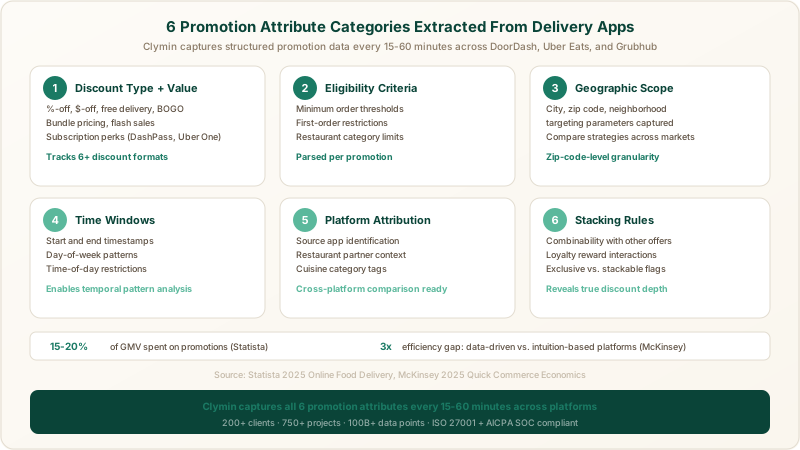
Clymin captures a comprehensive set of promotion attributes from each food delivery platform, structured for immediate analysis. The extracted fields go well beyond simple coupon codes.
Core promotion data points include:
- Discount type and value: Percentage-off, dollar-amount, free delivery, BOGO, bundle pricing
- Eligibility criteria: Minimum order thresholds, first-order restrictions, subscription requirements, restaurant category limits
- Geographic scope: City, zip code, and neighborhood-level targeting parameters
- Time windows: Start and end timestamps, day-of-week patterns, time-of-day restrictions
- Platform attribution: Source app, restaurant partner, cuisine category
- Stacking rules: Whether promotions combine with other offers or loyalty rewards
Clymin's AI agents adapt automatically when platforms change their promotion display formats, a common occurrence that breaks traditional static scrapers. With hundreds of projects delivered across industries, Clymin maintains extraction accuracy above 99% even as delivery apps update their interfaces.
How to Use Competitor Discount Data to Optimize Your Promotion Strategy
Raw promotion data becomes valuable when it reveals patterns your competitors follow and gaps your team can exploit. Clymin structures delivery data specifically to enable four high-impact analyses.
Discount frequency mapping tracks how often each competitor runs promotions in a given market. A platform offering free delivery every Tuesday and Thursday signals a predictable pattern your team can counter-program with targeted offers on those same days, or choose adjacent windows to avoid a bidding war for the same customers.
Promotion depth benchmarking compares average discount values across platforms and restaurant categories. If DoorDash averages 18% off for fast-food categories in San Francisco while Uber Eats averages 12%, that spread reveals where each platform invests most aggressively and where opportunities exist.
Geographic gap analysis identifies cities or neighborhoods where competitors run fewer promotions. According to Second Measure's 2025 food delivery market analysis, DoorDash held 67% of US meal delivery sales, but promotional intensity varies significantly by metro area, creating pockets where targeted discounts yield outsized customer acquisition.
Temporal pattern detection reveals time-of-day and day-of-week trends. Clymin clients have used this data to discover that competitor lunch promotions in major US cities tend to drop off between 1:30 PM and 4:00 PM, creating a low-competition window for afternoon deal campaigns.
Tracking Promotions Across DoorDash, Uber Eats, and Regional Platforms
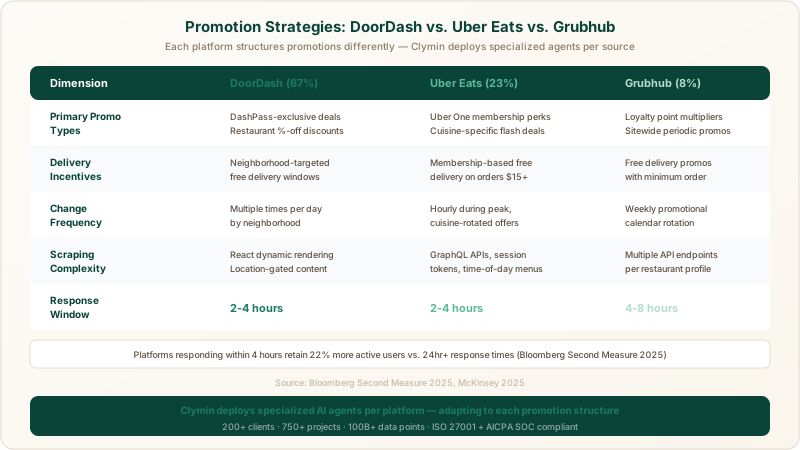
Each food delivery platform structures promotions differently, requiring platform-specific extraction logic. Clymin handles this complexity through our AI-agentic scraping approach, which deploys specialized agents per source.
DoorDash promotions often appear as DashPass-exclusive deals, restaurant-specific percentage discounts, and neighborhood-targeted free delivery windows. Uber Eats layers Uber One membership perks alongside restaurant promotions and flash deals tied to specific cuisine categories. Grubhub runs loyalty point multipliers, percentage-off deals, and periodic sitewide promotions that shift weekly.
Regional platforms add another layer. In markets like the San Francisco Bay Area, services such as Instacart (for grocery and prepared food delivery) and local operators run distinct promotion structures. Clymin's monitoring extends to these regional players, ensuring your competitive picture is complete rather than limited to the three national platforms.
For teams already using Clymin for menu price monitoring, adding promotion tracking creates a unified view of competitor pricing and discounting, revealing whether a competitor's lower menu prices are offset by fewer promotions, or vice versa.
Real-Time Alerts and Structured Data Delivery
Clymin delivers promotion tracking data through the format and frequency that fits your workflow. Standard options include JSON feeds, CSV exports, direct database integration, and cloud storage delivery to S3 or GCS.
For time-sensitive use cases, Clymin configures real-time alerts when a competitor launches a significant promotion, such as a sitewide free delivery event or a deep discount in a category where you compete. Bloomberg Second Measure's 2025 analysis noted that platforms responding to competitor promotions within 4 hours retained 22% more of their active user base compared to those with 24-hour-plus response times.
Every dataset Clymin delivers includes full metadata: extraction timestamp, source URL, geographic parameters, and data quality flags. This traceability matters for teams feeding promotion data into pricing algorithms or executive dashboards where data provenance is non-negotiable. With 100B+ data points extracted across all client projects, Clymin's infrastructure handles the scale food delivery monitoring demands.
Ready to Track Competitor Promotions?
Stop guessing what discounts your competitors are running. Clymin gives you structured, real-time food delivery promotion data across every platform and market that matters to your business. Contact us at contact@clymin.com or book a free consultation to scope your promotion tracking project.