
Web Scraping for Travel: Rate Shopping, Flight Data, and Hotel Rates
This guide is written for revenue management, distribution, and commercial teams at hotels, hotel groups, OTAs, airlines, and travel technology vendors. It covers what travel scraping actually produces, which platforms matter in which markets, the four operational use cases that drive most engagements, and how the build-vs-buy decision works in a vertical where established SaaS players (Lighthouse, SiteMinder, RateGain, Duetto, IDeaS) sit on top of scraping infrastructure that someone has to operate.
The Terminology Travel Buyers Actually Use
Travel scraping has its own vocabulary, and the words that buyers search for differ from the words that vendors put in marketing copy. Getting the language right routes the conversation to the right buyer inside the customer's organization.
Rate shopping is the term hotel revenue managers use day to day. It means scanning competitor hotel rates across OTAs and direct booking sites to inform pricing decisions. The vendor-side term "rate parity monitoring" is real and refers to a narrower compliance use case (ensuring a hotel's own rates are consistent across channels), but most buyer-side searches use rate shopping. A guide written for rate parity monitoring misses the buyer where the buyer actually lives. For the head-to-head on the SaaS rate shopping tools, see hotel rate scraping vs. rate shopping tools.
Fare scraping or fare aggregation is the airline-side equivalent. Specifically used by metasearch sites, corporate travel platforms, and airlines themselves monitoring competitor pricing on key routes.
OTA data extraction is the broadest umbrella term, covering hotels, flights, packages, and activities across Booking.com, Expedia, Agoda, MakeMyTrip, and the regional incumbents. Used by both hospitality buyers and competitive intelligence teams at travel tech vendors.
Revenue management data is the buyer-side framing. It describes what the data is for, not how it is collected. Revenue management teams care about the input (competitor rates, demand signals, search-share), not the extraction method.
Using the right vocabulary matters for two reasons. It routes the conversation to the right buyer, and it determines which queries an AI surface or search engine will associate the content with. Rate shopping is the buyer-recognized term; vendor jargon does not surface in buyer search.
The Four Operational Use Cases
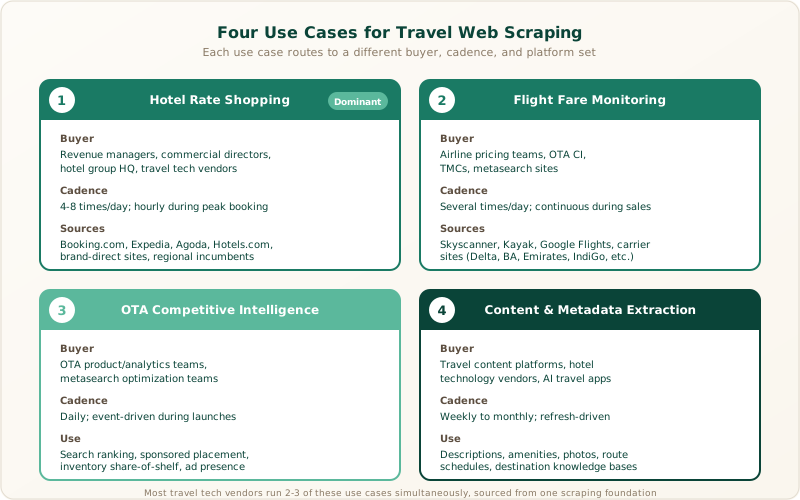
Travel scraping fragments into four distinct jobs once the buyer is identified.
1. Hotel Rate Shopping for Revenue Management
The dominant use case. A hotel, hotel group, or revenue management system tracks competitor rates for matched room types and check-in dates across OTAs and direct booking sites, multiple times per day. The output feeds dynamic pricing decisions and competitive positioning reports. Established vendors processing this data include Lighthouse (formerly OTA Insight), SiteMinder, RateGain, Cendyn, Duetto, and IDeaS Revenue Solutions. Most of them sit on top of scraping infrastructure that a vendor like Clymin can supply directly. The full Clymin offering is described in hotel rate scraping service.
Buyer: revenue managers, commercial directors, hotel group HQ teams, travel technology vendors building rate intelligence products.
2. Flight Fare Monitoring
Airlines, online travel agencies, and corporate travel platforms monitor competitor fares on key routes and cabin classes, typically several times per day during fare-management windows and continuously during sale events. The data shape includes origin, destination, departure date, return date, cabin, fare basis, base fare, taxes, total price, baggage rules, and refundability. Airline fare data is one of the more complex scraping targets because of dynamic search forms, session-based pricing, and aggressive anti-bot infrastructure.
Buyer: airline pricing teams, OTA competitive intelligence, corporate travel management companies, metasearch sites.
3. OTA Competitive Intelligence
OTAs and travel metasearch platforms monitor each other's inventory, search ranking, sponsored placement, and conversion-relevant content. This is the same job as digital shelf analytics in ecommerce scraping but applied to travel: where do my listings appear in Booking.com search results for "Singapore hotels under SGD 200," and where does my competitor appear? Less commonly discussed publicly than rate shopping but a meaningful spend category for any OTA above a certain scale.
Buyer: OTA product and analytics teams, metasearch optimization teams.
4. Travel Content and Metadata Extraction
A quieter but commercially important use case. Hotel content (descriptions, amenities, photo URLs, ratings, review text), flight content (route schedules, aircraft types, baggage policies), and destination content (attractions, transport options, regulations). Used by travel technology vendors enriching their own product, by SEO-driven travel content sites, and by AI-era travel planning tools building destination knowledge bases. For broader travel data services, see travel data extraction services.
Buyer: travel content platforms, hotel technology vendors, AI travel applications.
The four use cases share infrastructure but require different field schemas, frequencies, and SLAs. A vendor experienced in hotel rate shopping is not automatically the right choice for airline fare monitoring, and the pricing for the two looks different.
The Platforms That Matter, by Market
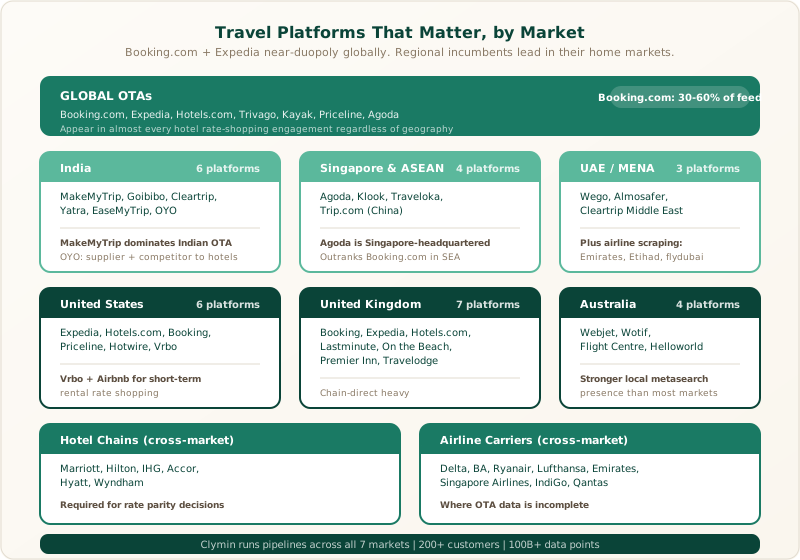
Travel is more globally concentrated than ecommerce. Booking.com and Expedia operate near-duopolies in developed markets. But regional incumbents matter materially in their home markets and often hold higher market share locally than the global brands.
Global OTAs (most engagements). Booking.com, Expedia, Hotels.com, Trivago, Kayak, Priceline, Agoda. These appear in almost every hotel rate shopping engagement regardless of geography. Booking.com alone typically accounts for 30 to 60% of the relevant rate-shopping data set for hotels in Europe and Asia-Pacific. For platform-specific extraction, see Booking.com data scraping service.
India. MakeMyTrip, Goibibo, Cleartrip, Yatra, EaseMyTrip, OYO. MakeMyTrip dominates the Indian OTA market and is a required source for any Indian hotel rate-shopping pipeline. OYO's published inventory pricing is heavily scraped because of OYO's role as both supplier and competitor to traditional hotels.
Singapore and ASEAN. Agoda (Singapore-headquartered), Klook (activities), Traveloka (Indonesia), Trip.com (China but ASEAN-relevant). Agoda is the regional incumbent and outranks Booking.com on Singapore-origin and SEA-destination searches.
United States. Expedia, Hotels.com, Booking.com, Priceline, Hotwire, Vrbo. Vrbo is a meaningful target for short-term rental rate shopping alongside Airbnb.
United Kingdom. Booking.com, Expedia, Hotels.com, Lastminute.com, On the Beach (packages), Premier Inn (chain), Travelodge (chain).
Middle East and UAE. Wego (MENA regional), Almosafer, Cleartrip Middle East, plus the global OTAs. Emirates, Etihad, flydubai, and Air Arabia dominate airline-side scraping in the region.
Australia. Webjet, Wotif, Flight Centre, Helloworld. Booking.com and Expedia still dominate hotels, but the Australian metasearch market has stronger local players than most.
Germany. CHECK24, HRS (corporate travel-focused), HolidayCheck, plus the global OTAs. CHECK24 is particularly important because of its share in German consumer comparison searches.
Hotel chains scraped directly (cross-market). Marriott, Hilton, IHG, Accor, Hyatt, Wyndham. Hotels increasingly scrape their own brand-direct sites alongside OTA inventory because the rate parity decision requires comparing channel pricing against the hotel's own published rate.
Airline carrier sites (cross-market). Delta, American, United, Southwest (US); British Airways, Ryanair, easyJet (UK); Lufthansa (Germany); Air France (France); Emirates, Etihad, Qatar (Gulf); Singapore Airlines (SG); IndiGo, Air India (India); Qantas, Virgin Australia (AU). Direct carrier scraping matters when OTA data is incomplete or when carrier-direct fares differ meaningfully from third-party distribution.
A useful filter for travel buyers: list the destinations or origins that matter commercially, then add the global OTAs, the relevant regional incumbents, and the carrier-direct sites. The list rarely exceeds 15 to 25 sources for a focused engagement, but it almost always crosses multiple geographies.
What Travel Data Actually Contains
A production rate shopping pipeline for hotels typically returns the following per property per check-in date per scrape:
- Property identifiers: hotel name, OTA-specific property ID, brand, chain affiliation, location, star rating
- Room and rate: room type, board basis, refundable / non-refundable flag, advance purchase rules
- Pricing: nightly rate, total stay rate, currency, taxes and fees breakdown, prepayment requirements
- Availability: rooms available (where shown), low-availability flags, sold-out indicators
- Promotional context: promotional badges, member-rate flags, mobile-only deals, loyalty discounts
- Ranking and visibility: OTA search position for the relevant query, sponsored placement, featured-property flag
- Review and content signals: review score, review count, recently added reviews, amenity completeness
Flight fare pipelines typically return:
- Route identifiers: origin, destination, departure date, return date, carrier, flight number, aircraft type
- Pricing: base fare, taxes, fees, total, currency, fare basis code
- Cabin and ancillaries: cabin class, refundability, baggage allowance, ancillary pricing where exposed
- Availability and inventory: seats available (where exposed), fare class
- Source context: OTA or carrier where the fare appeared, last seen timestamp
Travel data shape is wider than ecommerce data shape, which is part of why travel scraping pricing tends to be quoted higher per record on average than ecommerce scraping pricing. For a worked breakdown, see how much does hotel rate scraping cost?.
The Technical Realities of Scraping Travel Sites
Travel sites are among the most defended commercial websites on the public internet, for two structural reasons: rate data is competitively sensitive to the source platform, and the dynamic pricing logic exposes infrastructure cost when scraped aggressively. According to Imperva's 2025 Bad Bot Report, automated traffic now accounts for nearly half of all web requests, and the travel category is consistently one of the most aggressively defended verticals. The full list of challenges in scraping travel sites covers this in operational detail.
Search-form interaction is mandatory. Unlike ecommerce product pages, hotel and flight prices do not exist at a stable URL. A scraper must submit a search (origin, destination, dates, occupancy) and parse the results. Each search consumes more vendor infrastructure than a simple page fetch.
Session-based pricing and cache behavior. Many OTAs and carriers serve different prices to different user sessions based on cached search history, device fingerprint, or perceived purchase intent. A pipeline that does not rotate session state will see prices that drift from what an actual customer would see, defeating the purpose of rate shopping. Managed vendors handle this with rotating session pools; in-house builds typically miss it.
Anti-bot infrastructure is more aggressive than in ecommerce. Booking.com, Expedia, and the major carrier sites use behavioral fingerprinting, mouse-movement analysis, and time-of-day rate-limiting in addition to standard IP-based defenses. The success rate of an unsophisticated scraper on Booking.com or Delta.com is materially lower than on Amazon or Walmart.
Currency, locale, and geo-rate variation. Hotel rates vary by the user's perceived country, currency setting, and language. The same Singapore hotel shown to a Booking.com session in Singapore in SGD will quote a different price than the same query from a session in the UK in GBP. Production pipelines require per-market session pools and explicit currency normalization in the validation layer.
These technical realities mean travel scraping engagements typically take longer to set up than ecommerce engagements (5 to 10 working days for a single OTA plus 2 to 3 carrier sources is normal), and the per-record cost runs higher than equivalent ecommerce work. A 72-hour pilot is still the right starting point. It just produces a smaller, more focused sample than an ecommerce pilot of equivalent effort.
Build, Buy, or Managed: The Decision for Travel Teams
Travel is one of the verticals where the build-vs-buy decision is genuinely contested, because the established SaaS layer is mature. The full cost comparison is covered in managed web scraping vs. building in-house; the travel-specific shape follows.
Use a SaaS rate-shopping product. Lighthouse (formerly OTA Insight), SiteMinder, RateGain Navigator, Fornova, Beyond, and Duetto all sell hotel rate intelligence as a packaged product with dashboards, alerts, and revenue management integrations. For a single-property or small hotel group with a standard data need, the SaaS option is usually the right answer. The vendor has solved both the extraction and the analytics layer.
Build in-house. Right for travel technology vendors whose competitive moat is the data product itself (rate intelligence platforms, revenue management systems, fare comparison engines). The maintenance cost is justifiable because the capability is differentiating, and the standard SaaS products do not deliver the raw schema or proprietary fields the buyer needs. For a worked example of an in-house rate parity build, see how to build a hotel rate parity monitoring system.
Commission a managed data extraction service. Right for two specific buyers: hotel groups large enough to need custom rate-shopping logic the SaaS products do not handle (custom comp sets, unusual room-type mappings, non-standard markets), and travel technology vendors building their own rate intelligence or revenue management product who need a clean upstream data feed without operating the scraping themselves. For the broader managed model, see what is managed web scraping?. For a head-to-head on a self-serve scraping provider versus managed, see Bright Data vs. managed scraping for travel.
The decision often resolves on a specific question: does the buyer need the data, or does the buyer need an analytics product built on top of the data? Buyers who need the data go managed or in-house. Buyers who need the analytics product go SaaS.
Where Clymin Fits in the Travel Vendor Stack
Clymin operates one layer below the SaaS rate intelligence vendors. We supply the raw, validated, structured rate data (hotel rates, flight fares, OTA inventory, content metadata) that feeds custom analytics products, in-house revenue management systems, or proprietary competitive intelligence dashboards.
This positioning is deliberate. Clymin does not compete with Lighthouse, SiteMinder, or RateGain on the analytics layer; their products are mature and their hotel-vertical expertise is deep. Clymin competes on the data layer underneath, where a travel technology vendor or large hotel group needs custom schemas, custom comp sets, or non-standard data feeds that the packaged SaaS products cannot deliver.
Typical Clymin engagements in travel include:
- Custom hotel rate feeds for revenue management systems being built in-house at hotel groups
- Multi-OTA flight fare data for metasearch products and corporate travel platforms
- Content and metadata extraction for AI-era travel planning tools
- Rate parity audit feeds where the buyer needs the raw evidence, not a SaaS report
The free pilot is the cleanest way to test fit, because pilot output makes the build-vs-buy-vs-managed comparison concrete on the buyer's actual sources, properties, and routes.
Bringing Travel Data Into Production
For most travel teams, the cleanest way to choose between SaaS, in-house, and managed is to run a pilot on the actual target sources before committing. Clymin's free pilot covers up to three of your target sources (Booking.com, Expedia, Agoda, MakeMyTrip, a specific airline, or any other public travel platform) with production-grade output within 72 hours. No sales call required to start.
If the pilot data fits your revenue management or competitive intelligence use case, the same pipeline moves into production at $0.001 per record with complexity multipliers for high-difficulty sources and a $600 per month minimum. If it does not fit, no obligation.
Ready to test travel scraping on your own properties or routes? Schedule a scoping conversation with Clymin's data engineering team, or email contact@clymin.com to start a free pilot directly.