
Why Hospitality Brands Need Competitive Pricing Intelligence
Revenue managers in the hotel industry face a relentless challenge. Competitor rates shift multiple times per day across dozens of OTAs, direct booking sites, and metasearch platforms. Without automated monitoring, teams miss pricing moves that directly impact occupancy and RevPAR.
According to a 2025 Skift Research report, hotels that leverage real-time competitive pricing data see an average 8-12% improvement in revenue per available room. McKinsey's hospitality practice has similarly found that data-driven pricing strategies outperform intuition-based approaches by significant margins.
The question is not whether you need competitive rate intelligence. The question is which method delivers the most reliable, actionable data for your specific operation.
What Is Hotel Rate Scraping?
Hotel rate scraping involves deploying automated web crawlers to extract pricing data from hotel booking platforms, OTA listings, and competitor websites. These crawlers navigate web pages, parse HTML or API responses, and structure the extracted data into usable formats like JSON, CSV, or direct database feeds.
A managed scraping service handles the entire pipeline. Proxy rotation, CAPTCHA solving, anti-bot bypass, data cleaning, and delivery all fall on the provider. Revenue teams receive clean, structured data without managing any technical infrastructure.
Clymin operates as a fully managed scraping provider with over a decade of experience and hundreds of completed projects. The platform handles the complexity of modern anti-scraping defenses while delivering reliable data at scale.
What Are Rate Shopping Tools?
Rate shopping tools are SaaS platforms designed specifically for hospitality revenue management. Products like OTA Insight (now Lighthouse), RateGain, and Fornova offer pre-built dashboards that display competitor rates, market demand signals, and pricing recommendations.
These platforms pull data from a fixed set of sources using their own data collection infrastructure. Users access the data through web dashboards, scheduled reports, or API connections to their property management systems.
Rate shopping tools prioritize ease of use. Setup typically takes days rather than weeks, and the learning curve remains manageable for non-technical revenue managers.
Head-to-Head Comparison Criteria
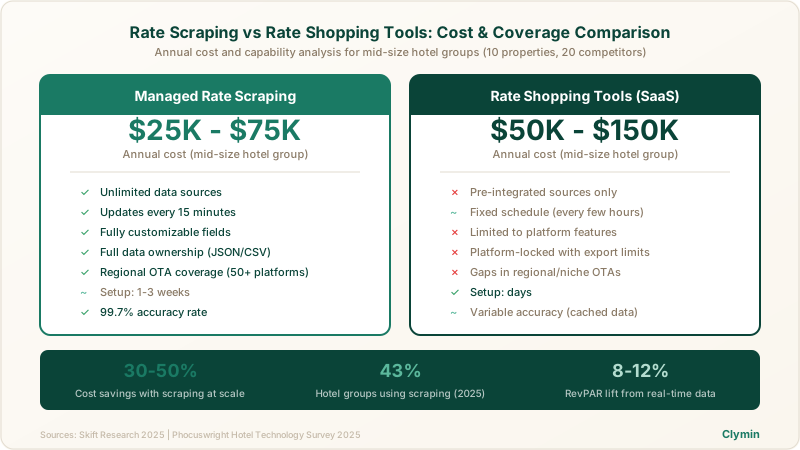
The following table breaks down how hotel rate scraping and rate shopping tools compare across the criteria that matter most to hospitality revenue teams.
Data Coverage
Rate scraping wins on coverage. A managed scraping service can target any publicly accessible website, including niche OTAs, regional booking platforms, and direct competitor sites. Rate shopping tools are limited to their pre-integrated data sources, which typically cover major OTAs but miss smaller or regional platforms.
For hotel groups operating across multiple markets, gaps in data coverage mean gaps in competitive intelligence. A property competing in Southeast Asia, for example, may find that rate shopping tools lack coverage of Traveloka or Tiket.com, while a scraping service can add these sources within days.
Data Freshness
Both approaches can deliver near-real-time data, but scraping offers more control over update frequency. With a managed service like Clymin, clients can specify scraping intervals down to every 15 minutes for high-priority competitors or markets.
Rate shopping tools typically update data on fixed schedules, often every few hours. Some premium tiers offer more frequent updates, but these come at significantly higher price points. For properties in highly dynamic markets where rates change multiple times daily, scraping provides a meaningful freshness advantage.
Customization and Flexibility
Rate scraping offers dramatically more flexibility. Need to track a new competitor? Add a specific room type filter? Monitor cancellation policies alongside rates? A managed scraping provider can adjust the crawl parameters to capture exactly the data points you need.
Rate shopping tools offer the features their product team has built. Customization is limited to configuration options within the platform. Requesting new data fields or sources often requires waiting for product roadmap prioritization.
Data Ownership and Portability
When you use a scraping service, you own the raw data. Feeds arrive in standard formats that integrate with any analytics platform, data warehouse, or revenue management system. Switching providers or bringing analysis in-house remains straightforward because the data format is under your control.
Rate shopping tools typically lock data within their platform. Export options exist but often come with limitations on historical data access or API call volumes. Migrating away from a rate shopping tool can mean losing access to historical benchmarking data.
Implementation and Maintenance
Rate shopping tools have a clear advantage in initial setup speed. Most platforms offer self-service onboarding that gets basic competitor monitoring running within a few days.
Managed scraping services require more upfront configuration. Defining target sources, specifying data fields, setting up delivery pipelines, and validating output quality takes one to three weeks with a provider like Clymin. However, once operational, the maintenance burden falls entirely on the provider.
Cost Structure
Rate shopping tools charge monthly SaaS fees that scale with the number of properties, competitors, and features. For a mid-size hotel group monitoring 20 competitors across 10 properties, annual costs can reach $50,000 to $150,000 depending on the platform and tier.
Managed scraping services typically price based on data volume and crawl frequency. For equivalent coverage, scraping often costs 30-50% less than premium rate shopping subscriptions, especially at scale. Clymin's pricing model delivers enterprise-grade data at a fraction of traditional rate shopping costs.
Accuracy and Reliability
Data accuracy depends heavily on the provider in both categories. Rate shopping tools occasionally display stale data when their crawlers encounter blocking or site changes. Managed scraping services face similar challenges but can respond faster to site changes because each client's crawl configuration receives dedicated attention.
Clymin maintains a 99.7% data accuracy rate across its travel data extraction projects, validated through automated quality checks and manual audits. With over 100 billion data points processed, the platform has built robust handling for the edge cases that trip up less experienced providers.
Comparison Summary Table
| Criteria | Rate Scraping | Rate Shopping Tools |
|---|---|---|
| Data coverage | Unlimited sources | Pre-integrated sources only |
| Data freshness | Configurable, down to 15 min | Fixed schedules, typically hours |
| Customization | Fully customizable | Limited to platform features |
| Data ownership | Full ownership, standard formats | Platform-locked with export limits |
| Setup time | 1-3 weeks | Days |
| Annual cost (mid-size) | $25,000-$75,000 | $50,000-$150,000 |
| Accuracy | Provider-dependent, high with managed | Provider-dependent, variable |
| Scalability | Linear cost scaling | Steep tier-based pricing |
When Rate Scraping Is the Better Choice
Rate scraping delivers the most value for hotel groups and hospitality brands that need broad market coverage, custom data fields, or integration with proprietary analytics systems. Organizations with dedicated revenue management or data teams benefit most from the flexibility of raw data feeds.
Properties operating in markets where rate shopping tools lack coverage gain immediate competitive advantage from scraping. Similarly, brands building proprietary pricing algorithms need the raw data inputs that only scraping can provide at the required granularity.
Clymin serves 40+ customers in the travel and hospitality sector, providing the managed infrastructure that makes scraping accessible even to teams without technical expertise. The hotel rate scraping service handles everything from crawler deployment to data delivery.
When Rate Shopping Tools Make Sense
Rate shopping tools work well for individual properties or small hotel groups that need basic competitor monitoring without technical complexity. Revenue managers who prefer visual dashboards and built-in recommendations over raw data analysis will find rate shopping tools more immediately useful.
Properties in major markets where rate shopping tools have strong coverage may find that the convenience of a packaged solution outweighs the flexibility advantages of scraping, at least initially.
The Hybrid Approach
Many sophisticated hospitality brands use both approaches. Rate shopping tools provide day-to-day operational dashboards for revenue managers, while managed scraping fills coverage gaps and feeds proprietary analytics models.
Clymin clients frequently start with scraping to supplement an existing rate shopping tool, then gradually expand scraping coverage as they realize the cost and flexibility benefits. Learning how to monitor hotel competitor rates automatically can help teams evaluate which approach best fits their workflow.
Making the Right Decision in 2026
The hospitality competitive intelligence landscape has matured significantly. Rate shopping tools that once represented cutting-edge technology now face pressure from more flexible, cost-effective scraping alternatives. Meanwhile, managed scraping services have eliminated the technical barriers that once made scraping impractical for non-technical teams.
According to Phocuswright's 2025 hotel technology report, 43% of hotel groups now use some form of web scraping for competitive intelligence, up from 28% in 2023. The trend toward data ownership and custom analytics pipelines continues to accelerate.
Evaluate your decision based on three factors: data coverage requirements, integration needs, and total cost of ownership. For most hotel groups with more than five properties, managed scraping delivers superior value. For individual properties seeking simplicity, rate shopping tools remain a viable starting point.
Sources
- Skift Research, "Hotel Revenue Management Technology Report 2025"
- McKinsey & Company, "The Future of Hospitality Pricing," 2025
- Phocuswright, "Hotel Technology Adoption Survey 2025"
Next Steps
Ready to explore how managed rate scraping compares to your current toolset? Book a consultation with the Clymin team to discuss your competitive intelligence requirements. You can also reach us at contact@clymin.com or visit clymin.com to learn more about our travel data solutions.