
Web Scraping for Ecommerce: Use Cases, Platforms, and Pricing
This guide is written for ecommerce operations, pricing, brand, and analytics teams evaluating whether to build scraping pipelines in-house, buy a self-serve tool, or commission a managed service. It covers the five operational use cases that drive most engagements, the platforms that matter by market, what ecommerce data actually contains, the technical realities of scraping marketplaces, and what to look for when scoping a vendor or build.
The Five Operational Use Cases
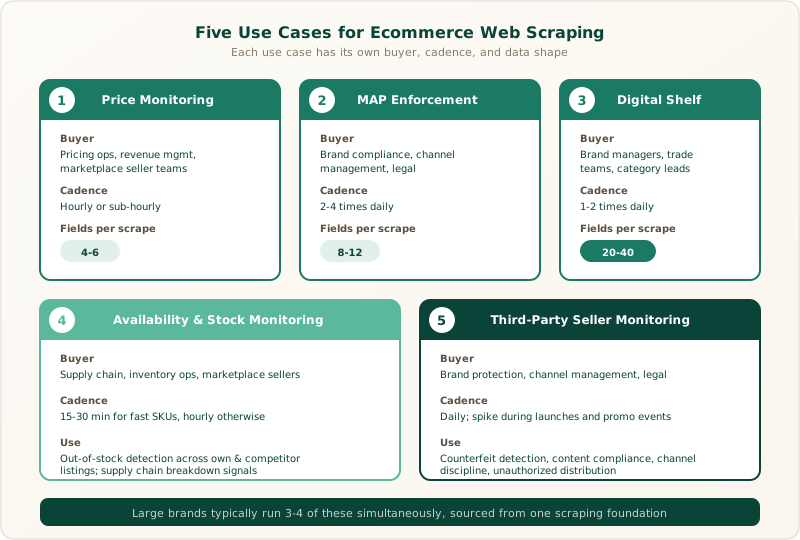
Ecommerce scraping looks like one category from the outside. Inside an operating team, it splits into five distinct jobs, each with its own buyer, its own SLA, and its own data shape.
1. Competitive Price Monitoring
The most common use case. A brand, retailer, or marketplace seller tracks the same SKU across competitor websites and marketplaces multiple times a day to detect pricing moves and adjust. The data shape is simple (SKU, competitor, price, stock status, timestamp) but the operational requirements are demanding: typically hourly or sub-hourly frequency, near-100% completeness, and platform coverage across 5 to 20 competitor sites simultaneously. For a worked example of the architecture, see Clymin's ecommerce price scraping service.
Buyer: pricing operations, revenue management, marketplace seller teams.
2. Minimum Advertised Pricing (MAP) Enforcement
Brands sell through retailers under contracts that specify the lowest price a retailer is allowed to publicly advertise. MAP enforcement requires scanning every authorized reseller and every marketplace listing for the brand's SKUs multiple times a day and flagging any violation. The MAP monitoring category alone represents roughly 1,800 US monthly searches across "MAP monitoring software," "MAP monitoring tool," and related terms. It is a recognized vertical SaaS category with established vendors.
Buyer: brand compliance, channel management, legal.
3. Digital Shelf Analytics
Originally a CPG and FMCG concern, increasingly extended to consumer electronics, beauty, and apparel. Digital shelf monitoring tracks where a brand's SKUs appear on retailer category pages, search results, and recommendation modules: share of search, ranking position, content compliance (images, descriptions, ratings), and content gaps versus competitor SKUs. The data shape is wider than price monitoring (dozens of fields per SKU per platform per day). Established vendors include Profitero, Stackline, CommerceIQ, NielsenIQ, and DataWeave; most of them sit on top of a web scraping foundation.
Buyer: brand managers, ecommerce trade teams, category leads.
4. Product Availability and Stock Monitoring
Out-of-stock detection across own listings and competitor listings. Used by brands to detect supply chain breakdowns, by marketplace sellers to identify when a competitor is out and prices can be raised, and by retailers to monitor third-party seller stock health. Sometimes combined with price monitoring; often a standalone feed for the supply chain or inventory team. See SKU tracking and monitoring for a deeper look.
Buyer: supply chain, inventory operations, marketplace sellers.
5. Third-Party Seller and Unauthorized Reseller Monitoring
Brands selling on marketplaces increasingly need to know which third-party sellers are listing their products, at what price, with what content, and whether they are authorized. This drives both brand protection (counterfeit detection, content compliance) and channel discipline (unauthorized distribution). The brand protection software category represents one of the highest addressable opportunities in the broader scraping market.
Buyer: brand protection, channel management, legal.
A single ecommerce team might be the buyer for one of these use cases. Most large brands or marketplaces have buyers for three or four simultaneously, often without realizing they are all sourced from the same underlying scraping infrastructure.
The Platforms That Matter, by Market
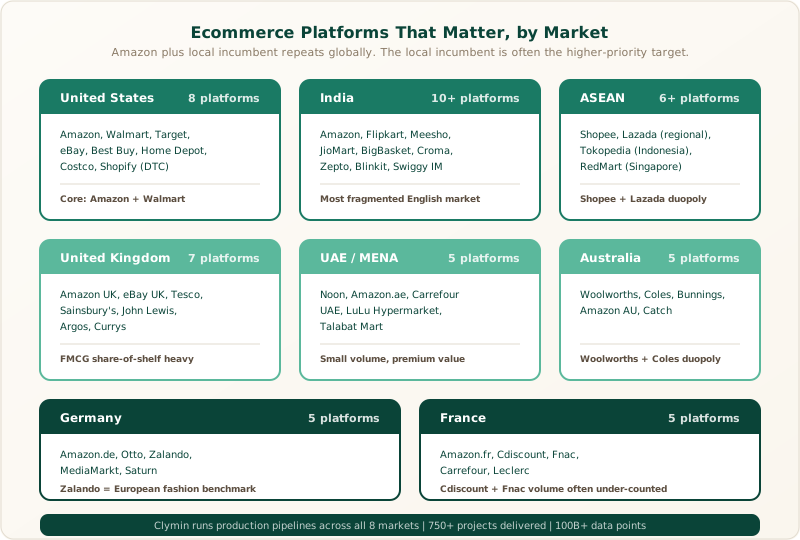
The platform list for ecommerce scraping is geographically specific. The Amazon-plus-local-incumbent pattern repeats globally but the local incumbent changes, and the local incumbent is often the more strategically important target for in-market sellers and brands.
India. Amazon, Flipkart, and Meesho dominate the marketplace layer. Reliance Retail's JioMart and Tata's BigBasket and Croma cover offline-to-online. Quick commerce is its own scraping target: Zepto, Blinkit, Swiggy Instamart, and BigBasket Now. India is the most fragmented English-language ecommerce market and almost always requires the broadest source list per engagement.
United States. Amazon and Walmart are the marketplace core, with Target, eBay, Best Buy, Home Depot, and Costco as standard secondary sources depending on category. Shopify is increasingly relevant when monitoring direct-to-consumer brand sites at scale.
United Kingdom. Amazon UK, eBay UK, Tesco, Sainsbury's, John Lewis, Argos, and Currys. Tesco and Sainsbury's grocery sites are among the most-scraped sources in the UK because of FMCG share-of-shelf tracking.
Singapore and ASEAN. Shopee and Lazada are the regional marketplace duopoly across Singapore, Malaysia, Indonesia, Thailand, the Philippines, and Vietnam. RedMart in Singapore and Tokopedia in Indonesia round out the local layer. Agoda and Klook also matter for travel-adjacent commerce.
UAE and MENA. Noon and Amazon.ae are the marketplace duopoly. Carrefour UAE, LuLu Hypermarket, and Talabat Mart cover grocery and quick commerce. The Gulf market is small in volume but high in per-engagement value because of premium pricing.
Germany. Amazon.de, Otto, Zalando, MediaMarkt, and Saturn. Zalando is the European fashion benchmark and a frequent scraping target for apparel brands.
France. Amazon.fr, Cdiscount, Fnac, Carrefour, and Leclerc. Cdiscount and Fnac carry heavier volume than non-French buyers usually expect.
Australia. Woolworths, Coles, Bunnings, Amazon AU, and Catch. Woolworths and Coles dominate FMCG share-of-shelf monitoring.
A useful filter for buyers: list the platforms where competitor prices, your own listings, or your distribution partners actually appear. That list is almost always 8 to 20 platforms for a category-leading brand, and it almost always crosses two or more markets. A vendor that has run pipelines on those platforms before will compress your build time materially.
What Ecommerce Data Actually Contains
A production scraping pipeline for ecommerce typically returns the following fields per SKU per platform per scrape:
- Product identifiers: SKU, ASIN (Amazon), product URL, brand, category, sub-category
- Pricing: list price, sale price, currency, unit price, bulk-discount tiers, coupon-applied price
- Availability: in-stock flag, stock level (where shown), delivery estimate, lead time
- Seller information: seller name, seller ID, seller rating, fulfilled-by (FBA, FBF, merchant), is-authorized flag (custom logic)
- Content: title, bullet points, description length, image count, hero image URL, A+ content flag
- Ratings and reviews: average rating, review count, recent review velocity, top complaint themes (NLP-derived)
- Search and ranking: organic search position for tracked queries, paid placement, ad type, sponsored-product flag
- Promotional flags: badges (Best Seller, Amazon's Choice, Deal of the Day), promotion text, lightning deal status
Pipeline complexity scales with field count. A pure price-and-stock feed for 5,000 SKUs across 5 sites at hourly frequency is straightforward. A full digital-shelf feed with all the fields above for 50,000 SKUs across 15 platforms is an order of magnitude more complex and priced accordingly. The product data extraction services page covers the wider field set in more detail.
The Technical Realities of Scraping Marketplaces
Amazon, Flipkart, Shopee, and Walmart are among the most-scraped websites on the public internet. Every major platform has invested heavily in anti-bot infrastructure. A scraping engagement that ignores this reality fails in the second week. According to Imperva's 2025 Bad Bot Report, automated traffic accounts for nearly half of all web requests, which means anti-bot infrastructure on target sites is standard rather than exceptional.
Three specific technical realities matter most for ecommerce buyers.
JavaScript rendering is the default, not the exception. Modern marketplace product pages render pricing, stock, and review data via JavaScript after initial page load. A simple HTTP-fetch-and-parse approach misses 60 to 80% of the relevant fields on Amazon, Flipkart, and Shopee. Headless browser infrastructure is mandatory.
Anti-bot defenses vary by platform and change without notice. Amazon uses one of the most sophisticated bot-detection systems in the industry, with frequent updates. Flipkart has lighter defenses but introduces challenges during high-traffic events (Big Billion Days, festive sales). Shopee uses regional CAPTCHA tiers that differ across Singapore, Malaysia, Vietnam, and the Philippines. A pipeline that worked yesterday may not work tomorrow without engineering attention.
Geo-restriction is real and expensive. Pricing on Amazon.com differs from Amazon.in differs from Amazon.de differs from Amazon.co.uk for the same ASIN. Each geography requires its own residential proxy pool sourced in-country. The cost of running 10 source platforms across 6 markets is materially higher than running 10 source platforms in one market, typically 2 to 3 times the proxy cost.
In Clymin's experience, the technical reality cuts both ways. It is a barrier to in-house builds reaching production. It is also why managed services exist as a category: a vendor running pipelines for dozens of customers amortizes the anti-bot, proxy, and monitoring cost across them, while an in-house build carries the full cost alone.
Build, Buy, or Managed: The Decision for Ecommerce Teams
Three options exist for an ecommerce team that needs scraped marketplace data. Each fits a different buyer profile. The full cost comparison is covered in managed web scraping vs. building in-house; the short version follows.
Build in-house. Right for teams whose competitive moat is the data product itself (price-comparison platforms, market-intelligence vendors), or teams with deep infrastructure engineering capability and the appetite to maintain scrapers across multiple platforms. Steady-state cost for a 10-platform pipeline is typically $8,000 to $20,000 per month including engineer time and infrastructure.
Buy a self-serve scraping tool or API. Right for engineering-led teams who want to control the pipeline but not build the proxy and anti-bot layer themselves. Apify, Bright Data, ScraperAPI, and Oxylabs sit in this space. The trade-off is that the buyer still owns parsing, validation, scheduling, and change management. Effective monthly cost including engineer time typically runs $500 to $2,000. For a head-to-head, see Apify vs. managed web scraping for ecommerce.
Commission a managed service. Right for operations, brand, and analytics teams that need data, not infrastructure. The vendor handles every operational responsibility from source analysis through delivery; the buyer specifies sources, fields, and frequency. Typical cost for a 10-platform pipeline ranges from $1,200 per month at the low end (per-record pricing on simple sources) to $6,000 per month for complex multi-market scope. For the full managed model, see what is managed web scraping?.
For most commerce-adjacent businesses where data feeds a decision rather than constituting the product, managed is the structurally cheaper option once the full cost of maintenance is counted. A free pilot on the actual target platforms is the fastest way to test which option fits, because the pilot output makes the difference between vendors and approaches concrete in 72 hours.
Pricing Benchmarks for Ecommerce Scraping
Published pricing in the managed category, for context. For a worked breakdown on a specific engagement, see how much does ecommerce data scraping cost?.
- ScrapeHero: $199 per site per month, custom for higher complexity. The only published per-site price in the field.
- Clymin: $0.001 per record delivered, with complexity multipliers (1.0x for simple, 1.25x and 1.5x for medium and complex sites). $600 per month minimum commitment.
- Most other managed peers (PromptCloud, Grepsr, Datahut, DataWeave, Intelligence Node) quote custom only. Expect $1,500 to $8,000 per month for typical ecommerce scope.
- Self-serve scraping tools start at $49 per month (ScraperAPI, ScrapingBee) plus the buyer's engineering cost.
The single biggest cost variable across managed vendors is whether the pricing model aligns vendor incentive with delivery. Per-record models pay the vendor only when records arrive, validated and clean. Retainer models pay regardless. For volatile ecommerce sources where layout changes break pipelines, per-record alignment shifts the cost of downtime to the vendor by design. Gartner's 2025 Market Guide for Data Integration Tools notes that outcome-aligned pricing is one of the strongest predictors of long-term vendor satisfaction in this category.
Common Patterns Across Clymin's Ecommerce Customers
A few patterns repeat across the brand and retailer customer base.
The buyer almost always under-counts the platform list at scoping. The first version of the source list comes from the pricing or category team; the real list (including authorized reseller sites, regional marketplaces, and the buyer's own listings) usually emerges in the second week of the engagement. Vendors that handle 8 to 15 platforms per engagement comfortably are better fits than vendors quoting for 3 to 5.
Frequency rarely matches the first ask. Buyers often request hourly when daily would suffice, or daily when hourly is required for the use case. The pilot output reveals the right cadence within a week of running.
Field count is the cost driver, not record count. A price-and-stock feed costs an order of magnitude less than a full digital shelf feed at the same record count, because the parsing, validation, and field-level normalization work is what consumes vendor effort. Scope the field list precisely before agreeing to a quote.
Bringing Ecommerce Data Into Production
For most ecommerce teams, the cleanest way to choose between options is to run a pilot on the actual target platforms before committing. Clymin's free pilot covers up to three of your target marketplaces (Amazon, Flipkart, Shopee, Noon, Walmart, Target, or any other public platform) with production-grade output within 72 hours. No sales call required to start.
If the pilot data fits your use case, the same pipeline moves into production at $0.001 per record with complexity multipliers and a $600 per month minimum. If it does not fit, no obligation.
Ready to test ecommerce scraping on your actual sources? Schedule a scoping conversation with Clymin's data engineering team, or email contact@clymin.com to start a free pilot directly.