Managed Web Scraping vs. Building In-House: A Cost Comparison
Why the Build-vs-Buy Question Matters in 2026
According to Gartner's 2025 Market Guide for Data Integration Tools, enterprises that automate external data collection outperform manual-process competitors by 34% in time-to-insight. Yet the cost framing for that automation often understates the true ownership cost, especially for buyers who model only the visible line items.
This guide is for a decision-maker who has roughly costed both options and wants a clear line-by-line comparison before committing. It assumes the data is needed on a recurring basis, not as a one-off extract. A one-time scrape almost always belongs in-house or as a project quote, and is not what this comparison addresses. If you are still working out whether your project is scraping or broader data extraction, see web scraping vs. data extraction. For the managed service model in full, see what is managed web scraping?.
What follows is a structured comparison across cost, time, risk, and operational ownership, plus the three buyer profiles where each option clearly wins.
The Real Cost of Building In-House
In-house scraping looks cheap on the first cost sheet. One mid-level engineer, two weeks to build, a few hundred dollars a month in proxy fees. The honest total cost is materially higher, because four categories get under-counted.
1. Initial Build (the visible cost)
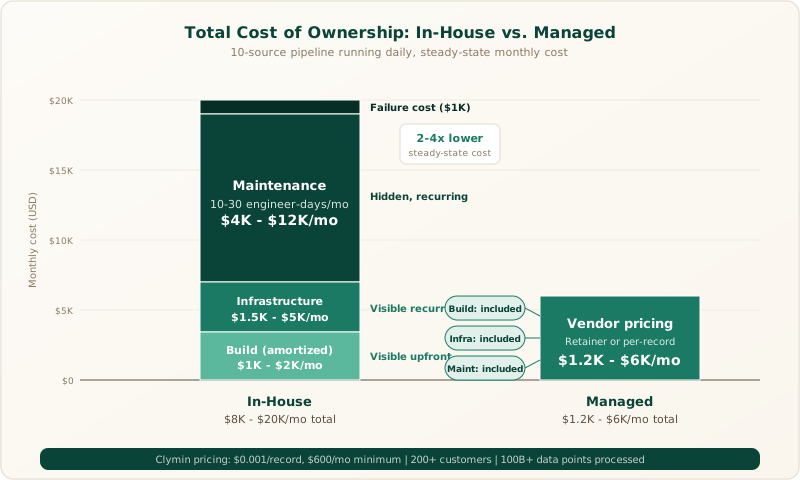
A simple ecommerce site can be scraped in 3 to 5 working days by a competent engineer. A complex one with JavaScript rendering, anti-bot infrastructure, login walls, or geo-restriction can take three weeks. Assume one mid-level engineer at fully-loaded cost (approximately $8,000 to $12,000 per month in most Indian and European markets, $15,000 to $22,000 in the US) and the build phase alone is $2,000 to $15,000 per source.
2. Infrastructure (the visible recurring cost)
Residential and datacenter proxies, headless browser farms, CAPTCHA-solving APIs, retry queues, monitoring. For a single source running daily, expect $200 to $800 per month. For a portfolio of 10 to 20 sources, expect $1,500 to $5,000 per month in pure infrastructure. This is what most build estimates capture.
3. Maintenance (the invisible recurring cost)
This is the line that undermines most in-house builds. Web sources change their layouts. They restructure their HTML. They add new bot defenses. According to Imperva's 2025 Bad Bot Report, automated traffic accounts for nearly half of all web requests, which means anti-bot infrastructure on target sites is now standard rather than exceptional. The buyer's engineer who built the original pipeline now spends 1 to 3 days per month per source keeping it running. Across a 10-source portfolio, that is 10 to 30 engineer-days per month of recurring maintenance, or roughly $4,000 to $12,000 per month at fully-loaded engineer cost.
The math compounds quickly. The buyer hired the engineer to build a scraping pipeline; six months later, the engineer is fully consumed maintaining it and can no longer build anything new. Two engineers later, the scraping infrastructure has become a department.
4. Failure Cost (the silent business cost)
When a scraper breaks at 3am and the engineer notices at 11am the next working day, the business has lost eight hours of data. If that data feeds a pricing engine, a competitor-monitoring dashboard, or a procurement decision, the cost is not just the engineering time to fix it. It is the commercial decision made on stale data.
A realistic total cost of in-house ownership for a 10-source pipeline running daily is $8,000 to $20,000 per month, sustained, with one to two engineers permanently allocated to maintenance.
The Real Cost of a Managed Service
A managed service collapses the four cost categories above into a single price line, with the vendor absorbing the maintenance and failure-recovery work.
1. No Build Cost to the Buyer
The buyer specifies sources, fields, and frequency. The vendor builds the pipeline at their cost. Pilot output usually arrives within 72 hours; production build for typical sources takes 2 to 10 working days. The buyer's engineering team is not involved.
2. No Infrastructure Cost to the Buyer
Proxies, headless browsers, CAPTCHA solving, retry queues, monitoring, anti-bot evasion. All owned and operated by the vendor. The buyer never sees a proxy bill.
3. No Maintenance Cost to the Buyer
When a source changes, the vendor's monitoring detects it and an engineer patches the parser. The buyer is usually unaware the change happened. This is the single largest cost reduction versus in-house, and it is recurring.
4. Predictable Per-Unit Pricing
The three common pricing models in the managed category:
- Monthly retainer. $600 to $3,000 per month for small pipelines, $5,000 to $20,000 per month for enterprise scope. Costs are flat regardless of volume.
- Per site. Some vendors quote a fixed price per source monitored, typically $199 to $500 per site per month, regardless of how many records the source produces.
- Per record delivered. Priced in tenths of a cent per record. Clymin's published rate starts at $0.001 per record with a $600 per month minimum, with complexity multipliers for sites that require more infrastructure to extract reliably.
For a worked pricing breakdown on a specific use case, see the ecommerce data scraping cost guide.
A realistic total cost of managed ownership for a 10-source pipeline running daily is $1,200 to $6,000 per month, with no engineer time consumed. The cost delta versus in-house is not subtle. It is structural.
Side-by-Side Cost Comparison
The table below compares the two approaches across the dimensions most buyers ask about. For a head-to-head on a specific self-serve scraping tool versus a managed engagement, see Apify vs. managed web scraping for ecommerce.
| Dimension | In-House Build | Managed Service |
|---|---|---|
| Initial build cost | $2,000 to $15,000 per source | $0 to the buyer |
| Time to first production data | 2 to 6 weeks | 72 hours (pilot) to 10 days (production) |
| Infrastructure cost | $200 to $800 per month per source | Bundled in vendor pricing |
| Engineering FTE consumed | 0.3 to 1.0 FTE per 10 sources, recurring | 0 |
| Who handles source changes | The buyer | The vendor |
| Who handles anti-bot changes | The buyer | The vendor |
| Who carries the cost of downtime | The buyer (data loss + fix time) | The vendor (per-record model only) |
| Pricing predictability | Variable (engineer time spikes with source instability) | Fixed monthly or per-record |
| Best suited for | Scraping is the product or a strategic moat | Data is an input to a product or decision |
The cleanest separator across all rows is who absorbs maintenance risk. In-house puts that risk inside the buyer's organization. Managed puts it inside the vendor's organization. Both are legitimate. The question is which one the buyer is structured to bear.
When Building In-House Wins
In-house is the right choice in three specific scenarios.
- Scraping is the product. If the buyer's company is itself a data product (a price-comparison engine, a real-estate aggregator, a market-intelligence platform), then scraping infrastructure is a strategic asset, not an operational expense. The maintenance cost is acceptable because the capability is differentiating.
- The data is too sensitive to share. Some buyers cannot share their source list or query patterns with a third-party vendor for competitive or compliance reasons. A managed engagement requires telling the vendor what is being scraped. If that information itself is the moat, in-house is the only option.
- The engineering team has the capacity and the appetite. A specific kind of engineering organization, typically one with a strong infrastructure team and a culture of internal tooling, will build and maintain scraping pipelines well and will be unhappy with a vendor relationship. If the team is set up for it, in-house works.
If none of these three apply, in-house is usually the more expensive option in steady state.
When Managed Wins
Managed services win in three different scenarios, which describe most commerce-adjacent businesses.
- The data feeds a decision, not a product. Competitive pricing intelligence, market share monitoring, supplier price tracking, shelf availability monitoring. The buyer needs the data; they do not need to own the means of getting it.
- The engineering team's cycles are too valuable to spend on scraping maintenance. If the buyer's engineers should be building the buyer's product, then anything that consumes them outside that product is a tax. Managed scraping converts variable engineer time into a predictable line item.
- The buyer needs to be in production in weeks, not months. A managed pilot delivers production-grade data within 72 hours. An in-house build delivers in two to six weeks at minimum, longer for complex sources. The speed differential matters when a market window is open or a board commitment exists.
The pattern across all three: the buyer's strategic asset is something other than scraping infrastructure, and scraping is therefore a cost to minimize, not a capability to develop. Clymin's full service model is described in the AI web scraping services overview.
The Hybrid Model (and Why It Usually Fails)
A common temptation is to build a hybrid: operate some pipelines in-house and outsource the rest. In practice, this usually creates the worst of both worlds.
The buyer ends up with two operating models, two cost centers, two skill sets to maintain, and two sets of relationships to manage. The engineering team that was supposed to be relieved is now coordinating with a vendor while still owning legacy pipelines. The vendor relationship that was supposed to be clean is now scoped around whichever sources the engineering team did not want to take.
The hybrid model occasionally works in two specific cases. First, when in-house owns a small number of high-strategic-value sources (typically internal or partner systems) and managed handles the long-tail of public web sources. Second, during a transition period of 3 to 6 months while a buyer migrates from one model to the other.
Outside those two cases, buyers are usually better off committing fully to one approach.
How to Decide in 20 Minutes
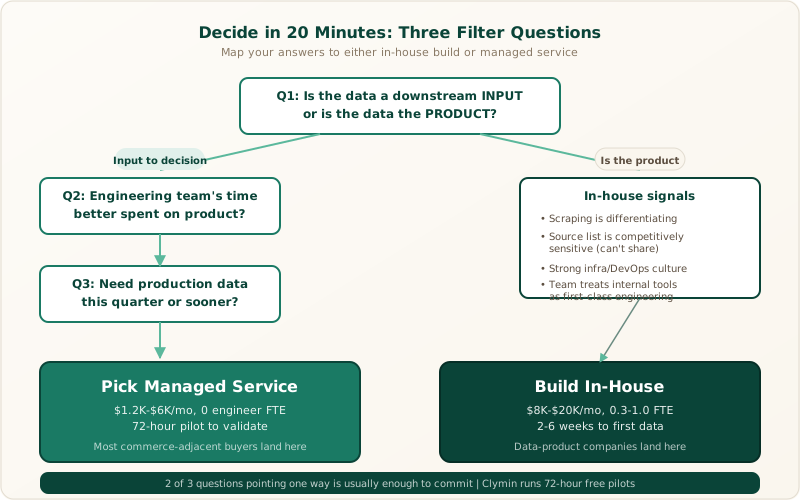
Three questions resolve the decision for most buyers.
Question 1: Is the data feeding a downstream decision, or is it the product itself?
If the data feeds a decision (pricing, procurement, monitoring, competitive intelligence), managed is almost always the right answer. If the data is the product (the buyer sells data, runs an aggregator, or runs a market-intelligence platform), in-house is usually the right answer.
Question 2: What is the opportunity cost of the engineering time?
Add up the fully-loaded cost of one engineer at the buyer's organization. Multiply by 0.5, the typical FTE consumed by maintenance once a scraping portfolio reaches 5 to 10 sources. Compare to the managed vendor's quote. If managed is cheaper, the answer is managed. If in-house is cheaper, look at what the engineer would otherwise be building. If that work is more valuable than the data the scraper produces, managed still wins.
Question 3: How fast does the buyer need to be in production?
If the answer is "this quarter" or sooner, managed is the only realistic option. In-house builds for a 10-source portfolio typically take 8 to 12 weeks from green light to steady-state operation.
For most commerce-adjacent buyers, two of the three questions point to managed. When all three point the same way, the decision is made.
Bringing the Right Model Into Production
For most teams, the cleanest way to validate the cost comparison is to run a managed pilot on the actual target sources and compare the output against an honest internal estimate of what in-house would cost. The pilot reveals what fields are reliably extractable, how clean the data arrives, and how fast the vendor responds to source changes. The internal estimate forces the maintenance line into the model.
Clymin's free pilot delivers production-grade data from up to three target sources within 72 hours. Compare the output, the freshness, and the validation against what an in-house build would deliver before signing anything. If the pilot data fits, the same pipeline moves into production at $0.001 per record with a $600 per month minimum. If it does not fit, there is no obligation.
Ready to test the cost comparison on your own sources? Schedule a scoping conversation with Clymin's data engineering team, or email contact@clymin.com to start a free pilot directly.