
The Cost of Rate Parity Violations
Rate parity violations occur when OTA platforms, wholesalers, or meta-search engines display hotel room rates below the agreed contracted minimum. These violations undermine direct booking strategies, erode brand pricing integrity, and redirect commission-free bookings to commission-heavy OTA channels.
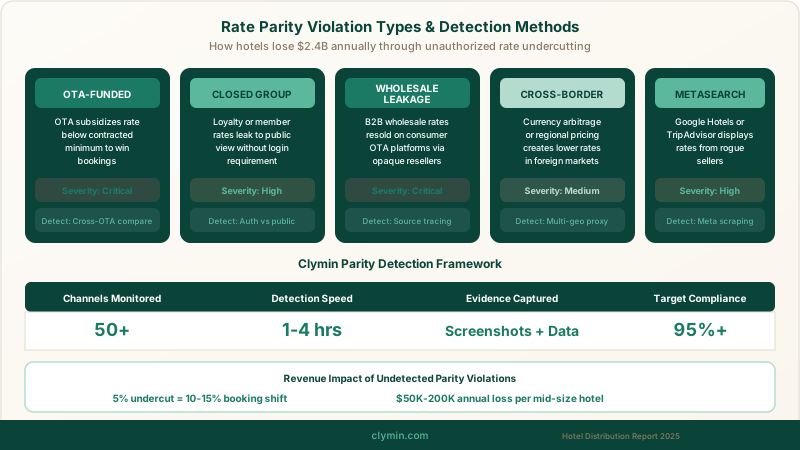
The financial impact is substantial. The Hotel Distribution Report 2025 estimates rate parity violations cost the global hotel industry $2.4 billion annually. For individual properties, even small violations, a 5% undercut on a major OTA, can shift 10-15% of bookings from direct channels to commission channels, increasing distribution costs by $50,000-200,000 annually for a mid-size hotel.
Most hotels detect violations too late. Manual parity audits, checking each OTA for each room type across multiple dates, require hours of daily effort and still miss violations that occur between checks. By the time a violation is discovered manually, it may have been live for days or weeks, diverting hundreds of bookings.
Step 1: Audit Your Current Distribution Landscape
Before building a monitoring system, map every channel where your rates appear:
Direct OTA contracts include your agreements with Booking.com, Expedia Group (Expedia, Hotels.com, Vrbo), Agoda, Trip.com, and other platforms where you have direct rate agreements. Document the contracted rate for each room type and the parity clause terms.
Wholesale and B2B channels present the highest parity violation risk. Rates distributed to wholesalers often leak to consumer-facing platforms through opaque reselling. Identify every wholesale partner and trace where their inventory appears online.
Meta-search engines aggregate rates from multiple sources. Google Hotel Ads, TripAdvisor, Trivago, and Kayak display rates from OTAs, wholesalers, and sometimes unauthorized resellers. Your monitoring system must cover meta-search results where potential guests compare prices.
Mobile-specific pricing differs from desktop rates on several OTAs. Booking.com's mobile app rates, Expedia's app-only deals, and similar mobile exclusives create additional parity check requirements.
Clymin's onboarding process maps this landscape automatically, identifying all channels displaying your rates, including unauthorized resellers you may not know about.
Step 2: Define Parity Rules and Violation Thresholds
Not every price difference constitutes a violation. Define clear rules:
Absolute parity means rates must match exactly across channels. Most strict but hardest to maintain given tax treatment differences and loyalty program discounts.
Relative parity allows rates to vary within a defined band (typically 1-3%). This approach accounts for legitimate differences in tax display, currency conversion rounding, and authorized loyalty discounts.
Channel-specific rules accommodate negotiated differences. You may allow a specific OTA to undercut your direct rate by 5% during a promotional period while maintaining strict parity elsewhere.
Set violation severity levels:
- Critical: Rates 10%+ below contracted minimum on a major OTA (Booking.com, Expedia)
- High: Rates 5-10% below minimum on any contracted channel
- Medium: Rates 1-5% below minimum, or violations on lower-volume channels
- Low: Rate differences within your defined tolerance band
Clymin configures these rules per property during setup and adjusts them as your distribution agreements evolve.
Step 3: Implement Continuous Multi-Channel Extraction
The technical foundation of parity monitoring is automated data extraction across all distribution channels. This requires:
Browser-based rendering because most OTAs deliver pricing through JavaScript-rendered pages. Simple HTTP requests return empty price fields. Your extraction system must run full browser sessions that execute JavaScript and handle dynamic content loading.
Search parameter variation to capture rates across multiple dates, room types, occupancy levels, and stay lengths. A single property on a single OTA may require 500+ rate checks daily to cover the full matrix of parameters where violations could occur.
Proxy infrastructure to distribute requests across diverse IP addresses. OTAs actively block automated access from concentrated IP ranges. Clymin maintains a pool of residential and datacenter proxies across 190+ countries to ensure reliable extraction.
Mobile emulation to capture app-specific and mobile-web rates that may differ from desktop pricing. Violations on mobile platforms are particularly damaging because mobile bookings now represent 60%+ of OTA transactions.
Building this infrastructure internally requires 2-4 data engineers and 6-12 months of development. Clymin's hotel rate scraping service provides it as a managed service operational within 5 business days.
Step 4: Build Automated Violation Detection
Raw extracted rates feed into a comparison engine that identifies violations in real time:
Rate comparison logic checks each extracted OTA rate against your contracted minimum for that room type, date, and occupancy configuration. Account for authorized discounts (loyalty programs, promotional periods) before flagging.
Cross-channel comparison identifies undercutting between OTAs. If Agoda shows your room $20 cheaper than Booking.com, investigate whether Agoda has an unauthorized rate source even if both rates exceed your minimum.
Trend detection identifies emerging violation patterns. A single rate discrepancy may be a display error. The same OTA consistently showing lower rates across multiple dates indicates a systematic issue requiring contract-level discussion.
False positive filtering prevents alert fatigue. Not every rate difference is a violation, tax display timing, currency conversion delays, and rate update propagation can create temporary discrepancies that resolve automatically. Clymin's detection system waits for confirmation across multiple extraction cycles before flagging violations.
Step 5: Configure Alert and Escalation Workflows
Detected violations need to reach the right people quickly:
Immediate alerts for critical violations (10%+ undercuts on major OTAs) go to the revenue manager and distribution director via email, SMS, or Slack. These violations actively drain revenue and require same-day response.
Daily summaries for medium and high-severity violations provide a consolidated view of parity issues requiring attention. Revenue managers review these during their morning competitive analysis.
Weekly reports aggregate violation trends, identify chronic offenders, and track resolution rates. These reports support quarterly business reviews with OTA partners.
Escalation protocols define who contacts which OTA partner. Your Booking.com market manager handles Booking.com violations. Your wholesaler account manager addresses reseller leakage. Clear ownership prevents violations from falling through cracks.
Clymin integrates with existing communication platforms to deliver alerts through your team's preferred channels.
Step 6: Collect Enforcement Evidence
Detecting violations is half the battle. Enforcing parity agreements requires documented evidence that OTA partners cannot dispute:
Timestamped screenshots capture exactly what the rate display looked like at the moment of violation. Clymin automatically generates screenshots during each extraction cycle, creating an indisputable visual record.
Rate comparison tables show the contracted minimum alongside the actual displayed rate, including any applicable taxes and fees. These tables demonstrate the magnitude of each violation.
Violation frequency logs document how often and how long violations persist. A one-time 24-hour violation is different from a chronic undercutting pattern spanning weeks. Frequency data strengthens enforcement arguments.
Revenue impact estimates calculate the booking revenue lost to each violation based on the rate differential, booking volume on the violating channel, and commission difference between OTA and direct bookings. Quantifying losses in dollar terms gets attention in enforcement discussions.
Clymin's OTA price monitoring service packages all evidence into ready-to-share reports formatted for OTA partner discussions.
Step 7: Establish Enforcement Processes
Evidence in hand, execute a structured enforcement process:
Level 1, Automated notification: For first-time or minor violations, send automated notifications to the OTA's partner support team with violation evidence. Many violations result from technical issues (feed update delays, caching problems) and resolve quickly once flagged.
Level 2, Account manager discussion: For repeated violations or significant rate differences, escalate to your dedicated OTA account manager. Present violation frequency data and revenue impact estimates to demonstrate the severity.
Level 3, Contract review: For chronic violators, invoke parity clauses in your distribution agreement. This may involve rate restriction, temporary suspension of inventory on the violating channel, or renegotiation of contractual terms.
Wholesale channel management: Rate leakage from wholesale channels requires tracing the violation source. Clymin's monitoring identifies which consumer-facing platform displays the leaked rate, and forensic analysis can often determine which wholesaler's inventory feeds that platform.
Step 8: Track Parity Compliance Over Time
Measure the effectiveness of your parity monitoring system:
Parity compliance rate, the percentage of monitored rate checks that show compliant pricing. Target 95%+ compliance across all channels.
Mean time to detection, how quickly violations are identified after they appear. Clymin targets detection within 1-4 hours.
Mean time to resolution, how quickly violations are corrected after detection. Track this by OTA partner to identify responsive versus unresponsive partners.
Revenue leakage prevented, estimate bookings retained on direct channels thanks to parity enforcement. This metric justifies the ongoing investment in monitoring.
Clymin's hospitality competitive intelligence data dashboard tracks all parity metrics alongside competitive rate intelligence, giving revenue teams a complete distribution management view.
Start Protecting Your Rate Integrity
Clymin deploys a complete rate parity monitoring solution within 5 business days. The managed service covers all technical implementation, extraction infrastructure, violation detection, evidence collection, and reporting, so your revenue team focuses on enforcement strategy rather than data engineering.
Contact the team at contact@clymin.com or book a meeting to discuss your distribution channels and parity monitoring requirements.