
What Is Managed Web Scraping? A Buyer's Guide
Why Managed Web Scraping Has Become a Default for Data-Driven Teams
Competitive intelligence, dynamic pricing, and market monitoring all run on data that has to be fresh, complete, and structured. According to Gartner's 2025 Market Guide for Data Integration Tools, enterprises that automate external data collection outperform manual-process competitors by 34% in time-to-insight. Yet building and maintaining scrapers in-house consumes engineering cycles disproportionate to the strategic value of the work.
The managed model exists because most buyers do not want a scraping problem. They want data. The category, sometimes called Data Extraction as a Service or Data as a Service, solves the buyer's actual need: a clean record in the right destination, on the right cadence, without an internal team owning proxy rotation, parser maintenance, and anti-bot defenses at 2am.
This guide explains what a managed web scraping service covers, how it compares to self-serve tools and in-house builds, when it is the right fit, and what to look for when evaluating a provider.
What a Managed Web Scraping Service Includes
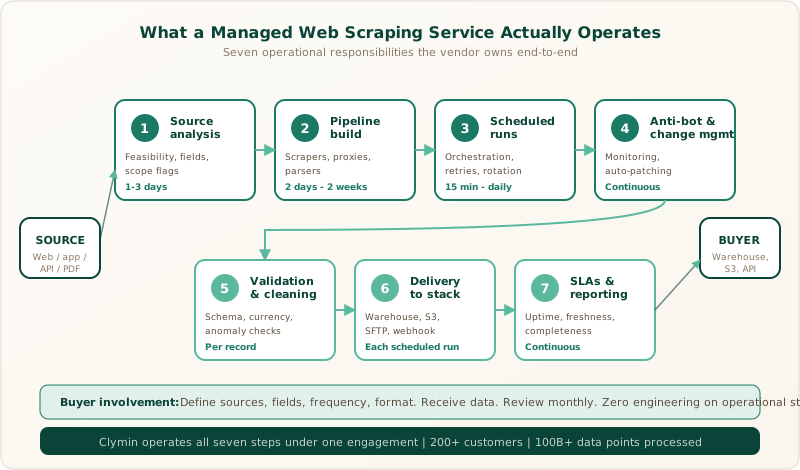
A managed service takes responsibility for every step between a public website and a clean data record in the buyer's system. In practice, that scope breaks into seven operational responsibilities.
1. Source Analysis and Feasibility
Before any pipeline is built, the vendor inspects target sites, identifies fields that can be extracted reliably, and flags any that cannot. Login walls, geo-restrictions, JavaScript-rendered content, and infinite scroll all change what is technically possible, and what it costs. A reputable managed vendor will tell the buyer upfront if a source cannot be extracted at the volume or frequency requested, before any contract is signed.
2. Pipeline Build
The vendor writes the scrapers, configures proxy and browser infrastructure, and sets up parsing logic. For straightforward sites this can take a day. For JavaScript-heavy enterprise sites with sophisticated anti-bot defenses, it can take a week or more. The buyer sees none of this work. They see only a sample dataset at the end.
3. Running the Pipeline on Schedule
Once approved, the pipeline runs at the agreed frequency: hourly, daily, weekly, or on demand. The vendor handles orchestration, retries failed requests, rotates infrastructure when sources rate-limit, and manages the operational cost of running at scale.
4. Anti-Bot Handling and Change Management
Websites change layouts. They add bot detection. They restructure data without notice. In an in-house build, every change is an engineering ticket. In a managed service, the vendor owns this maintenance: when a selector breaks or a layout shifts, monitoring catches it and a fix ships before the next scheduled run. According to Imperva's 2025 Bad Bot Report, automated traffic accounts for nearly half of all web requests, which means anti-bot infrastructure on target sites is now standard rather than exceptional.
5. Data Validation and Cleaning
Raw scraped data is messy. Prices carry currency symbols and locale-specific separators. Stock status is encoded as text in some pages and as a hidden CSS class in others. A managed service standardizes all of this before delivery, so the buyer receives data that is ready to query, not data that needs another engineering pass to normalize. IDC's 2025 Data Quality Benchmark found that automated validation reduces downstream data errors by 40% compared to rule-based checks alone.
6. Delivery to the Buyer's Destination
Managed vendors deliver to wherever the buyer's stack expects data: a relational database, a data warehouse like Snowflake or BigQuery, an object store such as S3 or GCS, an SFTP drop, a Kafka topic, an HTTP webhook, or a CSV in an email inbox. Format and schema are agreed during onboarding and stay stable across runs.
7. SLAs and Reporting
Managed engagements come with service-level commitments covering uptime, freshness, completeness, and accuracy. Buyers see when a run started, how many records were extracted, what percentage passed validation, and which sources failed. This visibility is the operational floor that separates managed services from informal contractor arrangements.
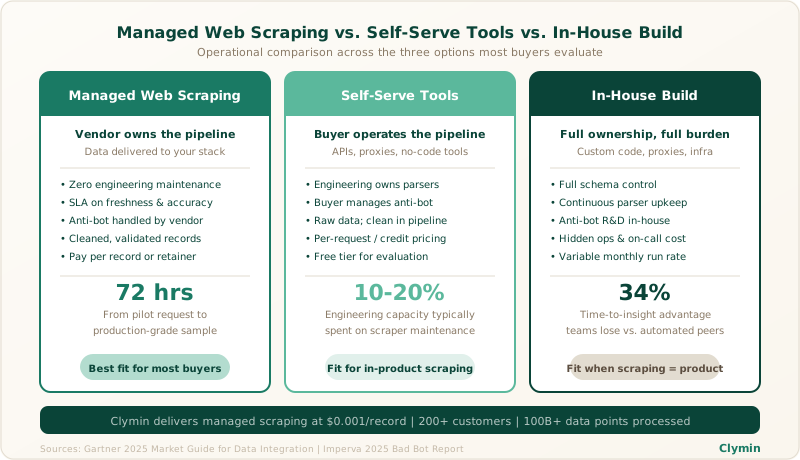
Managed Web Scraping vs. Self-Serve Tools vs. In-House Build
Most buyers comparing options hold three candidates in mind at once: build it themselves, buy a self-serve tool and operate it, or commission a managed service. The table below compares the operational differences between managed and self-serve tools. For a direct head-to-head on a specific self-serve platform, see Apify vs. managed web scraping for ecommerce.
| Dimension | Managed Web Scraping | Self-Serve Scraping Tools |
|---|---|---|
| What the buyer receives | Cleaned, validated data delivered to a destination of choice | API access, proxies, or a no-code interface to build pipelines |
| Who operates the pipeline | The vendor | The buyer's engineering team |
| Engineering effort to maintain | Zero (handled by vendor) | Ongoing (selector breaks, anti-bot changes, format shifts) |
| Typical pricing model | Per record, per site, or monthly retainer | Per request, per proxy, or per platform credit |
| Evaluation path | Pilot or sample dataset | Free tier or trial credits |
| Best suited for | Product, ops, and analytics teams that need data, not infrastructure | Engineering teams building scraping into their own product |
The single clearest separator is who operates the pipeline. Managed services own the operational layer; self-serve tools sell the buyer the operational layer to run themselves. Both categories are legitimate. The question is whether the buyer's organization wants to be in the scraping business.
When Managed Web Scraping Makes Sense
Managed web scraping is the right answer when three conditions are present together.
- Data is needed on a recurring basis, not as a one-off extract. One-time scrapes are usually cheaper to commission as a project; ongoing data is where the operational cost of in-house maintenance compounds quickly.
- The data feeds a downstream business decision or product feature where freshness, completeness, and accuracy are commercial requirements. Stale or incomplete data hurts revenue directly: incorrect competitor pricing, missing inventory signals, and outdated listings all show up as lost margin.
- The buyer's engineering team would rather spend cycles on the product than on scraping infrastructure. This is the most common reason in practice: scraping works until the source changes, and then it consumes engineering time disproportionate to its strategic value.
Common patterns where this combination shows up across Clymin's customer base:
- Ecommerce price intelligence across competitor catalogs, with dozens to hundreds of competitor sites monitored on schedules ranging from 15 minutes to daily.
- Hotel and flight rate monitoring across OTAs, covering real-time rate parity across Booking.com, Expedia, and direct hotel sites.
- FMCG shelf availability tracking on quick-commerce platforms, capturing out-of-stock and price signals across Zepto, Blinkit, Instacart, and similar.
- Real estate listing aggregation, pulling multi-source price and inventory data that feeds valuation and investment models.
- B2B contact and firmographic enrichment from public sources, supplying sales intelligence pipelines that feed CRM and outbound systems.
How a Managed Web Scraping Engagement Works
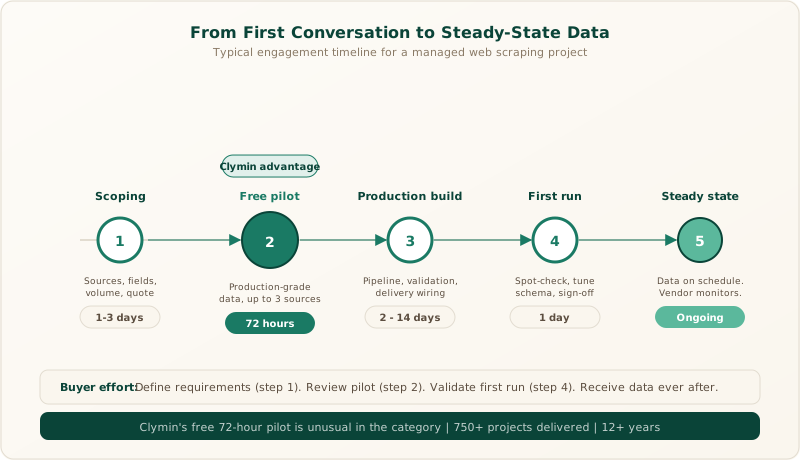
The typical sequence from first conversation to data in production runs in five steps. Clymin's process has evolved across 750+ delivered projects, and the cadence below is consistent across enterprise and mid-market engagements.
Step 1: Scoping
The buyer describes the sources, fields, volume, and frequency. The vendor returns a feasibility note and a quote. This conversation usually takes one to three working days. At Clymin, the scoping output includes a list of any fields that cannot be extracted reliably from the requested sources, so there are no surprises in the production build.
Step 2: Pilot or Sample Dataset
Most reputable managed vendors will run a paid or free pilot before contract signature. A pilot delivers a representative slice of the requested data on the actual target sites, so the buyer can validate accuracy, format, and freshness before committing to volume. Clymin operates from San Francisco and Hyderabad and runs a free pilot that covers up to three target sources at production-grade quality within 72 hours, with no sales call required to start. This pilot path is unusual in the category, where most peers gate evaluation behind a demo first.
Step 3: Production Build
Once the pilot is accepted, the vendor builds the production pipeline. Build time varies from two days for simple ecommerce sites to two weeks for complex enterprise sources with sophisticated anti-bot infrastructure. The build phase includes schema definition, validation rules, proxy provisioning, and delivery integration into the buyer's stack.
Step 4: First Production Run and Validation
The first scheduled run delivers data into the agreed destination. Both sides spot-check the output against expectations. Adjustments to schema, validation rules, or fields happen here, before the pipeline goes into steady-state operation. This is also where the buyer's downstream consumers (pricing engines, dashboards, ML models) are connected and tested.
Step 5: Steady-State Operation
Once stable, the pipeline runs without intervention. The buyer receives data on schedule. The vendor monitors, patches, and reports. Most teams interact with their managed vendor monthly at most, often less. The point of the service is that it gets out of the way and lets the buyer focus on what the data enables, not on how it arrives.
Pricing Models in the Managed Web Scraping Category
Three pricing models are common in managed web scraping, each with a different alignment of incentives between buyer and vendor. For a worked example, see the pricing breakdown for ecommerce data scraping.
Monthly Retainer
The buyer pays a fixed monthly fee covering an agreed scope of sources and frequency. Costs are predictable and easy to budget. The trade-off is that the buyer pays regardless of whether the data arrives at expected volume and quality, unless the SLA explicitly ties payment to delivery.
Per Site or Per Source
The buyer pays a fixed price per source monitored, regardless of how many records that source produces. This is useful when source count is the primary cost driver, less useful when volume varies significantly across sources.
Per Record Delivered
The buyer pays only for records that arrive validated and clean in the agreed format. This aligns vendor incentive directly with delivery. If a source breaks for two days, the buyer does not pay for those two days. Pay-per-record is uncommon in the category; most managed services default to retainer or project quotes. Clymin's pricing follows the pay-per-record model at $0.001 per record with a $600 monthly minimum, with complexity multipliers for sites that require more infrastructure to extract reliably.
Buyers evaluating options should ask explicitly which pricing model a vendor uses, because the answer changes who carries the risk of pipeline downtime.
How to Evaluate a Managed Web Scraping Vendor
Six criteria separate vendors who deliver consistently from vendors who promise. Use these as a checklist when shortlisting providers.
- A published evaluation path. A free pilot or paid pilot that produces real data on real sources before contract signature. Vendors that gate evaluation behind a sales call are protecting their margins, not the buyer's risk.
- A specific answer on how source changes are handled. Ask: when a source changes its layout, how is that detected and fixed, and who pays for the fix? Good answers involve monitoring infrastructure and SLAs. Weak answers involve change-request tickets and additional billing.
- A pricing model that aligns with delivery. Retainer pricing is fine when the SLA is tight and payment is tied to outcomes. Per-record pricing aligns vendor incentive with buyer outcome by construction.
- Vertical experience in the buyer's category. A vendor who has run competitor product data extraction for ecommerce before will know that Amazon's price element changes during peak hours and that Walmart encodes stock status in non-obvious ways. Vertical experience compresses build time and reduces edge-case risk.
- Compliance posture. The vendor should answer how they handle TOS-protected content, login-walled sources, and rate-limited APIs without the buyer having to ask twice. Look for ISO 27001, SOC 2, GDPR, and CCPA references in their materials and contracts.
- Reference data, not reference marketing. Ask for a sanitized example of the actual data the vendor delivers to a comparable customer. If they cannot share one, the engagement is unlikely to be production-grade.
Common Use Cases for Managed Web Scraping in 2026
The managed model is now standard for several categories where data is operational rather than experimental.
Competitive pricing intelligence. Retailers and brands monitor competitor pricing across hundreds of SKUs at intervals as short as 15 minutes, feeding dynamic pricing engines that adjust list prices in near-real time.
Travel and hospitality rate monitoring. Hotels, OTAs, and revenue managers track rates and availability across distribution partners to identify parity issues and revenue leakage.
Quick commerce and FMCG availability tracking. Brands monitor shelf availability and price on Zepto, Blinkit, Instacart, and similar platforms to catch stockouts and pricing inconsistencies before they affect sell-through.
Real estate market intelligence. Investors and proptech platforms aggregate listings from multiple portals to build valuation models and identify off-market opportunities.
B2B sales intelligence. Outbound sales teams enrich CRM records with firmographic and technographic data from public sources, feeding personalization and territory planning.
Across all of these, the common thread is that the data is an input to an operational decision, not a research project. That is the threshold where managed scraping becomes the economic answer.
Bringing Managed Web Scraping Into Production
For most teams, the right test of managed web scraping is not a sales conversation. It is a pilot on the actual target sources. A 72-hour pilot reveals everything that matters: which fields are reliably extractable, how clean the data arrives, how fast the vendor responds to a source change, and how well the schema fits the buyer's downstream systems.
Clymin's free pilot covers up to three sources at production-grade quality within 72 hours, with no sales call required to start. If the data fits, the same pipeline moves into production at $0.001 per record with a $600 monthly minimum. If it does not fit, there is no obligation. To explore the full Clymin service offering, see the AI web scraping services overview.
Ready to test a managed pipeline on your actual sources? Schedule a scoping conversation with Clymin's data engineering team, or email contact@clymin.com to start a free pilot directly.