What Drives Hotel Rate Scraping Costs?
Four variables determine Clymin's pricing for hotel rate scraping: competitive set size, extraction frequency, OTA platform coverage, and data delivery requirements.
Competitive set size, monitoring 10 competitor properties costs less than monitoring 50. Each additional property multiplies the data extraction volume across every OTA platform and date range combination.
Extraction frequency, daily monitoring serves most properties adequately. Hourly extraction costs more but captures intra-day rate changes critical for high-demand urban markets.
OTA coverage, monitoring rates on 3-5 major OTAs (Booking.com, Expedia, Hotels.com) represents the baseline. Full coverage across 50+ platforms costs more but captures niche OTA pricing that influences specific market segments.
Managed Service vs. In-House: Cost Comparison
Building in-house scraping requires hiring data engineers ($120,000-$180,000 annually), purchasing proxy services ($500-$3,000/month), maintaining server infrastructure ($200-$1,000/month), and dedicating ongoing engineering time to fixing broken scrapers.
Skift Research's 2025 hotel technology survey found that properties maintaining in-house scraping spend 35% of their data engineering budget solely on scraper maintenance, fixing scripts broken by OTA platform updates.
Clymin's managed service eliminates all infrastructure costs. Revenue managers receive clean data feeds without hiring developers or managing proxy networks. Clymin's hotel rate scraping service typically costs 40-60% less than equivalent in-house capabilities.
Typical Pricing Tiers
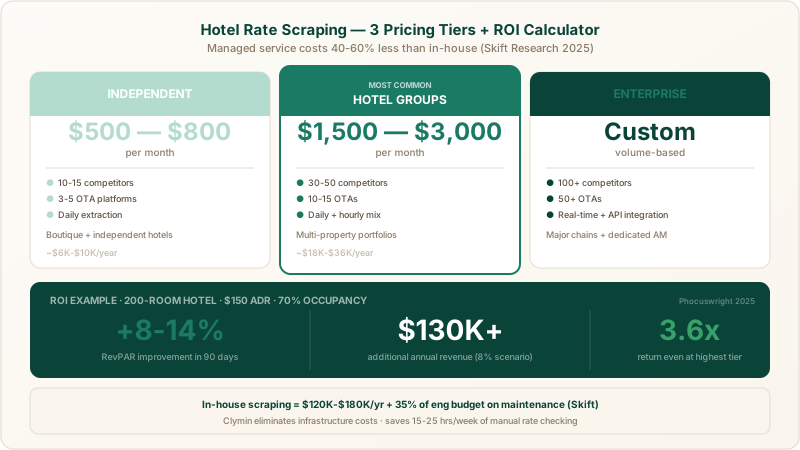
Independent hotels (10-15 competitors, 3-5 OTAs, daily extraction): approximately $500-$800/month. Suitable for boutique and independent properties needing competitive rate awareness.
Hotel groups (30-50 competitors, 10-15 OTAs, daily/hourly extraction): approximately $1,500-$3,000/month. Covers multi-property portfolios with market-specific competitive sets.
Enterprise chains (100+ competitors, 50+ OTAs, real-time extraction, API integration): custom pricing based on volume. Includes dedicated account management and custom data normalization.
ROI Calculation for Rate Scraping
Revenue gains from competitive rate intelligence typically dwarf the monitoring investment. A Phocuswright 2025 study found that hotels using automated rate monitoring achieve 8-14% RevPAR improvements within 90 days.
For a 200-room hotel with $150 average daily rate and 70% occupancy, an 8% RevPAR improvement represents approximately $130,000 in additional annual revenue. Even the highest monitoring tier ($36,000/year) delivers a 3.6x return.
Clymin's clients also reduce operational costs by eliminating 15-25 hours per week of manual rate checking. Revenue managers redirect that time toward strategic analysis and automated monitoring workflows.
Get a Custom Quote
Contact Clymin at contact@clymin.com or book a meeting for a pricing quote tailored to your competitive set and monitoring requirements.