
Why Are Travel Websites the Hardest to Scrape?
Travel platforms invest more in anti-scraping technology than nearly any other industry. Rate data represents a direct competitive advantage, OTAs spend millions annually protecting their pricing from automated extraction.
Booking.com updates its anti-bot defenses weekly. Expedia deploys multiple CAPTCHA variants across different page types. Agoda uses advanced browser fingerprinting that detects headless browsers within seconds. Each platform requires a different evasion strategy.
Imperva's 2025 Bad Bot Report found that travel websites receive 45% of all sophisticated bot traffic across the internet. Platforms respond with equally sophisticated defenses, creating an arms race that makes static scraping scripts obsolete almost immediately.
What Anti-Bot Protections Do Travel Sites Deploy?
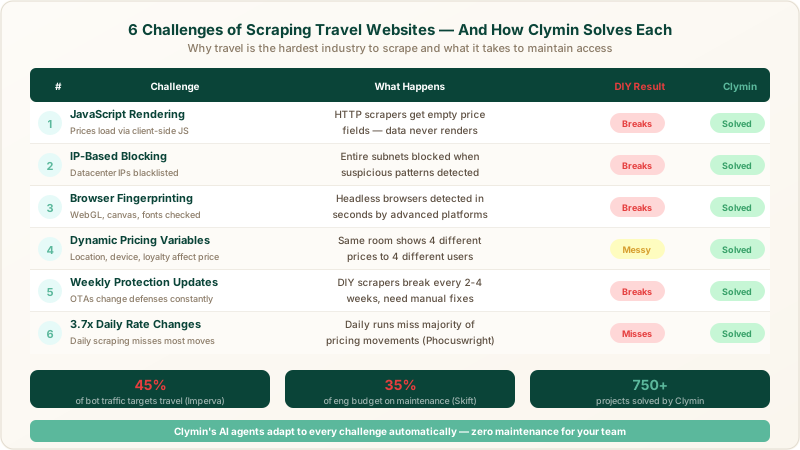
JavaScript rendering requirements represent the first barrier. OTA platforms load pricing data through client-side JavaScript execution, not in the initial HTML response. Simple HTTP request scrapers receive empty price fields because the data never renders without a full browser environment.
IP-based blocking catches scrapers that send too many requests from a single address. Travel platforms maintain blacklists of known datacenter IP ranges and block entire subnets when suspicious activity appears.
Browser fingerprinting goes beyond IP addresses to identify automated tools. Platforms check WebGL rendering, canvas fingerprints, installed fonts, and browser plugin lists to distinguish real users from headless browsers.
Clymin's AI agents overcome each protection layer. Residential IP rotation avoids IP blocks. Full browser emulation with realistic fingerprints passes detection checks. Adaptive request patterns mimic human browsing behavior. Learn more about Clymin's approach through the hotel rate scraping service.
How Do Dynamic Pricing Models Complicate Extraction?
Travel pricing changes based on dozens of variables, date, occupancy, user location, device type, loyalty status, and booking window length. The same hotel room may display four different prices to four different users accessing the same OTA simultaneously.
Capturing accurate rate data requires controlling for these variables. Clymin standardizes extraction parameters, consistent location, device profile, and user status, to produce comparable rate data across properties and OTAs.
Phocuswright's 2025 analysis found that hotel rates change an average of 3.7 times per day on major OTA platforms. Scrapers that run daily miss the majority of pricing movements, making hourly or real-time extraction essential for meaningful competitive intelligence.
What Happens When Scraping Infrastructure Breaks?
DIY travel scraping projects follow a predictable failure pattern. A developer builds a working scraper, it runs successfully for 2-4 weeks, then an OTA updates its page structure or anti-bot measures and the scraper stops collecting data.
Fixing broken scrapers requires reverse-engineering the platform's new protections, a process that takes days to weeks. During the downtime, revenue managers lose visibility into competitor pricing during potentially critical booking windows.
Clymin eliminates this maintenance burden entirely. AI agents detect protection changes and adapt extraction methods automatically. A Skift Research 2025 survey found that travel companies maintaining in-house scraping spend 35% of their data engineering budget on scraper maintenance alone.
How Does Clymin Solve Travel Scraping Challenges?
Clymin's managed approach addresses every challenge travel companies face with web scraping. AI agents handle anti-bot protections, dynamic rendering, and rate normalization as a fully managed service.
Revenue managers receive clean, structured rate data through automated monitoring without managing any scraping infrastructure. Data arrives in formats compatible with IDeaS, Duetto, and other revenue management platforms.
With 40+ customers and over a decade of experience, Clymin has developed solutions for every anti-bot measure deployed by major OTA platforms. Contact the team at contact@clymin.com or book a meeting to discuss your travel data needs.