
Why Pricing Managers Need Scraped Data in 2026
Manual competitor price checks are no longer viable for ecommerce brands operating at scale. A pricing manager tracking 500 SKUs against 10 competitors faces 5,000 data points per cycle, and that number multiplies with daily monitoring across marketplaces, direct-to-consumer sites, and aggregator platforms.
According to Gartner's 2025 Digital Commerce Technology report, 68% of mid-market ecommerce companies now use some form of automated pricing intelligence, up from 41% in 2022. The shift reflects a broader recognition that pricing speed directly correlates with margin performance.
McKinsey's research on pricing excellence shows that a 1% improvement in price realization yields an 8-11% boost in operating profit. For ecommerce brands, that 1% often comes from responding to competitor price changes within hours rather than days. Scraped data makes that response time possible.
Deloitte's 2025 retail analytics survey found that brands using automated competitive pricing data achieved 15% faster time-to-reprice compared to those relying on manual monitoring. Speed matters because pricing windows in categories like electronics and fashion close within 24-48 hours.
How to Build a Data-Driven Pricing Strategy From Scratch
Building a pricing strategy around scraped data requires a structured approach. Below is a step-by-step playbook that pricing managers can implement incrementally, starting with competitor mapping and ending with automated repricing loops.
Each phase builds on the previous one. Skipping steps, particularly the data quality and normalization phase, leads to unreliable insights and wasted effort downstream.
Step 1: Map Your Competitive Landscape
Start by identifying every competitor and channel that influences your pricing decisions. Create a structured competitor matrix with these columns: competitor name, website URL, marketplace presence (Amazon, Walmart, eBay), product overlap percentage, and pricing aggressiveness rating.
Prioritize competitors by revenue impact. A competitor who overlaps with 80% of your catalog and undercuts you on best-sellers deserves daily monitoring. A niche player with 10% overlap may only need weekly checks.
Include marketplace sellers, not just direct competitors. On Amazon alone, a single product listing can have 15-30 active sellers with different prices. Your competitive landscape extends beyond brand competitors to include resellers, gray market sellers, and marketplace-native brands.
Step 2: Define Your Data Requirements
Before configuring any scraping pipeline, document exactly what data points you need. A comprehensive ecommerce pricing dataset typically includes: product title, SKU or ASIN, current price, original price (if on sale), shipping cost, availability status, seller name, promotion details, timestamp, and source URL.
Go beyond price alone. Shipping costs, bundle offers, loyalty discounts, and coupon codes all affect the effective price a customer pays. A competitor may appear $5 more expensive on sticker price but offer free shipping that makes them $3 cheaper at checkout.
Clymin's ecommerce price scraping service captures all of these data points in a normalized format, ensuring your pricing analysis reflects the true competitive picture rather than surface-level sticker prices.
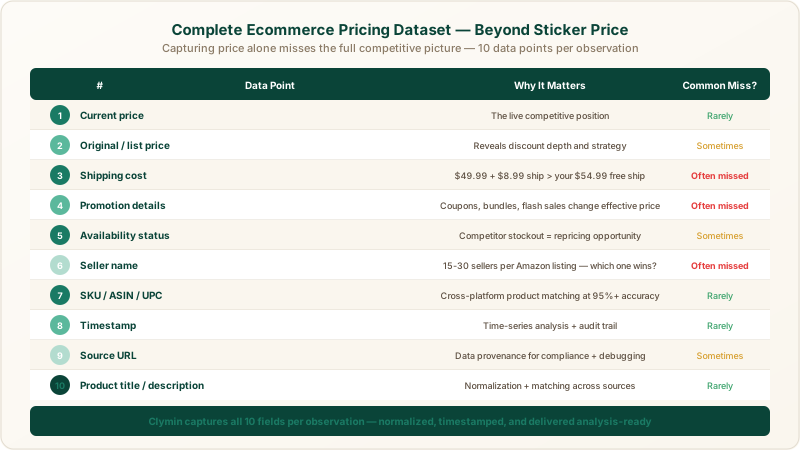
Essential data points for a complete ecommerce pricing dataset, capturing price alone misses the full competitive picture.
Step 3: Choose Your Data Collection Method
Three primary approaches exist for collecting competitor pricing data at scale, each with distinct trade-offs in coverage, reliability, and maintenance burden.
DIY scraping with open-source tools. Python libraries like Scrapy and Beautiful Soup let engineering teams build custom scrapers. The upside is full control; the downside is significant maintenance overhead. Anti-bot measures, CAPTCHA challenges, and site layout changes require ongoing developer time. A Statista 2025 report on data engineering workloads estimated that DIY scraper maintenance consumes 30-40% of a data engineer's time in ecommerce organizations.
SaaS price monitoring platforms. Tools like Prisync, Competera, and Price2Spy provide dashboards, alerting, and basic analytics. These work well for simple use cases but often struggle with non-standard site layouts, JavaScript-heavy pages, and custom data requirements. For a detailed comparison, see the guide on price monitoring tools vs managed scraping services.
Managed scraping services. A managed provider handles the entire data pipeline, scraper development, proxy infrastructure, anti-bot mitigation, data normalization, and delivery. Clymin's AI-agentic scraping model adapts to site changes automatically, eliminating the maintenance burden that makes DIY and SaaS approaches fragile over time. With hundreds of completed projects and 100B+ data points extracted, Clymin's infrastructure is purpose-built for the scale and reliability that pricing operations demand.
Step 4: Establish Your Scraping Cadence
Scraping frequency should match the velocity of price changes in your category. Over-scraping wastes resources; under-scraping means missed opportunities.
| Category | Recommended Frequency | Rationale |
|---|---|---|
| Consumer electronics | Every 4-6 hours | Flash sales and marketplace repricing happen intraday |
| Fashion and apparel | Daily | Seasonal markdowns and new arrivals shift pricing weekly |
| Health and beauty | Daily to twice weekly | Promotions drive most price variation |
| Home and garden | Twice weekly | Price changes are less frequent but seasonal |
| Industrial supplies | Weekly | Pricing is contract-driven and changes slowly |
Configure alerts for meaningful price movements rather than reviewing every data point manually. A 3-5% price drop from a key competitor on a high-margin SKU warrants immediate attention. A 0.5% fluctuation on a low-margin commodity does not.
Step 5: Normalize and Store Your Data
Raw scraped data is only useful after normalization. Product names, descriptions, and pricing formats vary wildly across sources. "Apple iPhone 15 Pro 256GB" on one site might appear as "iPhone 15 Pro, 256 GB, Unlocked" on another.
Build a normalization layer that standardizes product identifiers (UPC, EAN, ASIN), converts currencies, strips HTML artifacts, and maps variant attributes (size, color, storage) to a consistent schema. Clymin's product data extraction services handle this normalization automatically, delivering clean datasets that are ready for analysis without additional engineering work.
Store normalized data in a time-series database or data warehouse, PostgreSQL with TimescaleDB, BigQuery, or Snowflake all work well. Spreadsheets break down beyond a few hundred SKUs. Historical data is essential for trend analysis, seasonal pattern detection, and price elasticity modeling.
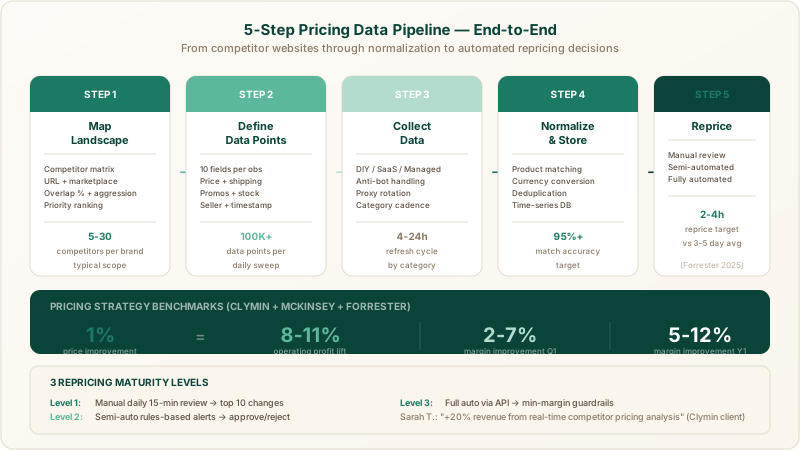
End-to-end pricing data pipeline, from competitor websites through normalization to actionable repricing decisions.
Benchmarks: What Good Pricing Intelligence Looks Like
Pricing managers often ask what benchmarks to target when building a scraping-based pricing strategy. Based on Clymin's work with 40+ ecommerce customers and industry research from Forrester and McKinsey, these benchmarks represent achievable targets for mature pricing operations.
Data freshness. Best-in-class ecommerce pricing teams work with data that is no more than 6 hours old for high-velocity categories. The median across ecommerce organizations is 24-48 hours, according to Forrester's 2025 pricing intelligence benchmark.
Coverage rate. Aim to track pricing on 90%+ of your top-revenue SKUs across all major competitors. Coverage gaps on best-sellers create blind spots that cost margin.
Match accuracy. Product matching across sources should exceed 95% accuracy. Poor matching, where a competitor's "iPhone 15 128GB" gets compared to your "iPhone 15 256GB", produces misleading insights and erodes trust in the data.
Repricing speed. Leading ecommerce brands reprice within 2-4 hours of detecting a meaningful competitor price change. Brands relying on manual processes average 3-5 business days, by which point the competitive window has often closed.
Margin impact. A well-executed data-driven pricing strategy typically delivers 2-7% margin improvement in the first quarter, scaling to 5-12% over 12 months as historical data enables more sophisticated optimization.
Pricing Frameworks That Work With Scraped Data
Scraped competitor data powers several proven pricing frameworks. Choosing the right one depends on your market position, category dynamics, and operational maturity.
Competitive Parity Pricing
Match or closely track competitor prices on key SKUs. Scraped data provides the real-time visibility needed to maintain parity without constantly checking competitor sites manually. Best suited for commoditized categories where price is the primary purchase driver.
Value-Based Pricing With Competitive Guardrails
Set prices based on perceived value and willingness-to-pay, but use scraped competitor data to establish upper and lower bounds. A premium brand might price 10-15% above the category average, scraped data confirms where that average actually sits and alerts when competitors shift positioning.
Dynamic Pricing
Adjust prices automatically based on competitor movements, demand signals, inventory levels, and time of day. Dynamic pricing requires a continuous feed of competitor data, making a reliable scraping pipeline essential. For details on collecting the data that powers dynamic pricing, see Clymin's guide on dynamic pricing data collection.
Promotional Response Pricing
Use scraped data to detect competitor promotions (flash sales, coupon codes, bundle offers) and respond with targeted counter-promotions. Rather than matching every discount, selective response pricing protects margin while remaining competitive on high-visibility products.
How to Avoid Common Pricing Data Pitfalls
Even well-designed scraping pipelines produce misleading insights when certain pitfalls go unaddressed. Pricing managers should watch for these recurring issues.
Ignoring shipping and total cost. A competitor listing a product at $49.99 with $8.99 shipping is more expensive than your $54.99 listing with free shipping. Always compare effective prices, not just sticker prices.
Failing to account for MAP policies. Minimum Advertised Price agreements mean some competitors cannot publicly display their lowest price. Scraped prices may reflect MAP floors rather than actual transaction prices. Factor this into your analysis to avoid underpricing against competitors who offer below-MAP discounts at checkout.
Over-indexing on a single competitor. Tracking one dominant competitor creates tunnel vision. Emerging D2C brands, marketplace sellers, and international competitors all influence buyer behavior. Broad competitive coverage prevents strategic blind spots.
Neglecting data quality. Stale data, mismatched products, and incomplete records lead to poor pricing decisions. Invest in validation layers that flag anomalies, a sudden 90% price drop is more likely a scraping error than a real fire sale. Clymin's price intelligence services include built-in anomaly detection that catches data quality issues before they reach your pricing team.
Treating pricing as a one-time project. Competitive pricing is a continuous discipline, not a quarterly exercise. Markets shift, new competitors enter, and consumer expectations evolve. Your scraping infrastructure and pricing processes need to be always-on.
Connecting Scraped Data to Your Repricing Workflow
Data without action creates overhead, not value. The final step in a data-driven pricing strategy is connecting your scraping output to an operational repricing workflow.
Manual review cadence. For teams not yet ready for full automation, establish a daily 15-minute pricing review. Pull the top 10 competitive price changes from overnight scraping, assess impact on your margins, and make repricing decisions. Weekly deep dives should cover trend analysis and strategic positioning.
Semi-automated repricing. Configure rules-based alerts that surface pricing opportunities. Examples: "If Competitor X drops price on any top-50 SKU by more than 5%, flag for review." "If our price is more than 10% above the category average on any SKU, generate a repricing recommendation." Pricing managers approve or reject each suggestion.
Fully automated repricing. Mature pricing operations connect scraped data directly to repricing engines via API. Rules govern minimum margins, competitor response thresholds, and velocity limits to prevent pricing wars. Automated repricing requires high-confidence data, which is why data quality and normalization from earlier steps are prerequisites, not optional.
Sarah T., Marketing Manager at an ecommerce client, described the impact: "Clymin's data insights helped us boost revenue by 20% through real-time market trend and competitor pricing analysis."
For a detailed walkthrough of setting up automated price monitoring, see the guide on how to monitor competitor prices automatically.
Three levels of repricing maturity, start with manual reviews and progress to full automation as data confidence grows.
Measuring the ROI of Your Pricing Strategy
Quantifying the return on a scraping-based pricing strategy requires tracking specific metrics before and after implementation.
Gross margin percentage. The primary KPI. Measure month-over-month and quarter-over-quarter changes after implementing data-driven repricing. Isolate the pricing contribution by controlling for volume and cost changes.
Win rate on competitive SKUs. Track how often your price is within the competitive range (typically within 3-5% of the lowest competitor) on your top-revenue products. Increasing your competitive win rate from 60% to 85% directly impacts conversion.
Time-to-reprice. Measure the elapsed time between a competitor price change and your repricing response. Reducing this from 72 hours to 4 hours captures margin that would otherwise be lost to slower competitors.
Price perception score. Survey-based or review-derived metric that captures how customers perceive your pricing relative to competitors. Data-driven pricing should improve competitiveness without sacrificing perceived value.
Data coverage ratio. Track the percentage of your catalog and competitor set covered by your scraping pipeline. Gaps in coverage equal gaps in intelligence.
Ready to Build Your Pricing Data Pipeline?
Clymin helps ecommerce pricing managers collect, normalize, and operationalize competitor pricing data at scale. With over a decade of experience, ISO 27001 certification, and AI-agentic scraping that adapts to site changes automatically, Clymin delivers the data infrastructure your pricing strategy needs. Reach out at contact@clymin.com or book a free consultation to discuss your pricing data requirements.