
Why Manual Ecommerce Price Monitoring Fails at Scale
Online retailers competing in 2026 face a pricing environment that changes by the minute. Amazon alone adjusts prices on millions of products multiple times per day. According to Statista's 2025 Global Ecommerce Report, the average online retailer competes against 25 to 50 direct competitors per product category, each with dynamic pricing algorithms of their own.
Manually tracking prices across this landscape is not viable. A pricing manager monitoring even 500 SKUs across five competitors would need to check 2,500 product pages daily. By the time that data lands in a spreadsheet, it is already stale. Price changes made by competitors during off-hours or weekends go entirely undetected.
The cost of this blind spot is measurable. McKinsey's 2024 pricing research found that companies using data-driven pricing strategies achieve 2% to 7% higher margins compared to those relying on periodic manual reviews. For a mid-size online retailer doing $50 million in annual revenue, that gap represents $1 million to $3.5 million in unrealized margin.
What Ecommerce Pricing Data Can AI Scraping Extract?
An ecommerce price scraping service powered by AI agents goes far beyond pulling a single price field. Clymin's AI-agentic scraping technology extracts multi-dimensional pricing intelligence from competitor storefronts, including data points that static scrapers routinely miss.
Core pricing fields captured include list price, sale price, MAP (Minimum Advertised Price) violations, shipping costs, bundle pricing, and quantity-based discounts. Beyond raw prices, Clymin also captures contextual signals such as stock availability flags, promotional labels, coupon codes, and estimated delivery timelines, all of which influence a competitor's effective price position.
Platform coverage spans major marketplaces and direct-to-consumer storefronts. Amazon, Walmart, Target, eBay, Shopify-powered stores, BigCommerce catalogs, and niche vertical marketplaces are all supported. For retailers operating across regions, Clymin handles geo-specific pricing by routing extraction through localized endpoints, capturing the exact prices a customer in New York, London, or Sydney would see.
Real-time monitoring operates on configurable schedules. Most ecommerce clients run hourly sweeps for high-velocity categories like electronics and daily sweeps for slower-moving categories like home goods. Clymin's AI agents detect and adapt to site structure changes, a capability that eliminates the maintenance burden that breaks traditional scraping setups whenever a competitor redesigns their product pages. To understand how intelligent agents differ from conventional scrapers, see our AI-agentic scraping approach.
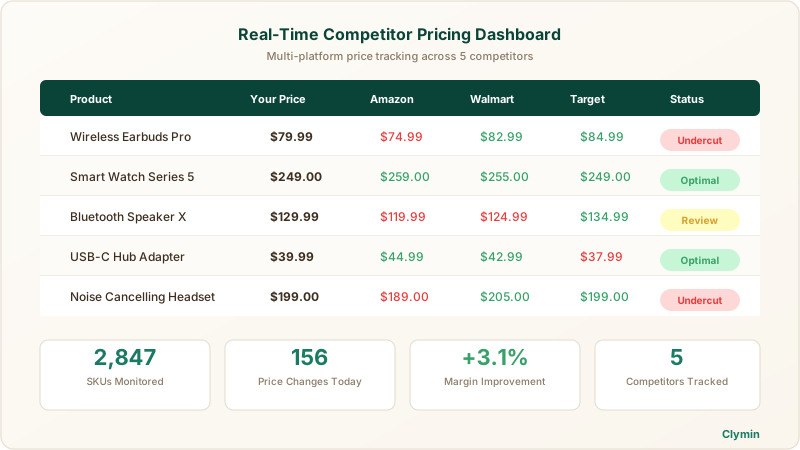
Real-time competitor pricing dashboard with multi-platform price tracking and change detection.
What Is the ROI of Automated Competitor Price Monitoring?
Automated price monitoring delivers returns that compound over time. The initial payoff is operational: eliminating the manual labor of price checks frees pricing teams to focus on strategy instead of data entry. A Forrester 2024 study on pricing automation estimated that mid-market retailers save 15 to 20 hours per week by automating competitor price tracking, time that translates directly into faster repricing decisions.
The strategic value runs deeper. With continuous pricing visibility, retailers can identify and act on three high-impact opportunities: undercutting competitors on price-sensitive SKUs where margins allow it, raising prices on products where competitors have moved up, and detecting MAP violations that erode brand value across the channel.
Sarah T., a Marketing Manager at a Clymin ecommerce client, reported measurable impact from this approach. Clymin's structured pricing feeds enabled her team to run real-time market trend and competitor pricing analysis, which contributed to a 20% revenue increase. The key was speed, having daily data meant pricing adjustments reached the storefront within 24 hours of a competitive shift, rather than the 7 to 14 day lag from manual processes.
For pricing managers evaluating the business case, Profitero's 2025 Price Intelligence Benchmark found that retailers with automated price monitoring achieve a 3.1% average margin improvement within the first six months of deployment. On a $20 million product line, that represents over $600,000 in additional margin annually, far exceeding the cost of any price scraping service.
How Does Clymin Ensure Pricing Data Quality and Compliance?
Data quality determines whether pricing intelligence is actionable or misleading. Clymin applies a multi-stage validation pipeline to every pricing dataset before delivery. Raw extracted prices are cross-referenced against historical baselines to flag anomalies, catching issues like currency mismatches, scraping artifacts, or temporary error pages that would otherwise corrupt downstream analysis.
Structured delivery formats are tailored to each client's analytics workflow. Clymin delivers pricing data via CSV, JSON, XML, direct database integration, or cloud storage drops to S3 and GCS. Each delivery includes metadata fields, extraction timestamp, source URL, product identifier mapping, and confidence scores, that allow pricing teams to audit and trace any data point back to its origin. Learn more about how price intelligence drives ecommerce strategy and how retailers automate competitor price monitoring at scale.
Compliance is non-negotiable when scraping at scale. Clymin holds ISO 27001 certification and maintains AICPA SOC compliance, ensuring that data handling meets enterprise security standards. All scraping operations follow GDPR-ready protocols, respect robots.txt directives, and use rate-limiting to avoid disrupting target sites. For retailers operating in regulated markets or working with vendor-sensitive data, Clymin provides full audit trails and data processing agreements on request.
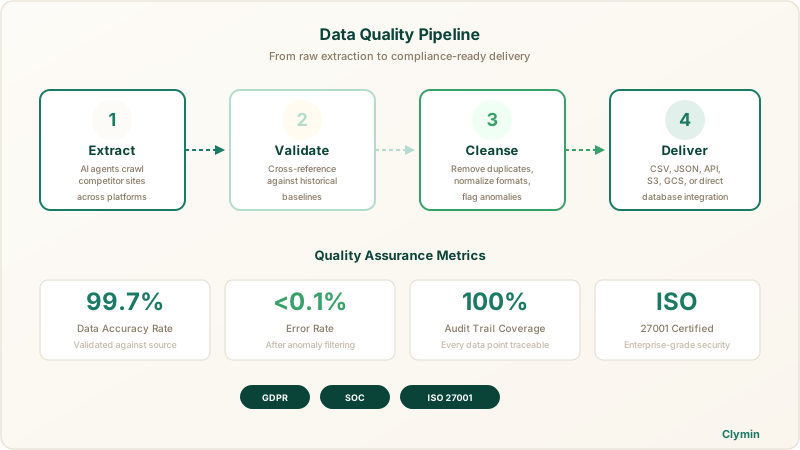
Data quality pipeline: from raw extraction through validation to structured, compliance-ready delivery.
Ready to Supercharge Your Pricing Strategy?
Stop losing margin to competitors you cannot see. Clymin's ecommerce price scraping service gives your pricing team the real-time data advantage that manual monitoring cannot match, backed by 40+ customers and over a decade of data extraction expertise. Reach out at contact@clymin.com or schedule a free consultation to discuss your pricing intelligence requirements.