
What Is the Best Price Monitoring Software?
There is no single best price monitoring software; the right fit depends on SKU volume, source coverage, and how much maintenance your team can absorb. SaaS tools suit small catalogs and hands-on teams, while a managed service like Clymin wins for large, frequently changing catalogs because anti-bot handling and maintenance are included. For continuous tracking, see competitor price monitoring, and for how managed delivery compares to tools and APIs, see the best data extraction services breakdown.
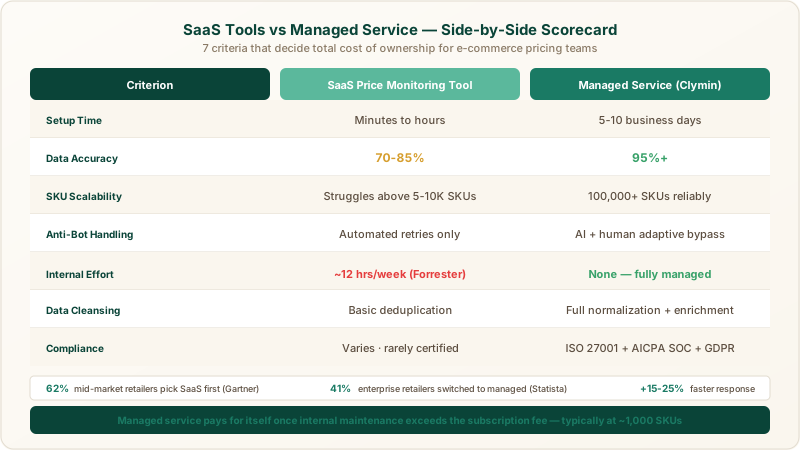
Quick Comparison: SaaS Price Monitoring Tools vs Managed Services
| Factor | SaaS Price Monitoring Tools | Managed Price Monitoring Services |
|---|---|---|
| Setup time | Minutes to hours (self-serve) | 5-10 business days (consultation + configuration) |
| Monthly cost | $200-$2,000/month | $1,500-$10,000+/month (custom) |
| Internal resources needed | 1-2 developers for setup and maintenance | None, fully handled by provider |
| SKU scalability | Struggles above 5,000-10,000 SKUs | Handles 100,000+ SKUs reliably |
| Data accuracy | 70-85% (degrades with anti-bot measures) | 95%+ (dedicated teams resolve blocks) |
| Anti-bot handling | Automated retries, limited workarounds | Human + AI adaptive bypass strategies |
| Data cleaning | Basic deduplication | Full cleansing, normalization, enrichment |
| Customization | Pre-built templates, limited flexibility | Fully custom to your catalog and sources |
| Ongoing maintenance | Your team fixes breakages | Provider handles all source changes |
| Best for | Small catalogs, tech-savvy teams | Large catalogs, lean e-commerce teams |
What Do SaaS Price Monitoring Tools Actually Deliver?
SaaS price monitoring tools like Prisync, Competera, and Price2Spy offer self-serve dashboards where e-commerce teams configure competitor URLs, map product matches, and schedule automated price checks. These platforms typically charge per-SKU or per-competitor-site, with plans starting around $200/month for small catalogs.
The appeal is clear: fast onboarding, lower entry cost, and direct control over configuration. According to a 2025 Gartner report, 62% of mid-market retailers initially choose SaaS pricing tools for competitive intelligence because of the perceived speed-to-value advantage.
However, SaaS tools hit practical limits that become expensive to work around. Retailers monitoring more than a few thousand SKUs routinely report data gaps caused by anti-bot protections, CAPTCHAs, and JavaScript-rendered pricing pages. A 2024 Forrester study found that e-commerce teams spend an average of 12 hours per week troubleshooting and maintaining their self-serve price scraping tools, time that directly reduces the cost advantage.
Dynamic pricing pages present another challenge. Many competitor sites now serve different prices based on geography, device type, and browsing history. Standard SaaS crawlers often capture only one price variant, missing the pricing segmentation that drives competitive strategy.
What Does a Managed Price Monitoring Service Include?
A managed price monitoring service assigns a dedicated team to handle every stage of competitor price data collection: source identification, scraper configuration, anti-bot resolution, data cleaning, normalization, and structured delivery. The e-commerce team receives clean, analysis-ready datasets without writing a single line of code or troubleshooting a single failed crawl.
Managed services excel where SaaS tools struggle. When a competitor redesigns their product pages or deploys new bot-detection, a managed provider like Clymin resolves the issue within hours, not days. According to Statista's 2025 e-commerce technology survey, 41% of enterprise retailers have switched from self-serve tools to managed scraping services specifically because of data reliability issues.
The data quality difference compounds over time. Managed providers normalize competitor prices across currencies, handle product matching across different naming conventions, and flag anomalies before they reach your pricing engine. For teams feeding competitor data into automated repricing systems, even a 5% accuracy gap can translate into margin erosion across thousands of daily pricing decisions.
Managed services also address compliance directly. Providers with certifications like ISO 27001 and SOC compliance (which Clymin holds) implement data handling practices that meet enterprise procurement requirements, a box that most SaaS scraping tools cannot check.
When Should You Choose a SaaS Tool Over a Managed Service?
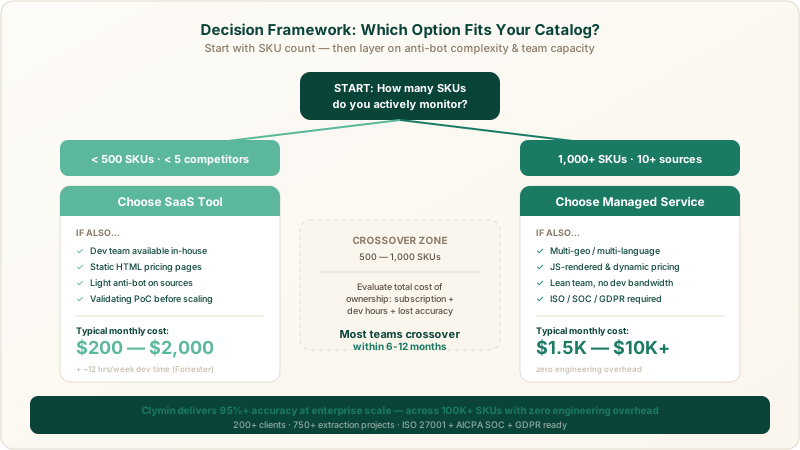
SaaS price monitoring tools make sense in specific scenarios. Teams with fewer than 500 SKUs, monitoring fewer than 5 competitors, and with available developer resources can extract strong value from self-serve platforms. The cost-per-SKU model keeps expenses predictable, and the dashboard interface gives pricing managers direct visibility.
Early-stage e-commerce businesses validating their competitive pricing strategy also benefit from starting with SaaS tools. The lower commitment allows rapid experimentation before investing in a managed relationship.
Choose a SaaS tool when:
- Your catalog has fewer than 500 actively monitored SKUs
- You track 5 or fewer competitor sites with standard HTML pricing pages
- Your team includes developers who can maintain integrations and troubleshoot failures
- You need a quick proof-of-concept before committing to a larger investment
- Competitor sites do not use aggressive anti-bot measures
When Does a Managed Service Become the Better Investment?
The managed service model pays for itself when internal maintenance costs exceed the service fee. For most e-commerce operations, this crossover happens around 1,000-2,000 tracked SKUs or when monitoring more than 10 competitor sources.
Choose a managed service when:
- Your catalog exceeds 1,000 SKUs with regular additions and removals
- You monitor competitors across multiple geographies or languages
- Competitor sites use JavaScript rendering, dynamic pricing, or anti-bot defenses
- Your pricing team needs clean, normalized data delivered on a fixed schedule
- You lack internal developer bandwidth to maintain scraping infrastructure
- Compliance requirements demand certified data handling (ISO 27001, SOC, GDPR)
According to McKinsey's 2025 retail analytics report, retailers using managed competitive intelligence services reported 15-25% faster pricing response times compared to those relying on internal tooling. The speed advantage directly correlates with margin protection in fast-moving categories like electronics, fashion, and consumer goods.
For a deeper look at how price scraping works for online retailers, see our guide on e-commerce price scraping services.
How Clymin Fits Into Your Price Monitoring Strategy
Clymin operates as a fully managed price monitoring partner for e-commerce teams that need reliable, large-scale competitor data without the engineering overhead. Our AI-agentic scraping technology uses intelligent agents that learn and adapt to site changes, anti-bot measures, and dynamic pricing structures, delivering 95%+ data accuracy across catalogs of any size.
What sets a managed approach apart from bolting together SaaS tools is the end-to-end ownership. Clymin handles source discovery, scraper deployment, ongoing maintenance, data cleansing, and structured delivery. Your pricing team receives normalized, analysis-ready competitor data on a schedule that matches your repricing cadence, daily, hourly, or near real-time.
With 40+ customers served and hundreds of data extraction projects delivered over a decade, Clymin brings the operational depth to handle complex multi-geography, multi-language price monitoring at enterprise scale. Our ISO 27001 certification, SOC compliance, and GDPR readiness ensure that your competitive intelligence pipeline meets procurement and legal requirements from day one.
For step-by-step guidance on setting up automated competitor tracking, explore our resource on how to monitor competitor prices automatically.
Get a Free Price Monitoring Assessment
Evaluating whether your team needs a SaaS tool or a managed service starts with understanding your catalog complexity and competitive landscape. Reach out to Clymin at contact@clymin.com or schedule a free consultation to get a tailored recommendation based on your SKU count, competitor sources, and data delivery requirements.