
What Is Dynamic Pricing and Why Does Collecting the Data Require Specialized Tools?
Dynamic pricing refers to the practice of adjusting product or service prices in real time based on variables such as demand levels, competitor positioning, time of day, inventory thresholds, and customer segmentation. Airlines pioneered dynamic pricing decades ago, but by 2026, algorithmic pricing has become standard across ecommerce, hospitality, ride-sharing, SaaS, and event ticketing.
The challenge for pricing managers is that dynamic prices are fundamentally different from static listed prices. A competitor's price for the same SKU can change dozens of times within a single day. According to Competera's 2025 Pricing Optimization Report, retailers using algorithmic pricing engines adjust prices an average of 60 times per day on high-velocity SKUs, making any single-snapshot approach to price monitoring immediately outdated.
Standard ecommerce price scraping captures what a price is at a given moment. Dynamic pricing data collection captures how, when, and why that price changes, revealing the algorithmic logic behind a competitor's pricing strategy.
Why Is Collecting Dynamic Pricing Data So Challenging for Pricing Teams?
Algorithmic pricing introduces layers of complexity that break conventional scraping approaches. Pricing managers attempting to collect dynamic pricing data face four distinct obstacles that demand specialized infrastructure.
Prices change at sub-hourly intervals. A competitor running a real-time pricing engine may adjust a product's price every 15 minutes based on demand signals. Collecting data once or twice daily misses the pattern entirely. Meaningful dynamic pricing intelligence requires high-frequency collection with precise timestamps to map pricing curves throughout the day.
A/B tested prices create conflicting data. Many ecommerce platforms serve different prices to different visitors as part of conversion optimization experiments. A single scraping session captures only one variant, producing incomplete or misleading intelligence. Clymin's AI agents execute multiple concurrent sessions per target URL, identifying and cataloging price variants being tested.
Personalized pricing varies by user profile. Returning customers, loyalty members, and first-time visitors often see different prices for identical products. Device type, browser history, and referral source can all trigger distinct price points. Capturing these variations requires simulating multiple user contexts, a capability that goes far beyond what rule-based scrapers offer.
Geo-variant pricing differs by region. Competitors frequently set region-specific prices based on local demand, shipping costs, and competitive density. A product priced at $49.99 in New York may appear at $44.99 in Dallas and $54.99 in London. Clymin routes collection requests through geo-distributed endpoints, capturing the exact price each market segment encounters.
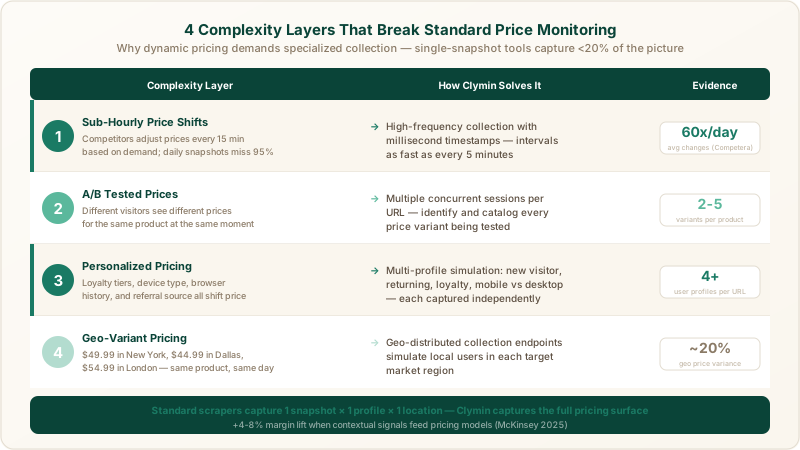
Four layers of complexity that make dynamic pricing data collection fundamentally different from static price monitoring.
What Data Points Should a Dynamic Pricing Intelligence Service Capture?
Effective dynamic pricing intelligence extends well beyond recording a price and a product name. Pricing managers building competitive models need multi-dimensional data that reveals the mechanics of a competitor's pricing algorithm. Clymin's collection framework captures the following data points for each observation:
- Price with millisecond-precision timestamp, enabling time-series analysis of pricing curves throughout the day, week, and month
- Geographic location of the simulated request, confirming which region-specific price was served
- User profile context, new visitor, returning visitor, loyalty tier, or device type associated with the captured price
- Promotional overlays, coupon codes, flash sale banners, bundle discounts, and limited-time offers applied at the point of capture
- Bundle and tiered pricing structures, multi-quantity discounts, subscription-versus-one-time pricing, and cross-sell bundle rates
- Shipping and fulfillment cost modifiers, free shipping thresholds, expedited delivery surcharges, and region-specific fulfillment fees that affect the effective price position
- Stock availability signals, low-stock alerts, backorder status, and estimated restock dates that often correlate with price increases
According to McKinsey's 2025 Pricing and Promotions Benchmark, companies that incorporate contextual signals, such as stock levels and promotional overlays, into their pricing models outperform competitors by 4% to 8% on gross margin. Raw price data alone leaves these optimization opportunities invisible.
Clymin delivers all captured data points in structured formats including JSON feeds, CSV exports, and direct database integrations. Each record includes full metadata for traceability, enabling pricing teams to audit any data point back to its source URL and collection timestamp. For a detailed look at how Clymin's AI agents handle the extraction infrastructure, see how AI-agentic scraping works.
How Does Dynamic Pricing Intelligence Feed Into Pricing Strategy Optimization?
Collecting dynamic pricing data is a means to an end, the end being pricing decisions that consistently beat the market. Pricing managers who move from reactive monitoring to pattern-based intelligence gain three measurable strategic advantages.
Predicting competitor price moves before they happen. When a competitor's pricing algorithm follows identifiable patterns, raising prices on Fridays, discounting during mid-week low-traffic hours, or surging prices when inventory drops below a threshold, those patterns become exploitable. Clymin's time-series data enables pricing teams to build predictive models that anticipate competitor adjustments, allowing preemptive repositioning.
Identifying optimal price positioning windows. Dynamic pricing data reveals when competitors are most and least aggressive. A competitor might hold premium pricing on electronics during weekday mornings but drop prices during weekend afternoons. Pricing managers with sub-hourly data can time their own price adjustments to capture demand during competitor vulnerability windows.
Quantifying the true competitive price landscape. When competitors run A/B tests and personalized pricing, the "real" competitive price is not a single number, a distribution exists. Clymin's multi-variant collection maps this distribution, giving pricing managers a realistic picture of the price range they are competing against rather than a misleading single-point estimate.
Sarah T., a Marketing Manager at a Clymin ecommerce client, experienced these advantages firsthand: "Clymin's data insights helped us boost revenue by 20% through real-time market trend and competitor pricing analysis." Her team leveraged time-series pricing feeds to identify recurring competitor discount cycles and timed promotional campaigns to coincide with competitor price increases, a strategy that would have been impossible without granular dynamic pricing data.
For pricing managers weighing managed data collection against self-service tools, a detailed analysis of monitoring tools versus managed services breaks down the operational and accuracy tradeoffs.
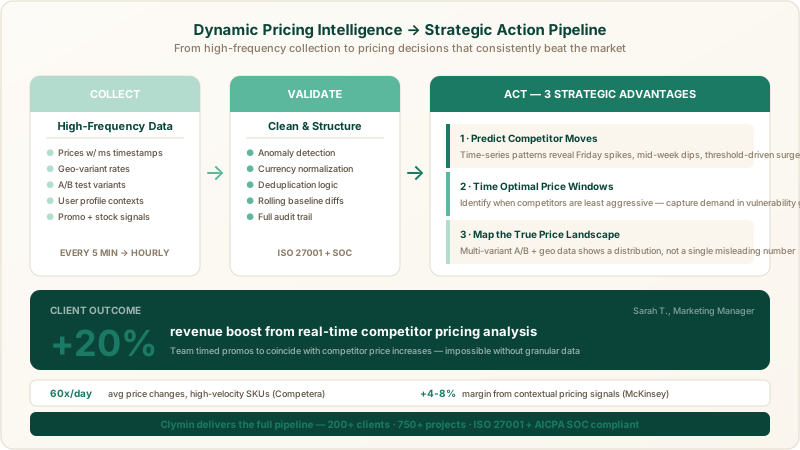
From raw collection to strategic action: how dynamic pricing intelligence drives measurable pricing advantages.
How Does Clymin Ensure Accuracy and Compliance When Collecting Dynamic Pricing Data?
Dynamic pricing data collection at scale introduces unique quality assurance challenges. Price fluctuations that occur every few minutes mean that even small collection delays or parsing errors compound into significant data drift. Clymin applies a dedicated validation layer designed specifically for high-frequency pricing environments.
Every collected price observation passes through anomaly detection that compares incoming values against rolling baselines. Sudden deviations, a $500 product appearing at $5.00, for example, get flagged and quarantined before reaching client dashboards. Currency normalization handles multi-market collection automatically, converting all observations to the client's base currency using real-time exchange rates.
Deduplication logic ensures that identical prices captured within overlapping collection windows do not inflate pattern analysis. Clymin's pipeline distinguishes between genuinely stable prices (a competitor holding a price for six hours) and collection redundancy, a distinction critical for accurate time-series modeling.
Compliance infrastructure supports enterprise-grade data governance. Clymin operates under ISO 27001 certification and AICPA SOC compliance, with full GDPR readiness across all collection operations. Rate limiting, robots.txt adherence, and ethical scraping protocols protect both clients and target sites. For SKU-level tracking and monitoring requirements, Clymin provides audit trails that map every data point to its source and collection parameters.
Ready to Decode Your Competitors' Pricing Algorithms?
Stop guessing what drives competitor price changes. Clymin's dynamic pricing data collection service gives your pricing team the high-frequency, multi-dimensional data needed to reverse-engineer competitor pricing logic, backed by 40+ customers, hundreds of completed projects, and over a decade of data extraction expertise.
Reach out at contact@clymin.com or schedule a free consultation to discuss your dynamic pricing intelligence requirements.