
Why Is Product Catalog Data So Difficult to Collect Across Marketplaces?
D2C marketing managers face a fragmentation problem that grows worse every quarter. Product data lives across dozens of platforms, each with unique page structures, naming conventions, and update cadences. Amazon organizes specifications in structured attribute tables. Shopify storefronts embed product details inside theme-specific templates. Walmart uses a different taxonomy altogether. Reconciling these formats manually turns competitive research into a full-time data entry job.
The scale of the challenge is accelerating. According to eMarketer's 2025 Global Ecommerce Forecast, worldwide ecommerce sales reached $6.8 trillion in 2024, with marketplace-driven sales accounting for 67% of that total. More marketplaces means more product listings to track, and more formats to normalize.
Inconsistency is the real cost. When a marketing manager exports product data from three different platforms into three different spreadsheets, the fields never align. Titles use different keyword structures, image URLs expire, and specification labels vary by category. Without automated extraction and normalization, this raw data cannot support catalog enrichment, competitive benchmarking, or content gap analysis at the speed D2C brands require in 2026.
What Product Data Fields Can AI-Powered Extraction Capture?
Product data extraction goes far beyond scraping a product title and price. Clymin's managed service captures every structured and unstructured field on a marketplace listing, delivering a complete product record that maps directly to your PIM system or analytics stack.
Core product information extracted includes:
- Titles, descriptions, and bullet points, full listing copy including A+ Content and Enhanced Brand Content on Amazon
- Product images and media, primary images, gallery images, variant-specific photos, and video URLs with direct download links
- Technical specifications, dimensions, weight, materials, compatibility, and category-specific attribute tables
- Customer reviews and ratings, aggregate star ratings, review counts, individual review text, verified purchase flags, and review date stamps
- Inventory and fulfillment signals, stock status, estimated delivery windows, fulfillment method (FBA, FBM, seller-fulfilled), and regional availability
- Category and taxonomy data, breadcrumb paths, category IDs, and marketplace-specific classification codes
This coverage extends across Amazon (all 20+ regional domains), Shopify-powered storefronts, Walmart Marketplace, eBay, Target, Best Buy, Etsy, and hundreds of specialty vertical marketplaces. According to Jungle Scout's 2025 State of the Amazon Seller report, Amazon alone hosts over 600 million product listings, making manual catalog tracking impossible for any brand monitoring more than a handful of competitors.
For brands already using ecommerce price scraping for competitive pricing, product data extraction adds the catalog layer, capturing the descriptive, visual, and review data that pricing feeds alone cannot provide.
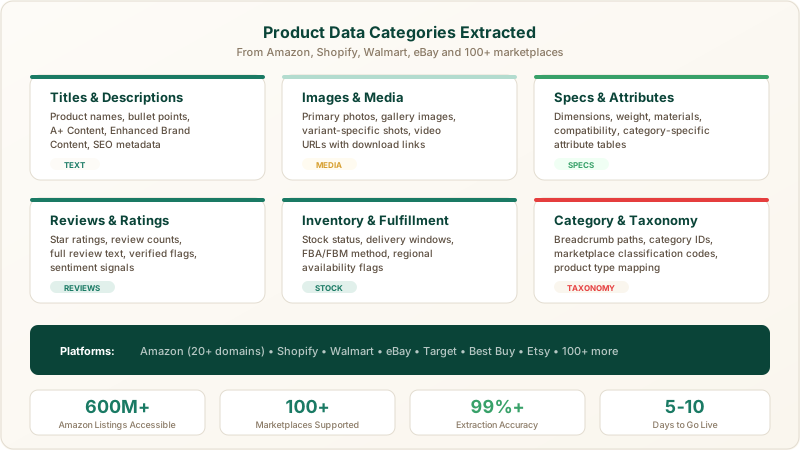
Core product data categories extracted from Amazon, Shopify, and global marketplace listings.
How Does Product Data Enrichment Turn Raw Catalog Feeds Into Competitive Intelligence?
Extracting raw product data is only the first step. The real value comes from transforming fragmented marketplace feeds into a unified, enriched dataset that supports direct competitor comparison. Clymin's managed service includes data cleansing, normalization, and enrichment as standard deliverables, not add-on services.
The enrichment pipeline standardizes product categories across platforms, normalizes attribute labels to a common schema, deduplicates listings that appear on multiple marketplaces, and maps competitor products to your own catalog using title matching and attribute alignment. A Shopify storefront listing and its Amazon counterpart get merged into a single enriched record with all fields populated.
Structured outputs arrive in the format your team already works with. JSON feeds integrate with product information management systems and internal databases. CSV exports serve spreadsheet-based analysis. For teams that need live access, Clymin builds custom API endpoints that serve the latest extracted data on demand. Unlike DIY scraping tools that leave you with raw HTML to parse, a managed service delivers analysis-ready output from day one. For a detailed comparison, see why managed scraping outperforms DIY tools for ecommerce.
Sarah T., a Marketing Manager at a D2C brand working with Clymin, reported measurable results from this approach: "Clymin's data insights helped us boost revenue by 20% through real-time market trend and competitor pricing analysis." Structured product feeds enabled her team to identify content gaps, optimize product listings, and adjust positioning against competitors, decisions that manual data collection could never support at the same speed.
How Do AI Agents Handle Marketplace Anti-Blocking and Scale?
Extracting product data from Amazon and Walmart at scale is an infrastructure challenge that breaks most DIY scraping setups within weeks. Major marketplaces deploy sophisticated anti-bot systems, rate limiting, CAPTCHA walls, IP fingerprinting, and dynamic page rendering, that static scrapers cannot navigate reliably.
Clymin's extraction infrastructure uses AI-agentic scraping technology that deploys intelligent agents capable of adapting to anti-bot countermeasures in real time. When Amazon changes its product page DOM structure or Shopify rolls out a new theme framework, Clymin's agents detect the change and adjust extraction logic automatically, with zero downtime for clients.
According to Grand View Research's 2025 Web Scraping Services market analysis, the global web scraping services market is projected to grow at a 13.1% CAGR through 2030, driven primarily by ecommerce demand for structured product intelligence. AI-adaptive approaches deliver significantly higher extraction success rates compared to rule-based scrapers, which require manual reconfiguration every time a target site updates its layout.
Reliability at scale also means handling marketplace-specific edge cases. Amazon renders different content based on geography, device type, and browsing history. Shopify storefronts use thousands of distinct themes with incompatible DOM structures. Walmart dynamically loads product specs via JavaScript after initial page render. Clymin manages all of this complexity, maintaining extraction accuracy above 99% across platform updates. For teams evaluating whether to build extraction pipelines in-house or use an API, this comparison of web scraping vs. API approaches for product data breaks down the tradeoffs.
Compliance underpins every extraction project. Clymin holds ISO 27001 certification, AICPA SOC compliance, and operates with full GDPR readiness. Every project undergoes a compliance review before launch, and data handling follows strict security protocols from extraction through delivery.
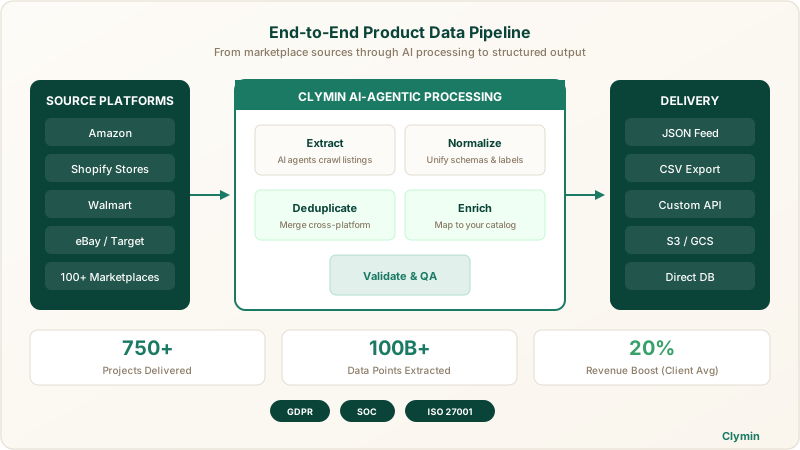
End-to-end product data extraction pipeline: from marketplace sources through AI-agentic processing to structured, analysis-ready outputs.
Ready to Extract Product Catalog Data at Scale?
Stop losing competitive visibility to manual data collection. Clymin's managed product data extraction service delivers clean, structured marketplace catalog data on your schedule, backed by 40+ active customers and over a decade of ecommerce data expertise.
Reach out at contact@clymin.com or schedule a free consultation to discuss your product data requirements.