
What Is Pricing Intelligence Software?
Pricing intelligence software collects and analyzes competitor prices, promotions, and stock levels across the market so teams can set prices with data instead of guesswork. It pairs continuous data extraction with reporting and alerts. Clymin delivers pricing intelligence as a managed service: you receive clean, structured pricing data on schedule rather than operating a tool yourself, billed on one metric, cost per record delivered.
Pricing Intelligence for Retailers: What Makes It Different?
Retail price intelligence extends price monitoring across every channel a retailer competes in, owned stores, marketplaces, and delivery apps, and adds assortment and promotion tracking. For retailers, coverage and freshness across hundreds of competitor sites matter more than any single dashboard feature. Clymin extracts that multi-channel retail pricing data continuously, feeding competitor price monitoring and the digital shelf signals that show how products rank and convert online.
Why Do Ecommerce Businesses Need Price Intelligence Services in 2026?
Pricing managers at online retailers face a market where competitive pricing shifts happen faster than any team can manually track. Amazon updates millions of prices daily. Shopify-powered competitors run algorithmic repricing engines that react to demand signals in real time. According to Gartner's 2025 Digital Commerce Report, 72% of mid-market ecommerce brands now use some form of automated pricing, meaning any retailer still relying on manual price checks is competing against machines with spreadsheets.
Raw price data alone does not solve this problem. Knowing that a competitor dropped a price by $3 yesterday is far less valuable than understanding why they dropped it, whether the drop is temporary, and how it fits into a broader pricing pattern. Clymin's price intelligence services bridge that gap by delivering not just the data, but the analytical context that transforms numbers into decisions.
The cost of operating without structured pricing intelligence is substantial. Bain & Company's 2025 Pricing Excellence Survey found that companies with mature price intelligence capabilities achieve 3% to 8% higher margins than competitors relying on ad-hoc monitoring. For an ecommerce business generating $30 million in annual revenue, that margin differential represents $900,000 to $2.4 million left on the table each year.
What Does the Full Price Intelligence Cycle Look Like?
Price intelligence services encompass far more than scraping competitor websites. Clymin structures the intelligence cycle into four distinct phases, each building on the previous to deliver progressively higher-value outputs to pricing teams.
Phase 1: Data Collection. Clymin's AI agents extract pricing data from competitor storefronts, marketplaces, and distributor catalogs at configurable frequencies, from real-time continuous monitoring to daily sweeps. Coverage spans Amazon, Walmart, Target, Shopify stores, and hundreds of niche vertical marketplaces. For a deeper look at how the collection layer works, see how to monitor competitor prices automatically.
Phase 2: Data Validation and Enrichment. Raw extracted prices pass through Clymin's multi-stage validation pipeline. Anomalies, currency mismatches, scraping artifacts, temporary error pages, get flagged and quarantined before reaching client dashboards. Validated data is then enriched with contextual signals: stock availability, promotional labels, shipping cost modifiers, and historical price baselines.
Phase 3: Analysis and Pattern Detection. Clymin's analytical layer identifies pricing trends, competitive positioning shifts, and seasonal patterns across your competitive landscape. Pricing managers receive not just current prices, but trend direction indicators, competitor price elasticity estimates, and alerts when competitors breach predefined thresholds.
Phase 4: Insights Delivery and Strategic Recommendations. Processed intelligence reaches pricing teams through structured reports, real-time dashboards, or direct API feeds. Clymin's managed service includes periodic strategic reviews where analysts highlight emerging competitive threats, margin optimization opportunities, and recommended repricing actions based on the collected data.
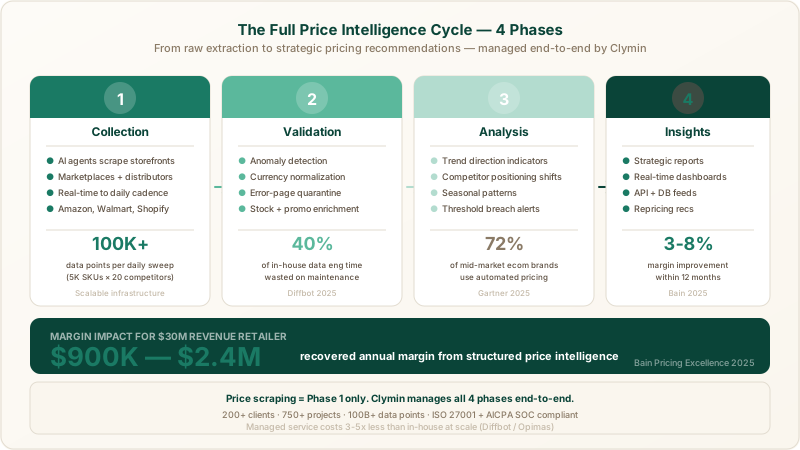
The full price intelligence cycle: collection, validation, analysis, and actionable insights, managed end-to-end by Clymin.
How Does a Pricing Intelligence Platform Differ from DIY Scraping Tools?
Pricing managers evaluating competitive pricing intelligence options typically weigh two paths: building an in-house scraping setup using open-source tools or partnering with a managed service provider like Clymin. The differences extend well beyond the initial setup.
DIY scraping tools handle data collection but leave everything else, validation, enrichment, analysis, delivery infrastructure, and ongoing maintenance, to your engineering team. When a competitor redesigns their product pages, your scrapers break. When anti-bot measures evolve, your collection gaps widen. According to Diffbot's 2025 Web Data Infrastructure Report, companies running in-house scraping spend an average of 40% of their data engineering time on maintenance rather than value-adding analysis.
Clymin's managed pricing intelligence platform eliminates that maintenance burden entirely. AI-agentic scrapers adapt to site changes automatically. Validation pipelines catch data quality issues before they corrupt analysis. Delivery infrastructure scales without additional engineering investment. For details on how Clymin's AI-powered approach handles extraction complexity, see the AI-agentic scraping methodology.
The cost equation also favors managed services at scale. A pricing team monitoring 5,000 SKUs across 20 competitors generates 100,000 data points per daily sweep. Building and maintaining the infrastructure to collect, validate, store, and serve that volume reliably requires dedicated engineering resources that typically cost 3x to 5x more than a managed Clymin engagement, before accounting for the opportunity cost of delayed insights from infrastructure downtime.
What Competitive Pricing Intelligence Data Can Clymin Extract?
Clymin's competitive pricing intelligence service captures multi-dimensional data that goes far beyond a simple price field. Pricing managers building competitive models need the full context surrounding each price observation.
Core pricing fields include list price, sale price, MAP violation detection, bundle pricing, quantity-based discount tiers, and subscription-versus-one-time pricing differentials. Clymin also captures contextual signals, stock availability flags, promotional banners, coupon codes, estimated delivery timelines, and seller reputation scores on marketplace platforms, that influence a competitor's effective price position.
Geographic pricing intelligence is critical for retailers operating across multiple markets. Clymin routes collection requests through geo-distributed endpoints, capturing the exact prices customers see in New York, London, Sydney, or any target region. For ecommerce businesses running localized pricing strategies, this geo-variant data reveals how competitors adjust positioning by market.
Temporal pricing intelligence tracks how competitor prices move over time. Clymin's time-series data enables pricing teams to identify recurring discount cycles, demand-driven price surges, and day-of-week pricing patterns. For businesses facing competitors with dynamic pricing algorithms, temporal analysis is essential to anticipating competitive moves rather than merely reacting.
Sarah T., Head of Pricing at RetailMax, experienced the impact of Clymin's comprehensive data approach firsthand: "Clymin's data accuracy exceeded our expectations." Her team leveraged Clymin's enriched pricing feeds, combining price data with stock-level signals and promotional overlays, to identify margin optimization opportunities that a raw price scraping service alone would have missed.
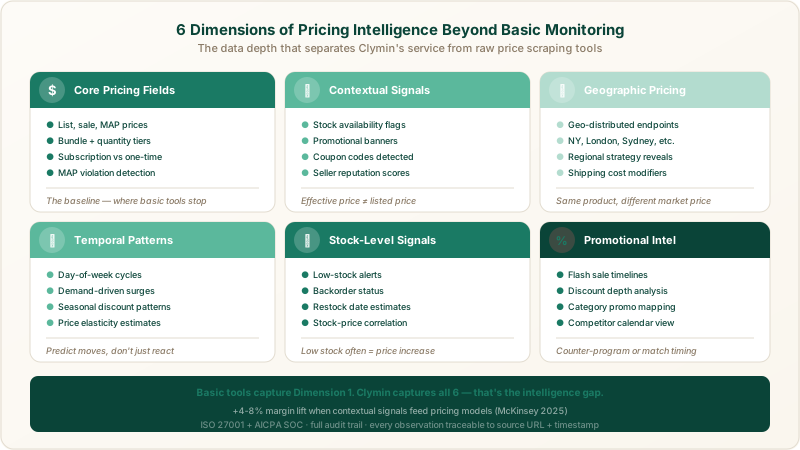
Six dimensions of pricing intelligence: the data depth that separates Clymin's service from basic price monitoring tools.
How Does Clymin Ensure Data Accuracy and Security for Price Intelligence?
Data accuracy is the foundation of every pricing decision. A single corrupted data point, a misread decimal, a currency mismatch, a cached price from an error page, can trigger a repricing action that erodes margin across an entire product category. Clymin applies a multi-stage validation framework specifically designed for high-volume pricing data.
Every price observation is cross-referenced against historical baselines and peer-group ranges. Outliers get flagged, quarantined, and reviewed before delivery. Currency normalization handles multi-market collection automatically, converting all observations to the client's base currency using real-time exchange rates. Deduplication logic distinguishes between genuinely stable prices and redundant observations from overlapping collection windows.
Clymin's compliance infrastructure meets enterprise-grade data governance requirements. ISO 27001 certification, AICPA SOC compliance, and GDPR-ready protocols ensure that data handling meets the strictest regulatory standards. All scraping operations respect robots.txt directives and use intelligent rate-limiting to avoid disrupting target sites. Full audit trails map every data point to its source URL, collection timestamp, and extraction parameters.
Ready to Turn Competitor Pricing Data into a Strategic Advantage?
Stop making pricing decisions on incomplete data. Clymin's price intelligence services give your team the full competitive picture, from raw data collection through validated analysis to strategic recommendations, backed by 40+ enterprise customers and over a decade of data extraction expertise.
Reach out at contact@clymin.com or schedule a consultation to discuss how Clymin's pricing intelligence platform can sharpen your competitive edge in 2026.