Web Scraping vs. Data Extraction: What's the Difference?
Why the Terms Get Confused
Three forces have collapsed the distinction in most market conversations. Recognizing them is the first step to scoping a project correctly.
Vendor marketing. Both phrases describe a service that buyers are willing to pay for. Vendors use whichever term ranks better for the buyer's search query. The same company often pitches "web scraping services" to a technical buyer and "data extraction services" to an operations buyer. The underlying work is identical; the vocabulary shifts to match the audience.
The dominance of the public web as a source. For most modern buyers, the source that matters is the public web. So when buyers say "data extraction" they almost always mean web scraping in practice. PDFs, scanned documents, internal databases, and mobile apps exist as source types, but they are addressed by specialist tools that rarely overlap with the scraping vendor category. The market has fused the terms because, for the typical buyer, the difference is academic.
Search behavior. Buyers who search for "web scraping service" and buyers who search for "data extraction service" land on the same vendor pages. Both queries carry commercial intent. Vendors optimizing for one cover the other in the same content. Over time, this further blurs the line and trains buyers to use the terms interchangeably.
The distinction snaps back into focus when a project's scope crosses source types. Pulling competitor prices from websites, product specifications from PDF catalogs, and dealer inventory from a partner API is a data extraction project that uses web scraping as one of three techniques. Calling that engagement "web scraping" understates the scope and usually mis-prices the contract.
The Short Definitions
A useful working distinction holds two ideas at once.
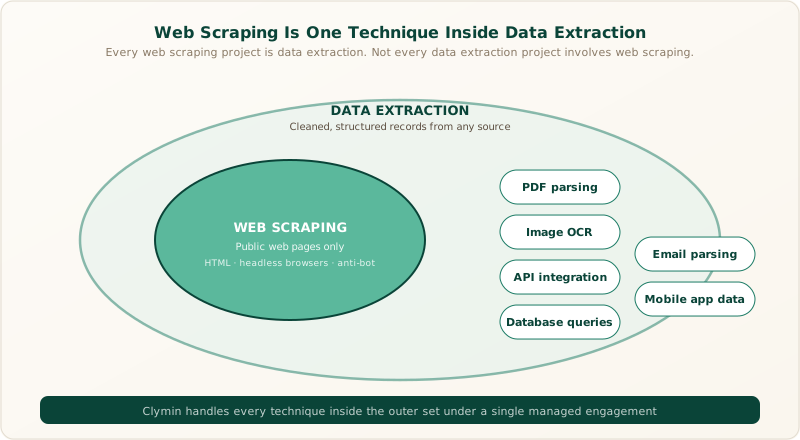
Web scraping is a method. Specifically, it is the automated retrieval of content from a website by sending HTTP requests, parsing the returned HTML or JavaScript-rendered DOM, and extracting fields from it. The output is raw or lightly processed data. The scope is bounded by public web pages.
Data extraction is an outcome. It is the broader practice of pulling structured information out of any source: websites, PDFs, images, APIs, databases, mobile apps, emails, and scanned documents. The output is clean, validated records that a downstream system can use without further engineering work. Web scraping is one of several techniques inside a data extraction workflow, alongside OCR, API integration, document parsing, and database queries.
A practical heuristic: web scraping describes how data comes out of the source. Data extraction describes what the buyer ends up with at the destination.
The Scope of Web Scraping
Web scraping is bounded by the public web. The technique works by sending HTTP requests, parsing the returned HTML or JavaScript-rendered DOM, and extracting fields from it.
In Scope
A web scraping engagement typically covers:
- Pulling structured fields from HTML pages: product listings, price tags, hotel rates, job postings, real estate listings
- Handling JavaScript-rendered content using headless browsers (Playwright, Puppeteer)
- Working around rate limits, CAPTCHA challenges, and anti-bot defenses
- Parsing dynamic content loaded by scroll, click, or background API call
- Extracting from public-facing search results, category pages, and pagination
Out of Scope
Web scraping does not natively cover:
- PDF parsing or document OCR (a different toolchain, usually a dedicated IDP platform)
- Internal database queries (requires database access, not scraping)
- Authenticated APIs where the buyer holds the credentials (this is API integration)
- Mobile app data unless the app exposes a scrapable web endpoint or the vendor reverse-engineers the app's API
- Data behind enterprise SSO, VPN, or paywalls without authorized access
Many managed vendors deliver projects that combine web scraping with these other techniques. Strictly speaking, only the first list is web scraping. The rest is data extraction by other means.
The Scope of Data Extraction
Data extraction is bounded by what can be turned into structured records. The source is irrelevant; the output defines the category.
In Scope
A data extraction engagement typically covers:
- Everything web scraping covers
- PDF and image parsing, including OCR for scanned documents and structured parsing for native PDFs
- API integration where the buyer has credentials or the API is public
- Database extraction from accessible internal or partner systems
- Email and form-based extraction (parsing inbound emails into records)
- Mobile app scraping where the app's data layer is accessible
- Document classification and field-level extraction from unstructured text
Out of Scope
Data extraction does not cover:
- Pure data transformation or ETL when the source is already structured (that is data engineering, not extraction)
- Manual data entry (outsourced typing services occupy a different category)
- Real-time event streaming from systems the buyer already owns (that is an internal data pipeline problem)
The honest test for whether a project is "data extraction" rather than "web scraping" is straightforward. Does the scope include more than one source type, or does it require turning unstructured content like PDFs, images, or free-text emails into structured records? If yes, it is a data extraction engagement, even when 90% of the work is scraping the public web.
Side-by-Side Comparison
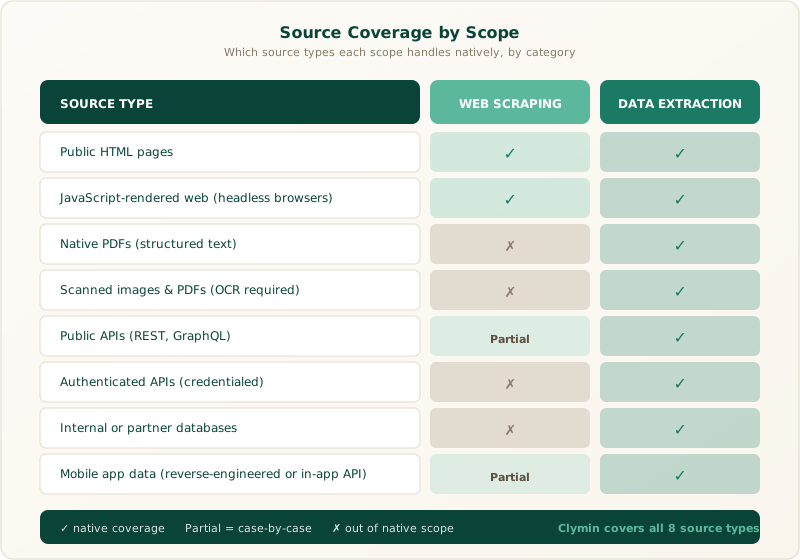
The table below lays out the operational differences between the two scopes. For a worked head-to-head on a related axis (scraping versus official APIs for the same data), see web scraping vs. API for product data.
| Dimension | Web Scraping | Data Extraction |
|---|---|---|
| Scope | Public web pages only | Any source: web, PDF, API, database, email, image |
| Technique | HTTP requests, HTML parsing, headless browsers | Scraping, OCR, API calls, database queries, document parsing |
| Output | Raw or lightly processed records from web sources | Cleaned, validated, structured records from any source |
| Typical pricing unit | Per request, per page, or per record | Per record, per source, or per project |
| Common buyer | Engineers, product teams, growth teams | Operations, analytics, procurement, compliance teams |
| Sold as | Tool, API, or managed service | Managed service or project-based engagement |
| Vendor category | Scraping APIs, proxy networks, managed scraping services | Managed data extraction services, DaaS providers |
The most important row is the last one. Pure-play web scraping vendors typically sell tools that engineering teams operate. Data extraction vendors typically sell outcomes that non-engineering teams consume. Clymin sits in the second category: a managed data extraction service that uses web scraping as its primary technique but delivers the cleaned record, not the raw HTML. For the full service model, see what is managed web scraping?. For a cost breakdown of managed vs. in-house, see managed web scraping vs. building in-house.
Which Term Should You Actually Ask For?
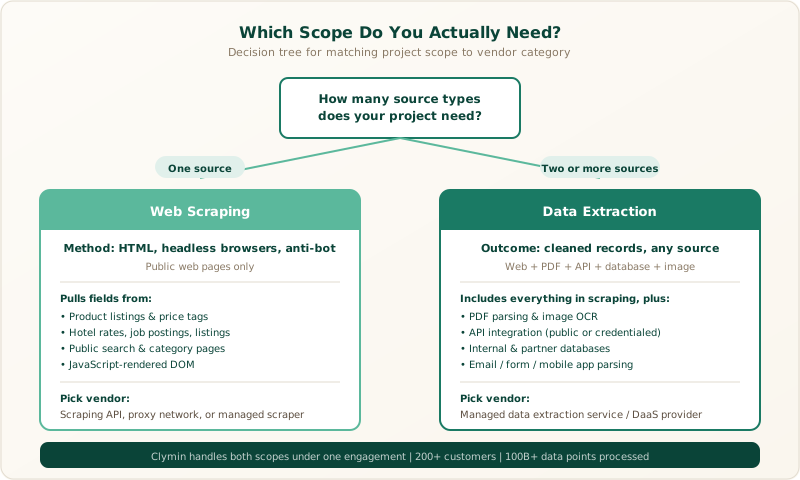
The right question is not "what do I call this" but "what does my project actually need." Three filters resolve it quickly.
Filter 1: How Many Source Types Are Involved?
One source type, all on the public web: web scraping is the accurate term, and the engagement should be scoped, priced, and contracted with that vocabulary. Multiple source types, or any mix of web and non-web sources: data extraction is the accurate term, and the scoping conversation should cover OCR, document parsing, and API integration alongside the scraping work.
Filter 2: What Does the Buyer Want to Receive?
Raw or near-raw output that the buyer's engineering team will further process maps to web scraping or a scraping API. Cleaned, validated records ready to query or load into a downstream system maps to data extraction or a managed service. The output expectation, more than the source list, is what drives the right vendor category.
Filter 3: Who in the Organization Owns the Project?
An engineering or technical lead with a clear technical specification maps to web scraping vocabulary, and the vendor will engage in technical tone. An operations, analytics, procurement, or product owner who wants data, not infrastructure, maps to data extraction vocabulary, and the vendor will engage in outcome-focused tone. A mismatch between owner type and vendor tone is one of the more common reasons that scoping conversations stall.
In Clymin's experience across 750+ delivered projects, buyers who arrive using "web scraping" tend to over-scope the technical aspect and under-scope validation and delivery. Buyers who arrive using "data extraction" tend to under-scope source difficulty and assume any source is achievable. Both groups benefit from a free pilot that produces actual data on the actual sources before contract signature, because the pilot output makes the difference between the two scopes immediately visible.
When the Distinction Matters in Real Engagements
Three situations move the conversation from academic to commercial. Buyers and vendors that recognize them up front avoid the most expensive scoping mistakes.
The scope crosses source types mid-project. A buyer commissions a "web scraping" project for competitor pricing, and then realizes mid-build that product specifications also need to be pulled from supplier PDFs. The vendor that only scrapes will either decline the PDF work or bring in a subcontractor at a higher rate. A vendor that handles full data extraction absorbs the new source type into the same engagement.
The buyer needs cleaned records, not raw data. A vendor sells "web scraping" at a per-request rate, and the buyer assumes the output is ready to load. What arrives is unstructured HTML with prices encoded inconsistently across pages. The buyer then either spends engineering cycles cleaning the output or pays the vendor a separate fee to do it. Both cases are avoidable if the engagement is scoped as data extraction with explicit cleaning requirements.
Legal exposure varies by source type. Public web scraping is broadly legal in the United States following the hiQ Labs v. LinkedIn ruling, with established caveats around copyright, personal data, and terms-of-service violations. Extraction from authenticated databases, private APIs, or copyrighted documents carries different legal exposure. According to Gartner's 2025 Market Guide for Data Integration Tools, enterprises increasingly require contractual clarity on the legal status of every source in a multi-source pipeline. A vendor selling "data extraction" should be able to address all of these in the same contract.
What Is Data Extraction as a Service (DaaS)?
Data extraction as a service (DaaS) is a managed model where a vendor builds, runs, and maintains extraction pipelines and delivers cleaned, structured data on schedule, so the buyer never operates the pipeline. DaaS is the commercial wrapper around data extraction work; web scraping is one of the techniques used inside it. Clymin provides DaaS billed on one metric, cost per record delivered, across managed web scraping and mixed-source projects.
Choosing the Right Vendor Category
The clearest rule for selecting a vendor is to match the vendor type to the scope type. Pure-play scraping vendors are right for engineering teams building scraping into their own product. Managed data extraction services are right for product, ops, and analytics teams that need a clean record delivered to a destination. Self-serve scraping platforms like Apify versus a managed extraction service is a separate axis of the same decision, focused on operational ownership rather than source scope.
For ecommerce pricing intelligence, where the sources are public websites and the buyer wants validated records on schedule, the distinction is less material. For mixed-source enterprise programs that combine web sources with product specification PDFs and supplier APIs, the distinction is where the contract gets won or lost.
For a worked pricing breakdown that illustrates both scopes side by side, see the ecommerce data scraping cost guide.
Bringing a Mixed-Source Project Into Production
For most buyers, the cleanest way to validate whether a project is "web scraping" or "data extraction" is to run a pilot on the actual sources. Clymin's free pilot delivers production-grade data from up to three target sources within 72 hours, regardless of whether those sources are public websites, PDFs, APIs, or a mix. No sales call required to start. The pilot output makes the web-scraping-versus-data-extraction question concrete: the buyer sees exactly what comes out, how clean it is, and how fast it arrives.
If the pilot fits, the pipeline moves into production at $0.001 per record with a $600 monthly minimum, with complexity multipliers for sources that require more infrastructure. If it does not fit, there is no obligation.
Ready to scope your own project against the right scope? Schedule a scoping conversation with Clymin's data engineering team, or email contact@clymin.com to start a free pilot directly.