
Quick Comparison
| Criteria | Web Scraping | API Access |
|---|---|---|
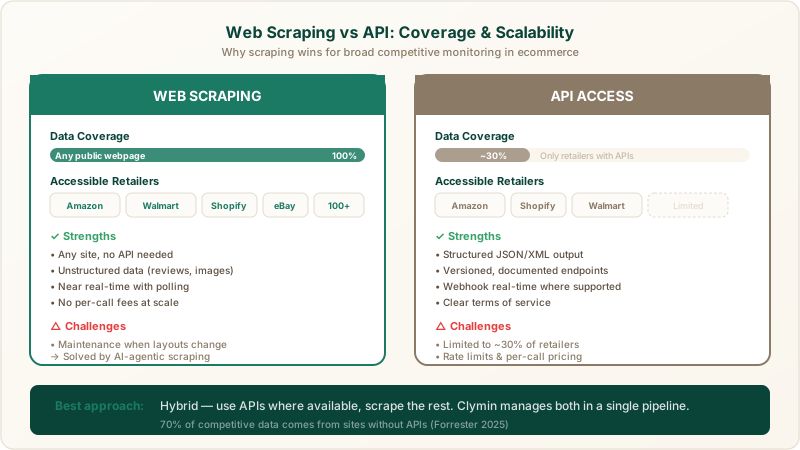
| Data coverage | Any public webpage | Only retailers with APIs |
| Data format | Unstructured (HTML) → structured | Structured (JSON/XML) |
| Setup complexity | High (parsers, proxies, infra) | Low-medium (auth, rate limits) |
| Maintenance | Ongoing (site layout changes) | Low (versioned endpoints) |
| Cost at scale | Infrastructure-dependent | Per-call pricing adds up |
| Rate limits | Proxy-managed | Enforced by provider |
| Real-time capability | Near real-time with polling | Webhooks where supported |
| Legal clarity | Varies by jurisdiction | Clear terms of service |
| Best for | Broad competitive monitoring | Deep single-retailer integration |
How Web Scraping Handles Product Data
Web scraping works by programmatically loading web pages and extracting structured data from the HTML. For product data, this means pulling prices, descriptions, availability, images, and reviews directly from retailer websites.
The primary advantage is coverage. According to Forrester's 2025 digital commerce research, the average enterprise tracks competitor pricing across 15+ retail sites. Most of those sites lack public APIs, making scraping the only viable extraction method.
The challenge is maintenance. Retailers redesign pages, change HTML structures, and deploy anti-bot measures. A 2025 Gartner survey on data engineering practices found that teams running DIY scrapers spend roughly 40% of their pipeline maintenance time on parser fixes alone.
Modern AI-agentic scraping addresses this by using machine learning models that recognize product data patterns regardless of layout changes. Instead of brittle CSS selectors, AI agents identify price fields, product titles, and availability indicators semantically.
How APIs Handle Product Data
Product APIs provide structured endpoints that return clean JSON or XML. When available, they offer predictable schemas, versioned responses, and documented rate limits.
The limitation is availability. Large marketplaces like Amazon, Walmart, and Shopify stores offer product APIs, but the vast majority of ecommerce sites do not. Even where APIs exist, they often restrict data fields, impose tight rate limits, or charge significant per-call fees.
API-based approaches work well for deep integration with a single retailer. If your pipeline needs real-time inventory updates from one Shopify store, the Shopify Admin API is the right tool. But if you need to monitor competitor prices automatically across dozens of retailers, APIs alone will not get you there.
Rate limits present another constraint. A Statista 2025 report on ecommerce data infrastructure noted that API rate limits force many teams to stagger requests across hours, delaying time-sensitive pricing intelligence.
Web Scraping vs API for Data Collection (Beyond Product Data)
For data collection in general, the trade-off mirrors product data: web scraping reaches any public page, while an API only returns what a provider chooses to expose. APIs are cleaner and more stable where they exist; scraping covers the long tail where they do not. Most data teams combine the two. For the underlying concepts, see what a web scraping API is and how to pick the best web scraping API.
When to Choose Each
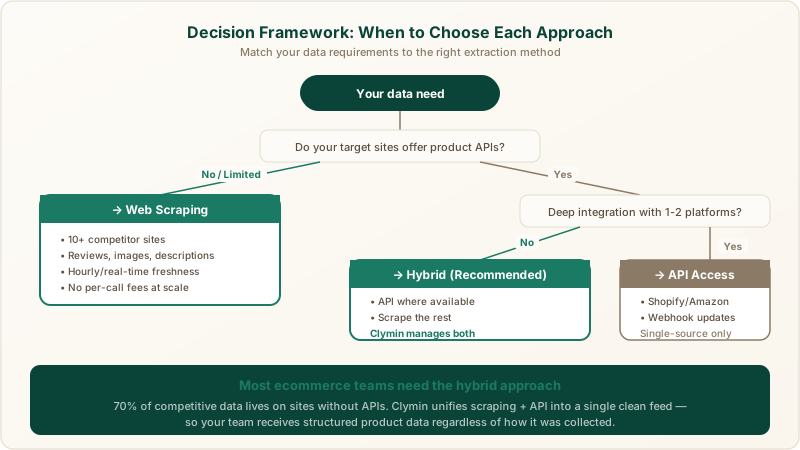
Choose web scraping when:
- You need product data from retailers without APIs
- Your competitive monitoring spans 10+ websites
- Price and availability freshness matters (hourly or faster)
- You want to capture unstructured data like reviews and product descriptions
Choose API access when:
- You integrate deeply with one or two platforms (Shopify, Amazon SP-API)
- The retailer provides a well-documented, stable API
- You need webhook-based real-time updates
- Compliance requirements mandate documented data access agreements
Choose a hybrid approach when:
- Your data sources include both API-enabled and non-API retailers
- You need a unified data feed regardless of source
- Your team wants to minimize infrastructure management
- Scale demands exceed what a single method can handle efficiently
For most ecommerce price scraping use cases, the hybrid approach delivers the best balance of coverage and reliability.
How Clymin Fits In
Most data engineering teams do not want to choose between scraping and APIs. They want clean, reliable product data delivered on schedule, regardless of source.
That is exactly what Clymin's managed scraping service provides. With over a decade of experience and over 100 billion data points extracted across hundreds of projects, Clymin handles the full pipeline: source identification, extraction (scraping or API), parsing, quality assurance, and delivery.
Clymin's AI-agentic scraping technology uses intelligent agents that learn each target site's structure and adapt when layouts change. This eliminates the parser maintenance burden that consumes engineering time in DIY setups. The agents handle proxy rotation, anti-bot navigation, and data validation automatically.
For data engineers evaluating scraping vs API approaches, the managed service model removes the build-or-buy decision entirely. Your team receives structured, validated product data through a clean API or direct database delivery. Clymin handles the extraction complexity behind the scenes.
The service is backed by ISO 27001 and SOC certifications, GDPR-ready processes, and a track record reflected in 5.0 ratings on both Clutch and G2.
Ready to stop maintaining scrapers and start using product data? Contact the Clymin team at contact@clymin.com or schedule a consultation to discuss your data extraction requirements.