
What Factors Determine Ecommerce Data Scraping Cost?
Five core variables drive the price of any ecommerce scraping engagement. Understanding each one helps Heads of E-Commerce budget accurately and avoid overpaying for services that do not match their actual requirements.
Data volume is the most straightforward factor. Scraping 1,000 product pages weekly costs significantly less than extracting 500,000 listings daily across multiple marketplaces. According to a 2025 Oxylabs industry pricing survey, per-record costs decrease at higher volumes, but total spend increases proportionally.
Collection frequency determines how often scrapers run against target sites. Hourly price monitoring for competitive electronics pricing demands more infrastructure than weekly catalog snapshots for seasonal home goods. Higher frequency means more compute resources, more proxy rotations, and higher cost.
Site complexity and anti-bot protections affect engineering effort substantially. A basic Shopify storefront with standard HTML is far simpler to scrape than Amazon or Walmart, which deploy advanced bot detection, CAPTCHAs, and dynamic rendering. Bright Data's 2025 Web Scraping Cost Guide reports that sites with aggressive anti-bot measures can cost two to three times more to scrape reliably.
Data fields per product also influence pricing. Extracting just the product name and price is a lightweight task. Adding images, reviews, seller information, stock status, shipping options, and variant details multiplies the data processing and storage requirements.
Support and maintenance level separates budget tools from production-grade services. Self-service platforms charge less upfront but leave your team responsible for fixing broken scrapers, rotating proxies, and handling CAPTCHA challenges. Managed services include all of that in the monthly fee.
Typical Price Ranges for Ecommerce Scraping in 2026
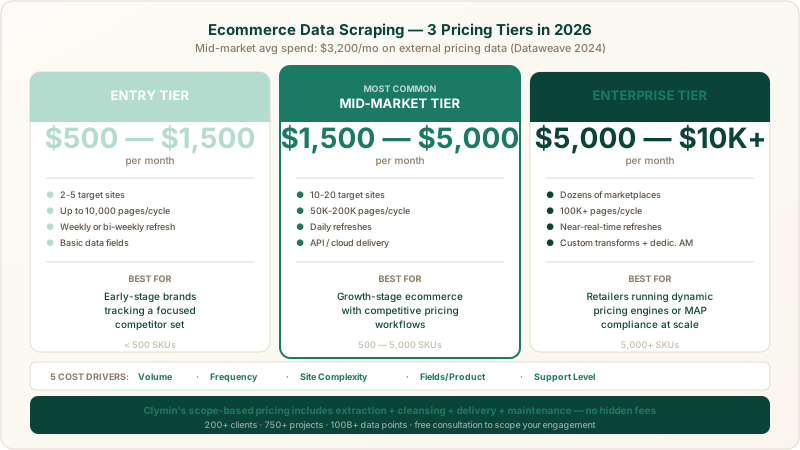
Pricing breaks down into three broad tiers based on scope and service model:
Entry tier ($500–$1,500/month) covers small-scale projects. Expect extraction from two to five target sites, up to 10,000 product pages per cycle, and weekly or bi-weekly refresh schedules. Suitable for early-stage ecommerce brands tracking a focused competitor set.
Mid-market tier ($1,500–$5,000/month) handles moderate complexity. Typical engagements include 10 to 20 target sites, 50,000 to 200,000 pages per cycle, daily refreshes, and structured delivery via API or cloud storage. Most ecommerce companies with 500 to 5,000 SKUs fall into this range.
Enterprise tier ($5,000–$10,000+/month) covers large-scale, mission-critical operations. Engagements at this level involve dozens of target marketplaces, hundreds of thousands of pages per cycle, near-real-time refresh windows, custom data transformations, and dedicated account management. Retailers running dynamic pricing engines or monitoring MAP compliance across hundreds of sellers typically operate here.
These ranges align with Dataweave's 2024 Competitive Intelligence Pricing Report, which found that mid-market ecommerce brands spend an average of $3,200 per month on external pricing data services.
In-House Scraping vs. Managed Service: A Cost Comparison
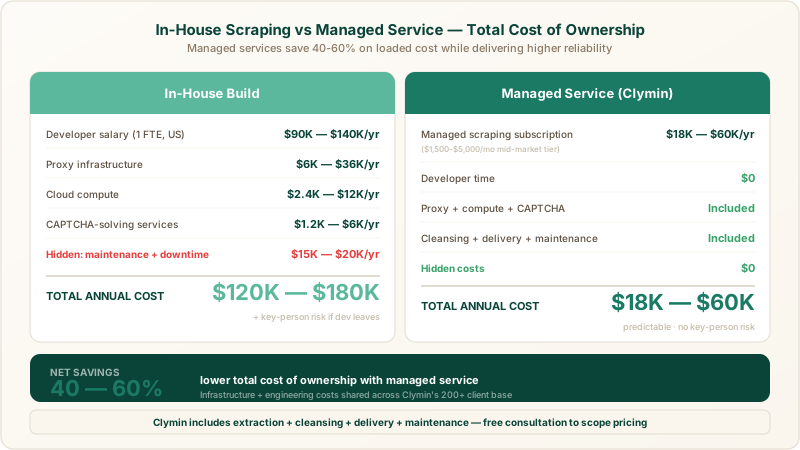
Building an in-house scraping operation seems cheaper on the surface, but total cost of ownership tells a different story.
An in-house setup requires at least one full-time developer ($90,000–$140,000 annual salary in the United States), proxy infrastructure ($500–$3,000/month), cloud compute ($200–$1,000/month), and CAPTCHA-solving services ($100–$500/month). Factor in maintenance time, broken scrapers, site layout changes, and anti-bot updates, and the realistic annual cost reaches $120,000 to $180,000.
A managed provider like Clymin delivers the same output for a fraction of that cost because engineering and infrastructure expenses are shared across 40+ customers. The managed model also eliminates the operational risk of a single developer leaving and taking institutional knowledge with them.
For a deeper breakdown of managed scraping economics, see our guide on ecommerce price scraping services.
How to Evaluate Web Scraping Pricing Proposals
When comparing quotes from scraping vendors, ask these questions before signing:
What is included in the base price? Some providers quote low monthly fees but charge separately for proxy costs, data cleaning, format conversion, or technical support. Ensure the proposal covers the full pipeline from extraction to delivery.
How are overages handled? Understand whether pricing scales linearly with volume increases or whether the provider charges premium rates once you exceed a usage threshold.
What SLAs are guaranteed? A provider quoting $1,000/month with 85% data accuracy delivers less value than one quoting $2,500/month with 99%+ accuracy. Data quality directly impacts downstream pricing decisions and revenue.
Is maintenance included? Target websites change layouts, update anti-bot defenses, and restructure URLs. Maintenance should be part of the service, not billed as hourly consulting.
How Clymin Structures Ecommerce Scraping Pricing
Clymin uses a scope-based pricing model tailored to each client's data needs. Every engagement starts with a free consultation where the team maps target sources, required data fields, delivery format, and refresh cadence.
All Clymin plans include AI-agentic scraping that adapts to site changes automatically, data cleansing and normalization, structured delivery via API or cloud export, and ongoing maintenance at no extra charge. With 100B+ data points extracted across hundreds of projects, Clymin's infrastructure is built to handle ecommerce workloads at any scale.
For teams already tracking competitor prices manually, switching to a managed approach can cut both cost and time investment. Learn how in our guide on how to monitor competitor prices automatically.
Ready to Get a Custom Scraping Quote?
Reach out to Clymin's data experts at contact@clymin.com for a free consultation. Share your target sites, data requirements, and delivery preferences, and receive a tailored proposal within 48 hours. Book a call today to see how managed scraping can cut your data costs while improving quality.