
Why Do Ecommerce Teams Need SKU-Level Tracking?
Managing an ecommerce catalog in 2026 means competing on a product-by-product basis across dozens of channels. Every individual SKU carries its own pricing history, availability status, and competitive context. Without granular SKU-level visibility, ecommerce teams operate on assumptions rather than data, missing competitor price drops, stockouts that create buying opportunities, and new product launches that shift category dynamics.
The scale of the problem makes manual monitoring impossible. A mid-size online retailer carrying 10,000 SKUs and tracking five competitors faces 50,000 data points to check per cycle. According to the National Retail Federation's 2025 Digital Commerce Report, the average ecommerce catalog grew 34% year-over-year, compounding the monitoring burden every quarter. Gartner's 2025 Supply Chain Research found that retailers using automated product monitoring achieved 18% faster response to competitive changes compared to those relying on periodic manual checks.
SKU tracking goes beyond what ecommerce price scraping delivers. While price scraping captures what competitors charge, SKU monitoring captures the full operational picture, whether a product is in stock, when a competitor adds or removes a listing, how inventory levels fluctuate, and which product variants are gaining or losing shelf space.
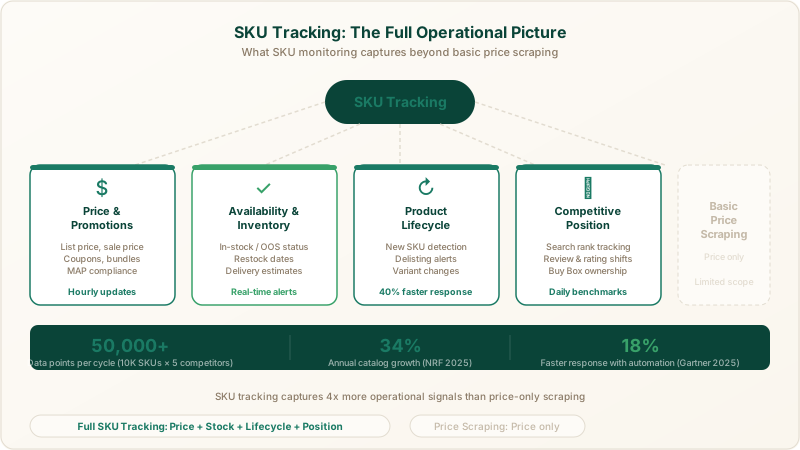
SKU tracking captures the full operational picture, price, stock, availability, new listings, and delistings, not just competitor pricing.
What Metrics Should You Track per SKU?
Effective SKU monitoring requires capturing multiple data dimensions for each product unit. Ecommerce leaders who track only price miss the operational signals that drive stocking decisions, promotional timing, and category management. Clymin's SKU tracking service captures the following metrics per product:
Price and promotion signals include current list price, sale price, discount percentage, coupon availability, bundle offers, and MAP compliance status. These data points feed directly into repricing engines and margin analysis workflows.
Availability and inventory indicators cover in-stock or out-of-stock status, estimated restock dates, shipping availability by region, delivery time estimates, and seller identity on marketplace listings. Detecting a competitor stockout within hours, rather than days, creates a window to capture displaced demand through paid search or organic repositioning.
Product lifecycle events encompass new SKU detection (when a competitor adds a product you should know about), delisting alerts (when a product disappears from a storefront), variant changes (new sizes, colors, or configurations), and listing quality shifts (title changes, image updates, description rewrites). According to Profitero's 2025 Digital Shelf Benchmark, brands that monitor product lifecycle events respond to competitive launches 40% faster than those relying on quarterly audits.
Competitive positioning data includes search rank within marketplace categories, review count and rating changes, buy box ownership on Amazon, and seller count per listing. These signals inform both organic search strategy and paid advertising allocation.
How Does Manual SKU Monitoring Fail at Scale?
Spreadsheet-based SKU tracking breaks down at three predictable thresholds. Understanding where manual processes fail helps ecommerce leaders build the case for automation.
The first threshold is volume. Once a catalog exceeds 1,000 SKUs tracked across three or more competitors, the daily data collection burden exceeds what any analyst team can sustain without sacrificing accuracy. Spot-checking a subset of SKUs introduces blind spots, and competitors know that most retailers are not watching every product.
The second threshold is speed. Marketplace pricing and availability shift continuously. Amazon updates prices on millions of products multiple times per day. A competitor stockout on a high-demand SKU might last only 6 to 12 hours, long enough to capture demand if detected immediately, but invisible to a team running weekly manual checks.
The third threshold is consistency. Manual processes rely on individual analysts remembering to check specific products on specific sites. Employee turnover, vacation days, and shifting priorities create gaps. Automated SKU monitoring runs on a fixed schedule regardless of staffing, ensuring every product is checked at every interval without exception.
Clymin's AI-agentic approach eliminates all three failure points. Intelligent agents adapt to site layout changes, scale across millions of SKUs, and deliver structured data on configurable schedules from hourly to daily. For a detailed look at how agentic scraping differs from traditional methods, see how Clymin's AI-agentic scraping works.
How Do Alert Systems and Thresholds Work for SKU Monitoring?
Raw data without filtering overwhelms ecommerce teams. Effective SKU tracking requires configurable alert thresholds that surface only the signals worth acting on, and suppress the noise that would otherwise flood inboxes.
Clymin's alert framework supports rule-based triggers across all tracked metrics. Price alerts fire when a competitor's price drops or rises beyond a defined percentage or dollar threshold. Stock alerts trigger when a tracked SKU moves from in-stock to out-of-stock (or vice versa). New SKU alerts notify your team when a competitor lists a product matching your defined category or brand criteria. Delisting alerts flag when a previously tracked product disappears from a storefront.
Threshold configuration is granular. A Head of E-Commerce can set a 5% price drop alert for high-margin SKUs, a 10% threshold for commodity items, and immediate alerts for any stockout on top-20 revenue-generating products. Alerts deliver via email, Slack, webhook, or direct API push, integrating into existing operational workflows without requiring a new dashboard login.
Alert fatigue is a real operational risk. Clymin addresses alert volume by supporting aggregation rules, batching low-priority alerts into daily digests while routing critical signals (competitor stockout on your best seller, MAP violation on a flagship product) as instant notifications.
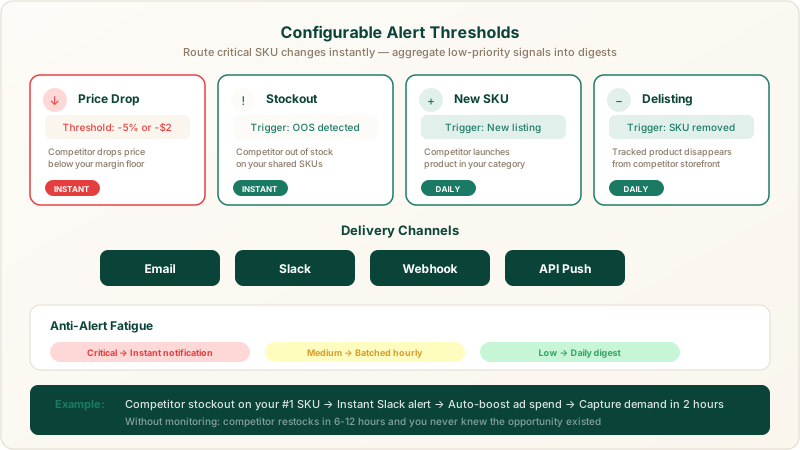
Configurable alert thresholds route critical SKU changes to your team via email, Slack, webhooks, or API, while aggregating low-priority signals into daily digests.
How Does SKU Tracking Data Integrate With Pricing Engines and Inventory Systems?
SKU monitoring delivers maximum value when connected to the systems that act on the data. Clymin provides direct integration paths to pricing engines, inventory management platforms, and business intelligence tools, eliminating the manual step of exporting data, reformatting, and uploading to downstream systems.
For pricing engine integration, Clymin delivers competitor SKU data in real time via API or scheduled feeds that match the input format required by platforms like Intelligence Node, Competera, and custom-built repricing systems. Each data record includes the competitor price, timestamp, source URL, and product identifier mapping (UPC, EAN, ASIN, or retailer-specific SKU), enabling automated repricing rules to execute without human intervention.
Inventory management integration supports platforms like NetSuite, SAP, and Shopify Plus. When Clymin detects a competitor stockout on a product you also carry, that signal can trigger automated inventory reallocation, advertising budget shifts, or promotional pricing to capture displaced demand. The product data extraction pipeline handles the full spectrum of product attributes required for inventory system synchronization.
Business intelligence integration delivers SKU tracking data to Tableau, Looker, Power BI, or custom dashboards via cloud storage drops (S3, GCS), database writes, or direct API connections. Every data delivery includes metadata fields, extraction timestamp, confidence score, source identifier, and change delta, so analytics teams can build trend reports and anomaly detection models on top of reliable, traceable data.
What Compliance and Data Quality Standards Apply to SKU Monitoring?
Tracking millions of SKUs across hundreds of competitor sites demands rigorous data quality controls and regulatory compliance. Clymin applies a multi-stage validation pipeline to every SKU data delivery, cross-referencing extracted values against historical baselines to catch anomalies before they reach your systems.
Clymin holds ISO 27001 certification, maintains AICPA SOC compliance, and operates under GDPR-ready protocols. All scraping operations respect robots.txt directives and apply rate-limiting to prevent disruption to target sites. For ecommerce brands working with vendor-sensitive competitive data, Clymin provides full audit trails, data processing agreements, and dedicated compliance documentation on request.
Data accuracy is validated at the field level. Price values are checked against currency and locale expectations. Stock status is confirmed through multiple page signals (add-to-cart button state, availability text, shipping estimates) rather than relying on a single indicator. Product identifiers are normalized across platforms, mapping Amazon ASINs, Walmart item numbers, and retailer-specific SKUs to a unified product graph maintained by Clymin's data engineering team. For a deeper comparison of building monitoring in-house versus using a managed service, see price monitoring tools versus managed services.
Ready to Track Every SKU Across Your Competitive Landscape?
Stop losing revenue to competitor moves you cannot see. Clymin's ecommerce SKU tracking and monitoring service gives your team real-time operational intelligence across every product unit that matters, backed by hundreds of delivered projects and over a decade of data extraction expertise. Reach out at contact@clymin.com or schedule a consultation to discuss your SKU monitoring requirements.