
Web Scraping for MAP Pricing Compliance: How to Catch Violators Before They Erode Your Brand
What Is Minimum Advertised Price (MAP) Monitoring?
Minimum advertised price (MAP) monitoring is the continuous tracking of how resellers advertise a brand's products to detect any advertised price below the brand's agreed MAP. It flags violations with timestamped evidence so brands can enforce policies and protect margins. Clymin automates MAP monitoring by extracting reseller and marketplace prices across hundreds of sites in near real time, feeding the same data that powers competitor price monitoring and price intelligence services.
Why MAP Violations Are Costing Brands More Than Ever
MAP (Minimum Advertised Price) policies exist to protect brand value and maintain healthy retailer margins. When resellers undercut MAP, the damage cascades quickly: other retailers match the lower price, margins compress across the channel, and brand perception shifts from premium to commodity.
The financial impact is significant. According to a 2025 Profitero study, brands without active MAP enforcement programs saw average selling prices decline 12-18% year-over-year across their reseller networks. Forrester Research estimates that channel conflict driven by pricing inconsistency costs consumer brands an average of $2.1 million annually in lost margin and diverted sales.
For Heads of E-Commerce managing dozens or hundreds of reseller relationships, manual price checking simply cannot keep pace. A brand with 500 SKUs across 50 authorized dealers faces 25,000 price points to monitor, and that number grows exponentially when unauthorized sellers enter the picture.
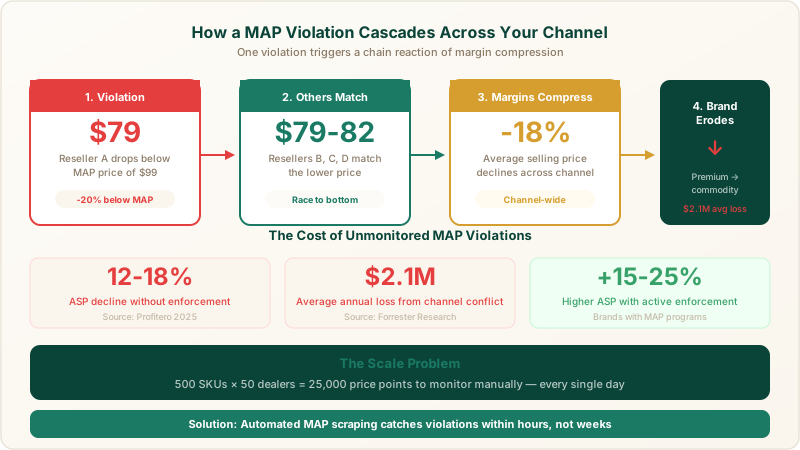
How a single MAP violation triggers a chain reaction across the reseller network
How MAP Pricing Monitoring With Web Scraping Works
Automated map pricing monitoring replaces manual spot checks with systematic, scheduled data collection from every relevant seller endpoint. Here is how the workflow operates in practice.
Define your MAP product catalog
Upload your SKU list with corresponding MAP floor prices, product identifiers (UPC, ASIN, MPN), and any promotional MAP exceptions with their effective dates.
Configure scraping targets
Identify every authorized dealer website, marketplace listing, and comparison shopping engine where your products appear. Clymin's AI agents can also discover unauthorized sellers by scanning marketplaces for your product identifiers.
Schedule automated price collection
Scrapers visit each target on a defined cadence, extracting the advertised price, seller name, product URL, and timestamp. Adaptive scraping handles site structure changes without manual intervention.
Flag violations and generate reports
Collected prices are compared against your MAP database. Violations are flagged instantly, with screenshots and timestamped evidence packaged for enforcement teams.
What Data Points to Capture Beyond Price
Effective map policy compliance scraping goes beyond grabbing a single price number. Sophisticated MAP monitoring programs capture multiple data points per observation to build airtight enforcement cases.
Essential fields include the advertised price, any coupon or discount codes displayed on the page, shipping offers that effectively reduce the total cost, bundle configurations that obscure per-unit pricing, and the seller's identity on marketplace platforms. According to the MAP Enforcement Institute's 2025 benchmark report, brands that capture five or more data points per price observation achieve 40% higher enforcement success rates than those tracking price alone.
Cart-level pricing deserves special attention. Some resellers maintain MAP-compliant advertised prices but reveal lower prices after the consumer adds the item to their cart. Scraping tools capable of simulating add-to-cart actions uncover these hidden violations that manual monitoring would miss entirely.
How to Build a MAP Enforcement Workflow Around Scraped Data
Collecting violation data is only valuable when paired with a structured enforcement process. Brands with the strongest MAP programs follow a tiered response model.
First offense: Automated notification. Send a templated email to the violating reseller within 24 hours, citing the specific product, advertised price, MAP floor, and timestamped evidence. Automation ensures no violation goes unaddressed.
Second offense: Escalation. A second violation within 30 days triggers a formal warning from the brand's channel management team, referencing the reseller agreement and MAP policy terms.
Third offense: Consequences. Persistent violators face consequences defined in your MAP policy, which may include suspension of promotional support, reduced allocation, or termination of the reseller relationship.
The National Association of Manufacturers notes that brands enforcing MAP policies consistently see 90% first-offense compliance, meaning most resellers correct violations after a single notification. Speed matters: the faster you detect and respond, the less damage each violation inflicts.
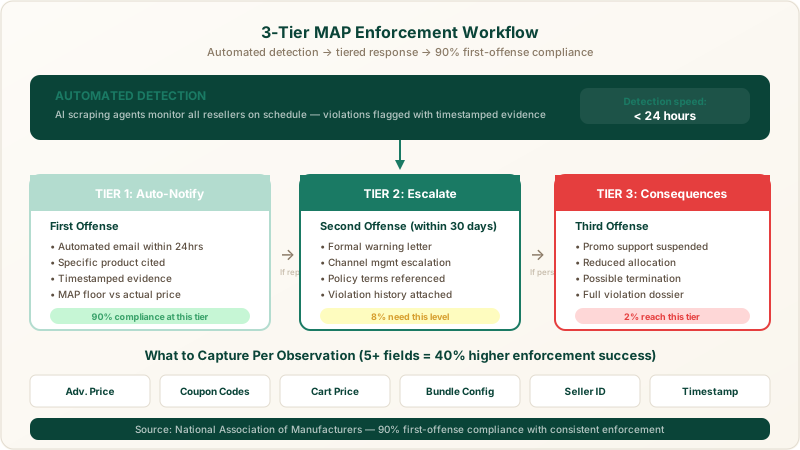
A three-tier MAP enforcement workflow powered by automated scraping and violation detection
Why Managed Scraping Outperforms DIY for MAP Compliance
Building an internal MAP scraping system sounds straightforward until anti-bot protections, dynamic page rendering, and marketplace layout changes start breaking your data pipeline. Ecommerce teams that build in-house scrapers typically spend 30-40% of engineering time on maintenance rather than analysis.
Clymin's AI-powered scraping approach eliminates that overhead. Adaptive AI agents self-correct when target sites change structure, and a fully managed service means your team receives clean violation reports instead of raw HTML. With hundreds of projects delivered across more than a decade, Clymin handles the technical complexity so your ecommerce and legal teams can focus on enforcement.
For brands already tracking competitor pricing, extending your scraping infrastructure to MAP compliance creates immediate synergy. Clymin's ecommerce price scraping service already supports MAP-specific data fields out of the box. Learn how automated price tracking works in our guide on how to monitor competitor prices automatically, and explore broader competitive intelligence applications in our ecommerce competitive analysis playbook.
Start Protecting Your MAP Pricing Today
Every day without automated MAP monitoring is a day violators go undetected, dragging your brand value and channel margins downward. Clymin helps ecommerce brands deploy MAP pricing monitoring programs that scale across every reseller and marketplace where your products appear.
Get a Free Consultation with the Clymin team, or reach out directly at contact@clymin.com to discuss your MAP compliance requirements.