
Ecommerce Competitive Analysis Using Web Scraping: A Strategy Manager's Playbook for 2026
Why Traditional Competitive Intelligence Falls Short
Manual competitor research cannot scale. By the time an analyst finishes tabulating prices across a dozen rival sites, the data is already stale. In 2026, ecommerce markets shift in hours, not weeks.
Scraping for market analysis solves this by automating collection across hundreds of data points simultaneously. The result is a living competitive dataset that updates on your schedule, giving strategy managers a real-time view instead of a quarterly snapshot.
The Five Dimensions of Ecommerce Competitive Intelligence
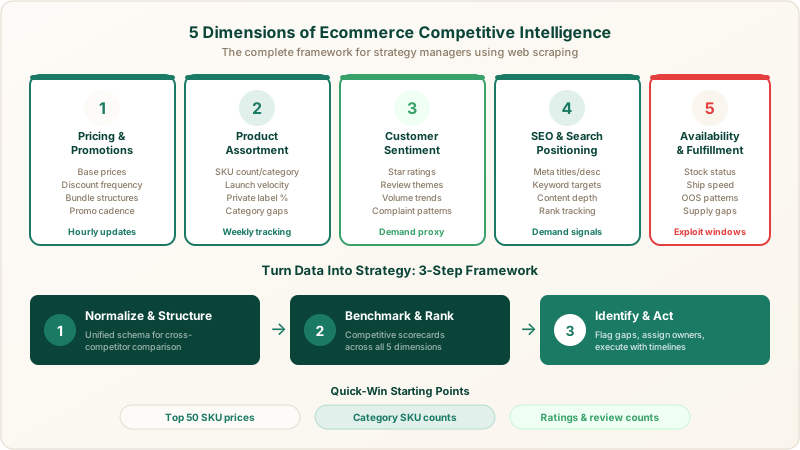
Effective competitive intelligence ecommerce programs go far beyond price tracking. Here are the five dimensions every strategy manager should monitor.
1. Pricing and Promotional Strategy
Price is the most visible competitive lever, but the analysis layer matters most. Track base prices, discount frequency, bundle structures, and promotional cadence to map a competitor's pricing philosophy, not just their price points.
For a deeper look at setting up automated price tracking, see our guide on how to monitor competitor prices automatically.
2. Product Assortment and Catalog Depth
Scraping competitor catalogs reveals assortment gaps and overlap. Measure SKU count by category, new product launch velocity, and private-label penetration to understand where rivals are investing.
Category-level assortment analysis often surfaces opportunities that pricing data alone would miss. A competitor's thin catalog in a growing subcategory signals an opening for expansion.
3. Customer Sentiment and Review Analysis
Aggregate review scores and extract sentiment themes at scale. Identify where competitors earn praise and where they generate complaints. These patterns point directly to product improvement priorities and messaging opportunities.
Review volume trends also serve as a proxy for demand. A sudden spike in reviews for a competitor's product line often precedes a broader category shift.
4. SEO and Search Positioning
Scraping competitor meta titles, descriptions, heading structures, and content strategies reveals their organic search playbook. Track which keywords they target, how their content depth compares to yours, and where they rank for high-intent commercial queries.
This dimension is especially valuable for ecommerce trend analysis with web scraping, since search behavior often signals demand shifts before they appear in sales data.
5. Availability and Fulfillment Signals
Monitor stock status, shipping speed claims, and fulfillment options across competitor sites. Out-of-stock patterns reveal supply chain vulnerabilities you can exploit with targeted ad spend or promotional pushes.
A Framework for Turning Scraped Data into Strategy
Collecting data is only half the equation. Here is a three-step framework for converting raw scraping output into competitive action.
Normalize and Structure
Standardize scraped data into a unified schema so that cross-competitor comparisons are apples-to-apples. This means mapping product categories, harmonizing price formats, and aligning review scales.
Benchmark and Rank
Build competitive scorecards across each of the five dimensions above. Rank your position relative to each rival to identify where you lead and where you trail. Weight dimensions by strategic priority for your business.
Identify and Act
Flag statistically significant gaps, whether a competitor's pricing undercut, an assortment white space, or a sentiment weakness, and translate each into a concrete initiative with an owner and timeline.
What Data to Collect First
Strategy managers new to scraping for market analysis should prioritize three data types to generate quick wins:
- Competitor pricing on your top 50 overlapping SKUs. This gives immediate pricing intelligence with minimal data volume. Our ecommerce price scraping service is built for exactly this starting point.
- Category-level SKU counts. A simple count of products per category across rivals highlights assortment imbalances.
- Star ratings and review counts on competing products. These are publicly available, easy to structure, and rich with insight.
Why Managed Scraping Beats DIY for Competitive Analysis
Building internal scrapers creates maintenance overhead that compounds fast. Anti-bot protections evolve constantly, site structures change without notice, and data quality degrades silently. Clymin's AI-agentic approach handles these challenges with adaptive scraping agents that self-correct when target sites change.
With 40+ customers, hundreds of projects, and over 100 billion data points processed across more than a decade, Clymin delivers analysis-ready data so your strategy team can focus on decisions, not data plumbing.
"Clymin's data insights helped us boost revenue by 20%...", Sarah T., Marketing Manager
Start Building Your Competitive Intelligence Engine
Ecommerce competitive analysis using web scraping is not a one-time project. It is an ongoing capability that compounds in value as your historical dataset grows. The strategy managers who invest in this infrastructure in 2026 will outmaneuver competitors who still rely on manual research and stale reports.
Ready to build a competitive intelligence program backed by reliable, structured data? Get a Free Consultation with the Clymin team and see how our managed scraping solutions can power your ecommerce strategy.