
How Does Retail Price Monitoring Work?
Retail price monitoring works by continuously extracting competitor and market prices across retail channels, websites, marketplaces, and delivery apps, then structuring them for comparison, trend analysis, and alerts at the SKU level. The system records every price change, promotion, and stock shift so teams can react the same day rather than weeks later. Clymin runs this as a managed pipeline, delivering clean retail pricing data on your schedule across hundreds of sources. Pair it with price intelligence services and digital shelf analytics for a full pricing picture.
Why Do Pricing Managers Need Automated Competitor Price Monitoring?
Manual competitor price checks become obsolete the moment a pricing team scales beyond a handful of SKUs. A pricing manager tracking 2,000 products across ten competitors faces 20,000 price points that shift without warning. According to Profitero's 2025 Price Intelligence Benchmark, the average ecommerce competitor changes prices on 15% to 25% of their catalog every week, meaning thousands of relevant price movements go undetected between manual reviews.
The business cost of monitoring gaps compounds quickly. McKinsey's 2024 pricing research found that retailers with continuous price visibility achieve 2% to 7% higher margins than those relying on periodic manual spot checks. For an online retailer generating $40 million in annual revenue, that margin gap translates to $800,000 to $2.8 million in unrealized profit each year.
Clymin's competitor price monitoring eliminates these gaps by running AI-powered collection sweeps at configurable intervals, hourly, daily, or custom, across every competitor and SKU in your tracking universe. Pricing managers receive structured change reports rather than raw data dumps, enabling same-day repricing decisions instead of week-old reactions.
How Does Competitor Price Monitoring Differ from Price Scraping and Price Intelligence?
Understanding where competitor price monitoring fits in the competitive pricing stack helps pricing managers choose the right service for their needs. Clymin offers all three capabilities, but each serves a distinct purpose.
Price scraping is the extraction layer. Clymin's ecommerce price scraping service captures raw pricing data from competitor websites at a single point in time. Scraping answers the question: "What are competitor prices right now?", but does not track how those prices evolve or alert you when changes occur.
Competitor price monitoring adds the time dimension. Clymin's monitoring service runs scheduled scraping sweeps and compares each new observation against historical baselines. Monitoring answers the question: "What changed, when did it change, and by how much?", delivering trend data, threshold alerts, and change logs that scraping alone cannot provide.
Price intelligence adds the analytical layer. Clymin's price intelligence services layer pattern detection, strategic recommendations, and competitive positioning analysis on top of monitoring data. Intelligence answers: "What should we do about these changes?", transforming tracked observations into repricing strategies.
Most Clymin ecommerce clients start with competitor price monitoring as their foundation, then layer intelligence services on top as their pricing operations mature. For a practical walkthrough of setting up automated tracking, see how to monitor competitor prices automatically.
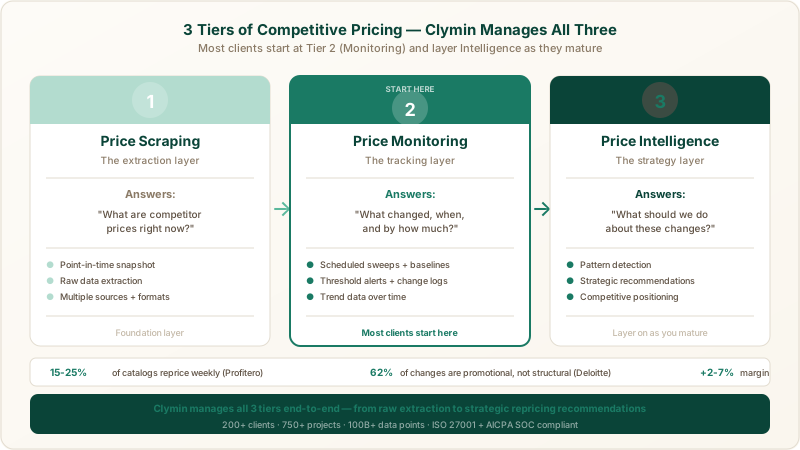
Three tiers of competitive pricing: scraping captures data, monitoring tracks changes, intelligence drives strategy, Clymin manages all three.
What Data Does a Competitive Pricing Tracker Capture?
Effective competitor price monitoring goes beyond recording a single price field on each visit. Clymin's competitive pricing tracker captures multi-dimensional data that gives pricing managers the full context behind every price movement.
Price change detection forms the core output. Clymin records current price, previous price, change magnitude (absolute and percentage), change direction, and timestamp for every observed movement. Pricing teams can set custom alert thresholds, for example, flagging any competitor price drop exceeding 5% on a priority SKU, to filter signal from noise across large catalogs.
Promotional overlay tracking captures the context around price changes. Clymin's AI agents detect promotional banners, coupon codes, bundle offers, and limited-time labels that indicate whether a price drop is a permanent repositioning or a temporary campaign. According to Deloitte's 2025 Retail Analytics Survey, 62% of competitor price changes in ecommerce are promotional rather than structural, a distinction that raw price data alone cannot reveal.
Stock and availability signals add supply-side context. Clymin monitors in-stock status, low-stock indicators, and out-of-stock events alongside pricing data. A competitor dropping price while showing low stock suggests clearance behavior; a price increase paired with "limited availability" messaging signals demand-driven repricing. Combining price and availability data lets pricing managers distinguish between competitive threats that require response and short-term fluctuations that do not.
Geographic variant tracking captures how competitors price differently across regions. Clymin routes monitoring requests through geo-distributed endpoints, recording the exact prices visible to customers in target markets. Retailers operating localized pricing strategies gain visibility into how competitors adjust positioning by city, state, or country.
Why Choose a Managed Price Monitoring Tool Over DIY Solutions?
Off-the-shelf price monitoring tools and open-source scrapers appeal to pricing teams looking for quick, low-cost solutions. The hidden costs of DIY monitoring, however, consistently outweigh the subscription savings, especially at enterprise SKU volumes.
Clymin's managed approach eliminates three categories of ongoing cost that DIY tools transfer to your team:
Maintenance overhead. Competitor websites redesign their product pages, update anti-bot defenses, and restructure their URL patterns regularly. According to Diffbot's 2025 Web Data Infrastructure Report, companies running in-house scraping spend approximately 40% of their data engineering time on scraper maintenance. Clymin's AI agents adapt to site changes automatically, reducing your team's maintenance burden to zero.
Data quality risk. DIY monitoring tools extract data but rarely validate accuracy. Currency mismatches, cached pages, region-defaulting errors, and promotional price artifacts introduce noise that corrupts repricing decisions. Clymin applies multi-stage validation, cross-referencing each observation against historical baselines, peer-group ranges, and known error patterns, before any data reaches your dashboard.
Scaling constraints. Monitoring 500 SKUs across five competitors is manageable with DIY tools. Monitoring 10,000 SKUs across 30 competitors at hourly intervals requires infrastructure that scales without proportional engineering investment. Clymin handles that scale as a managed service, backed by over a decade of extraction infrastructure built to process billions of data points. For technical details on how Clymin's extraction technology handles complex sites, see how to scrape product data from competitor websites.
Sarah T., Head of Pricing at RetailMax, experienced the managed advantage directly: "Clymin's data accuracy exceeded our expectations." Her team replaced a three-person manual monitoring process with Clymin's automated tracking, gaining hourly price visibility across 4,000 SKUs while freeing analysts to focus on strategy rather than data collection.
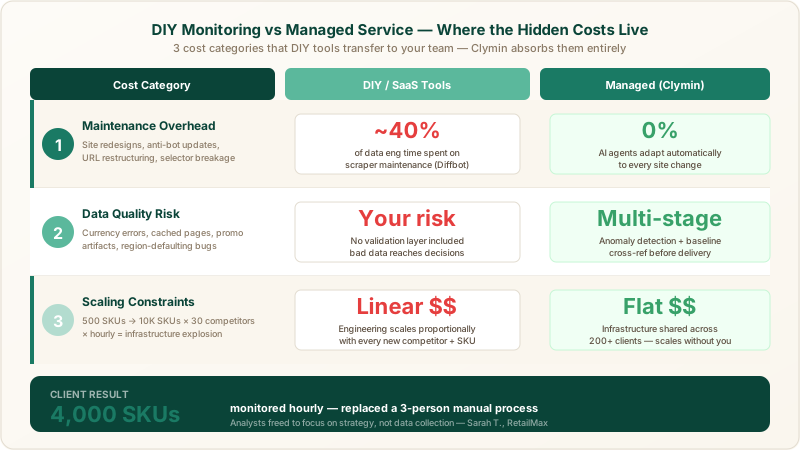
DIY monitoring transfers maintenance, validation, and scaling costs to your team. Clymin's managed service absorbs them entirely.
How Does Clymin Deliver Competitor Price Monitoring Data?
Clymin structures monitoring data delivery around how pricing managers actually use competitive intelligence in their daily workflows. Delivery is not a one-size-fits-all data dump, each engagement is configured to match the client's analytics stack and decision cadence.
Structured feeds in CSV, JSON, or XML arrive on schedule, hourly, daily, or at custom intervals, directly to cloud storage (S3, GCS), email, or SFTP endpoints. Each feed includes enriched metadata: extraction timestamp, source URL, product identifier mapping, price change flags, and confidence scores that enable full auditability.
Real-time alert APIs push notifications when monitored prices breach predefined thresholds. Pricing managers define rules per SKU group, competitor undercuts by more than 3%, MAP violation detected, out-of-stock event on a key product, and Clymin's monitoring engine triggers alerts within minutes of detection. Direct REST API integration allows these alerts to feed into repricing engines, Slack channels, or custom dashboards without manual intervention.
Historical trend exports provide the longitudinal data that powers strategic pricing reviews. Clymin maintains full price history for every monitored SKU and competitor, enabling pricing teams to analyze seasonal patterns, identify long-term competitive positioning shifts, and benchmark their own pricing trajectories against the market.
Clymin's monitoring infrastructure is backed by ISO 27001 certification, AICPA SOC compliance, and GDPR-ready protocols. All competitor data is sourced from publicly available information using ethical collection practices that respect robots.txt directives and intelligent rate limiting. Full audit trails map every data point to its source, timestamp, and extraction parameters.
Ready to Monitor Competitor Prices Automatically?
Stop reacting to competitor price changes days after they happen. Clymin's competitor price monitoring service gives your pricing team continuous, validated competitive visibility, backed by 40+ enterprise customers and over a decade of data extraction expertise operating from San Francisco and Hyderabad.
Reach out at contact@clymin.com or schedule a free consultation to configure a monitoring program tailored to your catalog, competitors, and repricing workflow.