
Why San Francisco Ecommerce Needs Price Scraping in 2026
San Francisco is the birthplace of more venture-backed DTC brands per capita than any other U.S. metro. According to PitchBook's 2025 Venture Monitor, the Bay Area accounted for 31% of all U.S. ecommerce startup funding, with SF proper home to hundreds of direct-to-consumer brands competing across beauty, food, apparel, and consumer electronics. That density creates a pricing environment where competitors launch, reprice, and pivot faster than anywhere else.
For a CEO running an ecommerce startup out of SoMa or the Mission District, the competitive landscape is not static. SF-based competitors share the same investor networks, the same growth playbooks, and often the same customer base. A competitor's pricing shift on a Friday afternoon can redirect traffic before Monday morning. The gap between knowing and not knowing what rivals charge is the gap between capturing margin and subsidizing someone else's growth.
Manual price tracking does not scale in this environment. Even monitoring 10 SF-based competitors across 100 SKUs each means checking 1,000 product pages daily, a task that burns analyst hours and still misses off-hours changes, flash sales, and variant-level adjustments.
What SF Ecommerce Startups Gain From Managed Price Scraping
A managed ecommerce data scraping service eliminates the build-versus-buy decision that stalls many early-stage teams. San Francisco startups already stretch engineering resources across product development, infrastructure, and growth experiments. Diverting developer cycles to build and maintain a scraping pipeline is a misallocation, especially when anti-bot defenses, site redesigns, and rate limits demand ongoing maintenance.
Clymin's managed approach means your team receives clean, structured pricing datasets without writing or maintaining any code. AI agents handle extraction across Shopify storefronts, marketplace listings, headless commerce sites, and custom platforms. Data arrives in CSV, JSON, API feeds, or direct database integrations on whatever schedule your pricing decisions require. For a detailed comparison of build-versus-buy tradeoffs, see web scraping vs API for product data.
The output is not just raw prices. Clymin captures sale prices, compare-at prices, shipping costs, bundle offers, stock availability, and promotional banners, the full pricing context that determines a competitor's effective position. Sarah T., a Marketing Manager at a Clymin ecommerce client, reported that this level of competitor pricing analysis contributed to a 20% revenue increase by enabling her team to act on market shifts within hours.
The SF DTC Pricing Landscape: What Makes It Different
San Francisco's ecommerce ecosystem has characteristics that generic price monitoring tools are not built to handle. Three dynamics stand out.
High DTC concentration on Shopify and headless stacks. A large share of SF-based brands run on Shopify Plus or custom headless architectures using frameworks like Hydrogen, Next.js Commerce, and Medusa. These storefronts render product data through JavaScript, making them invisible to simple HTTP scrapers. Clymin's AI agents render dynamic pages fully, extracting pricing data that basic tools miss. For Shopify-specific intelligence, explore Shopify competitor analysis scraping.
Frequent promotional experimentation. SF startups A/B test pricing aggressively, running limited-time offers, influencer-exclusive discounts, and geo-targeted promotions. Capturing these signals requires scraping at sub-daily intervals with profile-level variation, not once-a-day snapshots from a single session.
Cross-channel pricing divergence. Many SF brands sell simultaneously on their own storefronts, Amazon, and marketplace aggregators, often at different price points. Monitoring a single channel gives an incomplete picture. Clymin tracks pricing across all channels a competitor sells through, delivering a unified view of their pricing strategy.
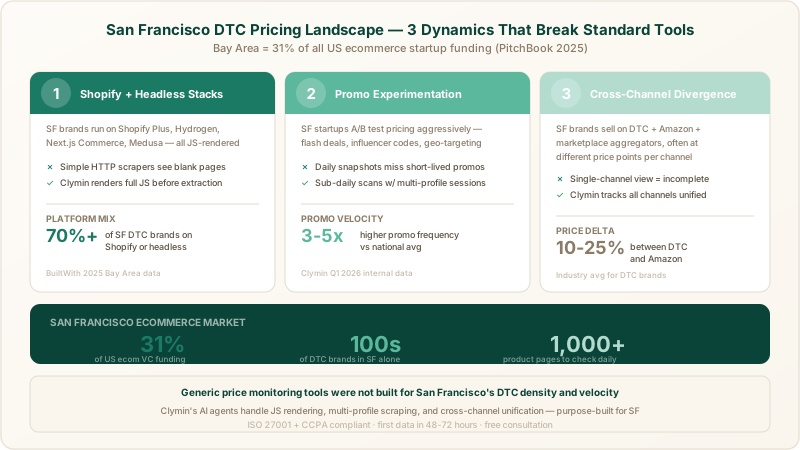
San Francisco's DTC brand density creates a uniquely competitive pricing environment for ecommerce startups.
How Price Intelligence Translates to Revenue for SF Startups
Structured competitor pricing data unlocks three high-impact plays for ecommerce CEOs.
Margin recovery on underpriced SKUs. Many startups price conservatively at launch, leaving margin on the table. Competitor price feeds reveal where your prices sit below market, identifying SKUs where a 5% to 15% increase would match competitors without affecting conversion rates.
Speed-to-reprice advantage. In SF's fast-moving DTC market, the startup that reprices first after a competitor shift captures disproportionate traffic. Automated competitor price monitoring cuts response time from days to hours, turning pricing agility into a growth lever.
Investor-ready market intelligence. VC-backed startups in San Francisco face board-level questions about competitive positioning. Structured pricing data provides defensible answers, showing exactly where your pricing sits relative to the market, backed by timestamped, auditable data from Clymin's extraction pipeline with 100B+ data points processed to date.
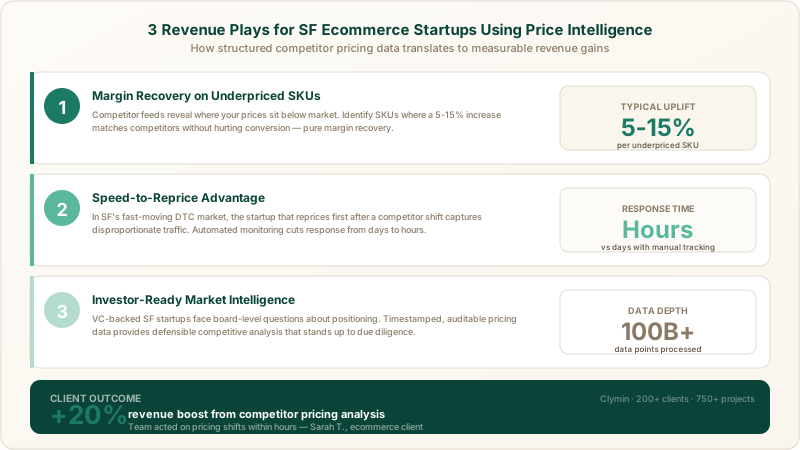
Why SF Ecommerce Teams Choose Managed Over DIY
San Francisco has no shortage of open-source scraping frameworks. Scrapy, Playwright, and Puppeteer are well-documented, and many startup engineers can build a prototype scraper in a weekend. The problem is not building, it is maintaining.
Anti-bot systems evolve monthly. Cloudflare, DataDome, and PerimeterX update detection algorithms continuously. A scraper that works today breaks next week. Site redesigns invalidate selectors. Rate limits tighten. IP blocks accumulate. What started as a weekend project becomes a recurring engineering tax.
Managed ecommerce data scraping through Clymin eliminates that tax entirely. AI agents adapt to site changes, rotate through residential proxies, and handle CAPTCHA challenges without human intervention. Your engineering team stays focused on product and growth, not on debugging a scraping pipeline at 2 AM. For a broader look at the managed service advantage, see price monitoring tools vs managed service.
Start Getting SF Competitor Pricing Data This Week
San Francisco's ecommerce market rewards the teams with the best data, not just the best product. Clymin gives SF startups a pricing intelligence edge that scales with your business, from seed-stage with 5 competitors to Series B with 200. Reach out at contact@clymin.com or get a free consultation to scope your competitive landscape.