Why Shopify Store Owners Need Competitor Scraping in 2026
Shopify powers over 4.6 million active stores globally, according to BuiltWith's 2025 ecommerce platform usage report. That density means every product niche has dozens of direct competitors running on the same platform, each adjusting prices, launching products, and testing promotions in real time.
Manual competitor monitoring fails in this environment. A Shopify merchant tracking even 10 competitors across 50 SKUs each would need to check 500 product pages daily. Pricing changes, new collection drops, and review velocity shifts happen constantly, and spreadsheet-based tracking captures only a fraction of the picture.
Baymard Institute's 2025 ecommerce UX benchmark found that 68% of online shoppers compare prices across at least three stores before purchasing. Shopify store owners without real-time competitor visibility are pricing blind, losing customers to rivals they never even monitored.
What Shopify Data Points Can Competitor Scraping Capture?
Shopify storefronts expose a rich set of competitive signals beyond basic pricing. Clymin's AI agents extract multi-layered datasets from every public Shopify store, covering the full range of intelligence that drives merchandising decisions.
Pricing and promotions include current price, compare-at price, variant-level pricing, quantity discounts, automatic discount rules, and active promotional banners. Capturing compare-at prices reveals a competitor's discounting strategy, showing how aggressively they mark down and which products carry permanent sale pricing.
Product catalog intelligence covers titles, descriptions, tags, product types, vendor labels, variant options (size, color, material), weight, and SKU identifiers. Monitoring catalog additions and removals reveals a competitor's assortment strategy, what categories they are expanding into and which product lines they are pruning.
Reviews and social proof data includes review counts, average star ratings, individual review text, reviewer names, and review dates. Tracking review velocity shows which competitor products are gaining traction and which are stalling. Deloitte's 2025 Consumer Review Survey found that products with 50+ reviews convert at 4.6x the rate of those with fewer than five, making review monitoring a direct signal of competitive threat.
Bestsellers, collections, and new arrivals round out the intelligence layer. Scraping Shopify's collection sort orders (best-selling, newest, price-ascending) reveals which products a competitor's customers actually buy most, not just what the competitor promotes.
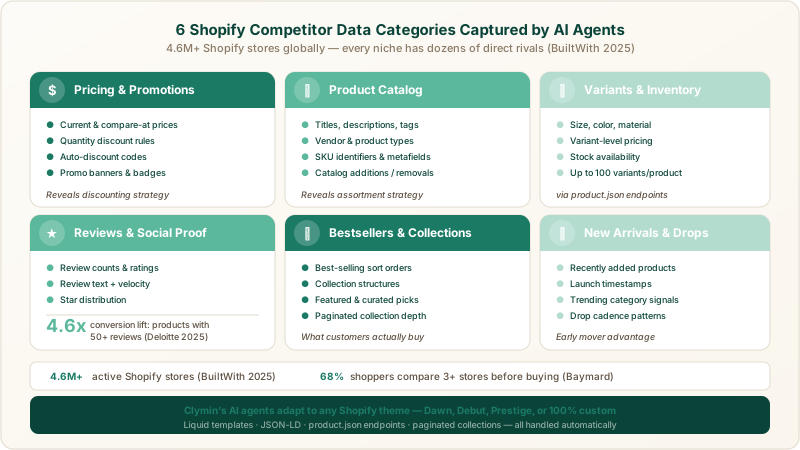
Six categories of Shopify competitor data that AI-agentic scraping captures automatically.
What Makes Shopify Scraping Technically Challenging?
Shopify stores present unique extraction challenges that break generic scraping tools. Understanding these obstacles explains why Shopify-specific expertise matters for reliable competitive intelligence.
Liquid template rendering means Shopify pages are server-rendered through Shopify's proprietary templating engine. Product data can appear in Liquid variables, JSON-LD schema blocks, or JavaScript objects, sometimes all three on the same page with slight variations. Generic scrapers that parse HTML alone miss critical data embedded in Liquid output or structured data markup.
Aggressive rate limiting is enforced at the Shopify CDN level. Shopify throttles automated requests and returns 429 status codes when thresholds are exceeded. Repeated violations trigger IP-level blocks that can persist for hours. Extracting data from a competitor with 5,000+ products requires careful request pacing and intelligent retry logic.
Dynamic product variants add complexity. A single Shopify product can have up to 100 variants, each with unique pricing, inventory status, and images. Variant data loads dynamically via Shopify's AJAX cart API and product.json endpoints, requiring scrapers to handle asynchronous JavaScript rendering or direct API-level extraction.
Theme diversity across Shopify's ecosystem means no two stores render product data identically. Dawn, Debut, Prestige, and hundreds of custom themes all structure product pages differently. An extractor that works on one Shopify theme may fail entirely on another. Clymin's AI agents learn page structures adaptively rather than relying on brittle CSS selectors, a core capability of our AI-agentic scraping approach.
How Does Shopify Competitive Intelligence Drive Revenue?
Structured competitor data transforms from raw numbers into revenue when applied to three core Shopify merchandising levers.
Dynamic pricing optimization uses competitor price feeds to identify repricing opportunities automatically. When a competitor raises prices on a shared SKU, your store can hold steady and capture price-sensitive buyers. When a competitor undercuts aggressively, you can match selectively on high-margin items rather than racing to the bottom across the board.
Assortment gap analysis compares your catalog against competitor offerings to find products they sell successfully that you do not carry. Monitoring new arrivals across five to ten competitor stores surfaces trending products weeks before they appear in supplier catalogs or trade publications. Early movers on trending products capture disproportionate search traffic and review momentum.
Promotional timing intelligence reveals when competitors launch sales, how deep they discount, and which product categories they promote most heavily. Planning your own promotions around competitor patterns, whether counter-programming against their sales or matching timing on category-wide events, maximizes promotional ROI. For a deeper look at how scraping compares to manual price tools, see price monitoring tools versus managed service.
Sarah T., a Marketing Manager at a Clymin ecommerce client, reported that competitor pricing analysis contributed to a 20% revenue increase. Real-time data feeds enabled her team to act on pricing shifts within hours rather than weeks.
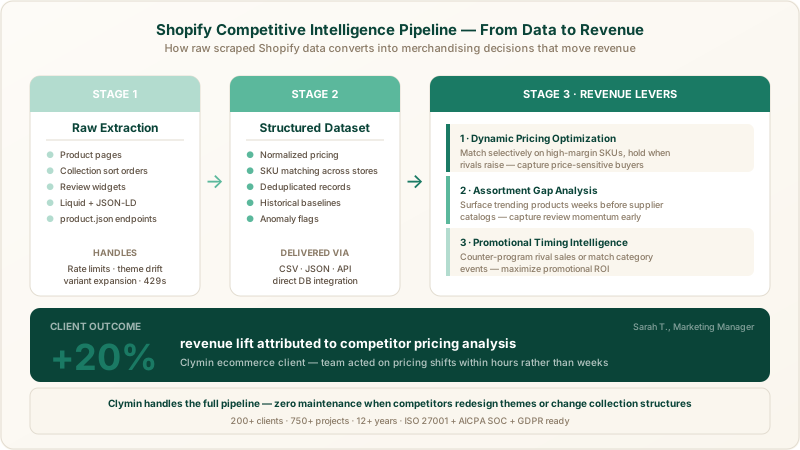
From raw Shopify competitor data to revenue-driving decisions: the competitive intelligence pipeline.
How Clymin Delivers Shopify Competitor Data at Scale
Clymin's fully managed approach means Shopify store owners receive structured competitive datasets without building or maintaining any scraping infrastructure. Our AI agents handle the entire extraction pipeline, from target store identification through data cleansing and delivery.
Setup begins with defining your competitive landscape: which Shopify stores to monitor, which data points matter most, and how frequently you need updates. Clymin's team configures extraction pipelines tailored to your specific competitor set, whether that is 5 direct rivals or 200 stores across a product category. Delivery integrates directly with your existing analytics stack via CSV, JSON, API, or database feeds.
Data quality is enforced through automated validation. Every extraction run cross-references results against historical baselines to catch anomalies, flagging issues like temporary out-of-stock pages, A/B test price variations, or theme changes that alter page structure. Clymin holds ISO 27001 certification and AICPA SOC compliance, with GDPR-ready data handling protocols that meet enterprise security standards.
Ongoing monitoring requires zero maintenance from your team. When a competitor redesigns their Shopify theme or changes their collection structure, Clymin's AI agents detect the shift and adapt automatically. For context on how managed scraping compares to building in-house solutions, explore web scraping versus API for product data.
Ready to Outpace Your Shopify Competitors?
Stop guessing what your Shopify competitors are doing with pricing, products, and promotions. Clymin gives store owners the structured competitive intelligence that turns market visibility into revenue, backed by 40+ customers, hundreds of projects, and over a decade of data extraction expertise. Reach out at contact@clymin.com or book a free consultation to discuss your Shopify competitor monitoring needs.