
Why Competitor Pricing Tracking Is Non-Negotiable in 2026
Ecommerce pricing trends in 2026 are defined by speed. According to Profitero's 2025 Ecommerce Intelligence Report, the average online retailer adjusts prices 2.5 times more frequently than in 2023, driven by the widespread adoption of dynamic pricing algorithms. Marketing managers who cannot match that pace fall behind.
A Bain & Company 2025 retail study found that brands with real-time pricing intelligence achieve 5% to 8% higher margins than those relying on weekly manual reviews. The gap widens in competitive categories like consumer electronics, apparel, and health and beauty, where price changes happen multiple times per day.
The takeaway is clear: competitor pricing strategies in 2026 demand automated, continuous tracking rather than periodic snapshots.
How to Choose the Right Competitor Pricing Tracking Method
Marketing managers have three primary options for tracking competitor prices, each with distinct trade-offs.
SaaS pricing tools like Prisync, Competera, or Intelligence Node offer dashboards and alerts out of the box. These platforms work well for straightforward tracking across a limited competitor set, but they often struggle with heavily protected sites, custom data requirements, or large-scale monitoring across thousands of SKUs.
In-house scraping using open-source libraries like Scrapy or Playwright gives full control over data collection. However, building and maintaining scrapers requires dedicated engineering resources and ongoing attention to anti-bot countermeasures and site layout changes.
Managed scraping services provide the most reliable option for marketing teams without engineering bandwidth. A provider like Clymin builds and maintains custom scrapers tailored to your specific competitor sites, handles anti-bot protections, and delivers structured data on your schedule. For details on how this process works, see our overview of AI web scraping services.
What Competitor Pricing Data Points Should You Track?
Price alone does not tell the full story. Effective competitor pricing strategies in 2026 require tracking a broader set of data points to understand the context behind each number.
Base price and sale price. Capture both the listed price and any active discount to distinguish between everyday pricing and temporary promotions.
Stock availability. A competitor's out-of-stock event creates a pricing opportunity for your brand. Monitoring availability alongside price reveals when demand may shift to your listings.
Shipping costs and delivery speed. Total landed cost matters more to buyers than sticker price. A competitor offering free next-day delivery at a higher base price may still win the conversion.
Promotional flags and bundle offers. Track "buy one get one" deals, loyalty discounts, and bundled pricing to map each competitor's full promotional calendar.
Our ecommerce price scraping service is designed to capture all of these data points in a single structured feed.
How to Set Up a Competitor Pricing Tracking Workflow
A reliable tracking workflow follows four stages: scope, collect, structure, and act.
Stage 1: Define your competitor set and SKU scope. Start with your top five to ten direct competitors and your highest-revenue SKUs. Attempting to track everything on day one creates noise without proportional value. Prioritize the products and competitors that most directly impact your revenue.
Stage 2: Establish collection frequency. Match your monitoring cadence to category dynamics. McKinsey's 2025 Pricing Excellence Survey found that high-velocity categories benefit from sub-daily collection, while stable categories perform well with daily or every-other-day checks. Over-collection wastes resources; under-collection misses opportunities.
Stage 3: Normalize and store data. Raw scraped data needs transformation before analysis. Standardize currency formats, product identifiers, and category mappings. Store historical data in a queryable format, a database or data warehouse rather than spreadsheets, so trend analysis is always possible.
Stage 4: Build decision triggers. Connect your pricing data to action. Set alerts for meaningful events: a competitor dropping price by more than 5%, a new entrant pricing below your floor, or a stockout that opens a margin window. For guidance on automating these triggers, see our guide on how to monitor competitor prices automatically.
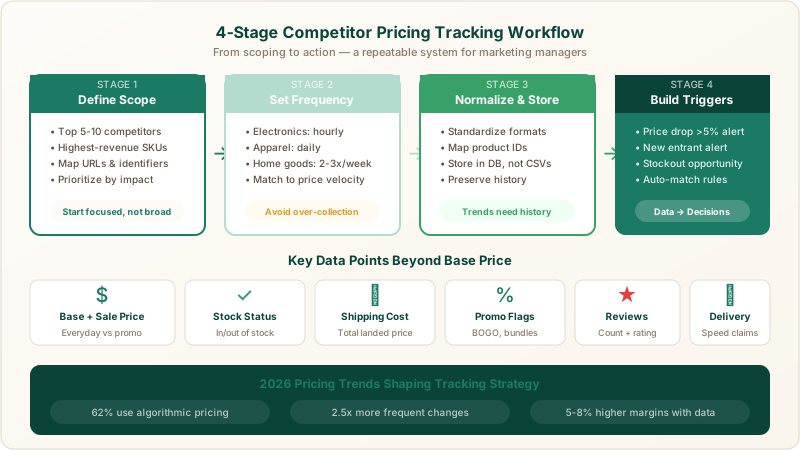
A four-stage workflow for building a repeatable competitor pricing tracking system.
What Ecommerce Pricing Trends Are Shaping 2026?
Several macro trends are reshaping how marketing managers approach competitor pricing strategies in 2026.
AI-driven dynamic pricing adoption has gone mainstream. Gartner's 2025 Digital Commerce Survey reported that 62% of mid-market ecommerce brands now use some form of algorithmic pricing, up from 38% in 2023. Tracking competitors now means tracking algorithms, not just price points.
Cross-marketplace price consistency is under pressure. Sellers operating on Amazon, Walmart, and their own DTC storefronts face growing complexity in maintaining price parity across channels. Monitoring competitor prices across all channels, not just one, has become essential.
Promotional velocity has increased. Flash sales, personalized offers, and time-limited discounts have shortened the window for competitive response. Marketing managers need near-real-time data to react before a competitor's promotion ends.
How to Turn Pricing Data into Competitive Advantage
Collecting data without acting on it creates cost, not value. Marketing managers should build a weekly pricing review cadence where the team examines competitor movements and makes explicit decisions about responses.
Segment your competitive responses into three tiers. Automate tier-one responses, straightforward price matches on high-elasticity SKUs where the decision is obvious. Escalate tier-two decisions, situations requiring margin trade-off analysis, to a pricing committee or senior stakeholder. Log tier-three observations, long-term trends and strategic shifts, for quarterly strategy reviews.
Clymin's managed scraping approach supports this by delivering structured, analysis-ready data that integrates directly into your existing BI tools or pricing engines. With 40+ customers and hundreds of completed projects, the platform adapts to site changes automatically so your data pipeline stays uninterrupted. For a broader look at how web scraping supports competitive strategy, explore our guide on ecommerce competitive analysis using web scraping.
Common Mistakes Marketing Managers Make When Tracking Competitor Prices
Tracking too many competitors without prioritization. A focused view of five high-impact rivals produces better decisions than a noisy dataset of fifty loosely related sellers.
Ignoring data quality. A scraper returning stale or incorrect prices leads to worse outcomes than no data at all. Validate your sources regularly and choose providers that guarantee accuracy and freshness.
Treating price tracking as a one-time project. Competitor websites change layouts, deploy new anti-bot protections, and restructure URLs constantly. Your tracking system requires ongoing maintenance, a key reason managed services deliver better long-term ROI than DIY setups.
Ready to Track Competitor Pricing at Scale?
Competitor pricing intelligence is a baseline requirement for ecommerce marketing managers in 2026, not a competitive advantage. The brands that win are those with reliable, automated systems that deliver clean data and connect directly to pricing decisions.
If you need a hands-off solution for tracking competitor prices across any number of ecommerce storefronts, Clymin can help. Reach out at contact@clymin.com or book a free consultation to discuss your pricing intelligence needs.
"Clymin's data insights helped us boost revenue by 20% through real-time market trend and competitor pricing analysis.", Sarah T., Marketing Manager