
Why Menu Price Monitoring on Delivery Apps Matters in 2026
Food delivery generated over $350 billion globally in 2025, according to Statista's Food Delivery Market Report. Restaurant operators and delivery platforms competing in this space face a unique pricing challenge: menu prices on apps like DoorDash, Uber Eats, and Grubhub are not static. Restaurants adjust prices for inflation, promotions, and platform-specific fees, often independently across each app.
A 2025 McKinsey study on restaurant economics found that delivery menu prices are typically 15-30% higher than dine-in prices, and this markup varies significantly by platform and geography. Without automated monitoring, product managers and strategy directors miss these shifts entirely.
The stakes are substantial. According to the National Restaurant Association's 2025 State of the Industry report, 60% of consumers compare prices across multiple delivery apps before ordering. Losing visibility into competitor pricing means losing orders to restaurants that price more aggressively on specific platforms.
How to Set Up Automated Menu Price Tracking Across Delivery Platforms
Setting up automated competitor menu price monitoring on delivery apps involves three core stages: identifying target restaurants, configuring data extraction, and building a structured output pipeline.
Define your competitive set
Start by listing the restaurants and menu categories that directly compete with your business in each geographic market. A pizza chain in San Francisco, for example, should track 20-50 competing pizza restaurants across DoorDash, Uber Eats, and Grubhub within a 5-mile delivery radius.
Configure multi-platform extraction
Each delivery app structures its menu data differently. DoorDash nests items under store-specific pages, Uber Eats uses dynamic JavaScript rendering, and Grubhub employs API-driven content loading. Clymin's AI agents handle these technical differences automatically, adapting to layout changes without manual reconfiguration.
Structure and normalize the output
Raw scraped data must be normalized across platforms. A "Large Pepperoni Pizza" on DoorDash and a "Pepperoni Pizza (Large)" on Uber Eats are the same product but arrive as different data strings. Clymin's data cleansing pipeline uses entity matching to unify items across platforms, delivering clean datasets in CSV, JSON, or direct database formats.
Schedule monitoring frequency
For most restaurant operators, daily extraction captures the majority of price changes. High-volume quick-service restaurants (QSRs) in competitive urban markets may benefit from twice-daily monitoring to catch lunch and dinner pricing variations.
What Pricing Data Points to Extract From Each Delivery App
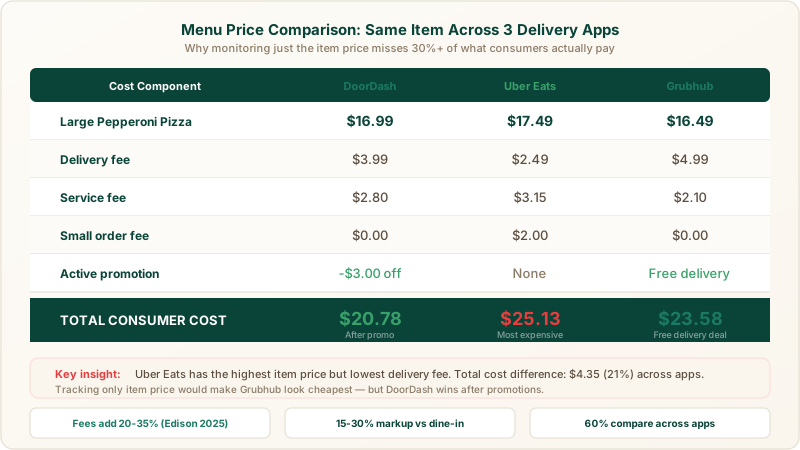
Effective menu price monitoring goes beyond capturing the listed price of each item. Delivery apps layer multiple cost components that influence consumer choice and competitive positioning.
Core data points to extract per menu item include base item price, modifier and add-on prices, combo or bundle pricing, promotional discounts (percentage off, dollar off, BOGO deals), delivery fee by distance tier, service fees, small order fees, and estimated delivery time. Clymin extracts all of these data points simultaneously through its food delivery data scraping service, ensuring you get a complete picture rather than isolated price snapshots.
According to a 2025 Edison Trends analysis, delivery fees and service charges can add 20-35% to the base menu price. Tracking only the item price misses more than a third of what consumers actually pay. A competitor with a higher menu price but lower delivery fees may still appear cheaper to end users.
Geographic variation adds another dimension. The same restaurant chain may price a burger at $12.99 in San Francisco and $10.49 in Hyderabad on the same platform. Clymin's location-aware extraction captures city-level and even ZIP-code-level pricing differences across all target markets.
How to Analyze Competitor Menu Price Data for Strategic Decisions
Collecting data is only the starting point. Transforming menu price data into competitive advantage requires structured analysis frameworks.
Price gap analysis identifies where your menu items are priced significantly above or below competitors for comparable products. A gap exceeding 10% on high-volume items (burgers, pizza, fried chicken) typically signals an opportunity to adjust pricing or a risk of losing price-sensitive customers.
Platform pricing variance reveals how competitors price the same item differently across DoorDash, Uber Eats, and Grubhub. Some restaurants absorb platform commissions differently, leading to 5-15% price differences for identical items across apps. Tracking these differences helps you optimize your own platform-specific pricing strategy.
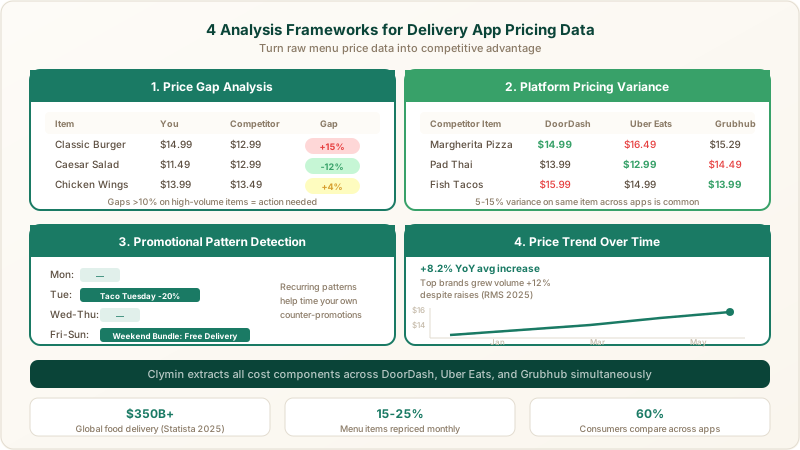
Promotional pattern detection uncovers recurring discount cycles. Many restaurants run weekly promotions (Taco Tuesday, Weekend Deals) that follow predictable patterns. Identifying these cycles lets you time your own promotions to counter or complement competitor offers. For a deeper look at how competitors stack up across delivery platforms, see the Grubhub vs DoorDash market share comparison.
Trend analysis over time tracks whether competitors are gradually raising prices, absorbing cost increases, or shifting toward value-focused bundle pricing. According to Revenue Management Solutions' 2025 Restaurant Pricing Report, the average restaurant adjusted delivery menu prices upward by 8.2% year-over-year, but top-performing brands used data-driven pricing to grow order volume by 12% despite raising prices.
Common Challenges When Scraping Delivery App Menu Data
Delivery apps present specific technical challenges that make DIY scraping unreliable for sustained menu price monitoring.
Dynamic content rendering is the first barrier. Uber Eats and DoorDash heavily rely on JavaScript-based rendering, meaning traditional HTTP scrapers see empty pages. Headless browser automation solves this but requires significant infrastructure and maintenance.
Anti-bot protections are increasingly aggressive across delivery platforms. DoorDash uses CAPTCHAs, rate limiting, and device fingerprinting to detect automated access. Grubhub employs similar measures. Clymin's AI agents rotate through residential IP pools and mimic human browsing patterns to maintain consistent access without triggering blocks.
Menu structure inconsistencies create data quality issues. Restaurants format menus differently across platforms, use inconsistent naming conventions, and frequently add or remove items. A managed scraping service maintains entity resolution logic that keeps your dataset clean despite these inconsistencies.
Scale limitations affect DIY approaches most acutely. Monitoring 50 competitors across 3 platforms in 10 cities means tracking 1,500 restaurant-platform combinations, each with dozens of menu items. Clymin has delivered hundreds of data extraction projects and handles this scale through its distributed AI-agentic architecture, which adapts automatically as menus and platform structures change.
How Clymin Helps Food Delivery Businesses Monitor Competitor Prices
Clymin's menu price monitoring service is purpose-built for the food delivery industry. Rather than selling you a tool and leaving you to handle the technical complexity, Clymin delivers clean, structured, ready-to-analyze pricing datasets on your schedule.
The fully managed approach means zero technical overhead. Clymin's team configures extraction for your specific competitive set, handles ongoing maintenance when delivery apps change their layouts, and delivers normalized data through REST APIs, direct database integration, or scheduled file drops.
With over a decade of experience in data extraction and over 100 billion data points extracted across industries, Clymin brings proven reliability to food delivery price intelligence. The AI-agentic scraping approach means extraction agents learn and adapt to platform changes, reducing downtime compared to static scraping tools that break whenever DoorDash or Uber Eats updates their site structure.