
Why Do Delivery Platforms Need a Menu Price Monitoring Service?
Food delivery platforms compete on restaurant selection, delivery speed, and pricing. Only one of those three, pricing, changes multiple times per week across thousands of restaurant listings. Without systematic menu price monitoring, growth teams make expansion and commission decisions based on stale data that misrepresents the competitive landscape.
The scale of menu pricing volatility makes manual tracking impossible. A mid-size delivery platform operating in 15 metro markets tracks approximately 50,000 restaurant listings across three to four competing platforms. That represents 150,000 to 200,000 menu price points shifting independently. According to McKinsey's 2025 Food Delivery Economics Report, restaurant partners adjust delivery-app menu prices 2.3 times per month on average, with fast-casual chains adjusting weekly in competitive zones.
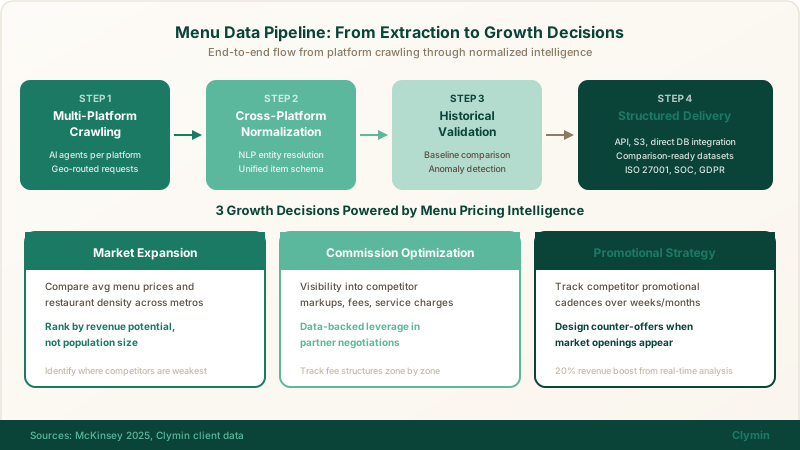
Clymin's menu price monitoring service automates the entire collection workflow. AI agents crawl target platforms daily, extract structured menu data, validate accuracy against historical baselines, and deliver comparison-ready datasets to your analytics stack. Growth teams gain real-time visibility into competitor pricing instead of quarterly snapshots assembled from screenshots.
What Menu Pricing Data Does Clymin Capture?
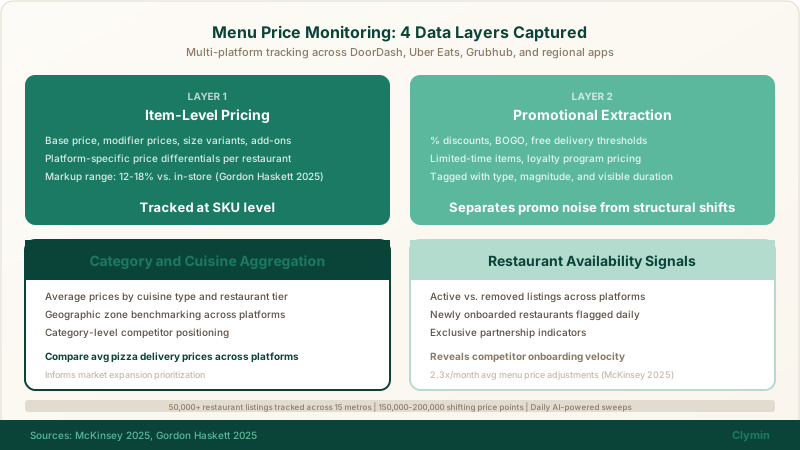
Effective menu pricing intelligence goes beyond recording a dollar amount next to a dish name. Clymin's restaurant menu data aggregation service captures multi-layered data that reveals the competitive strategy behind each price point.
Item-level pricing forms the baseline. Clymin records each menu item's base price, modifier prices (size variants, add-ons, substitutions), and platform-specific price differentials. Research from Gordon Haskett's 2025 Restaurant Delivery Pricing Study found that identical menu items are priced 12% to 18% higher on delivery platforms compared to in-store, but that markup varies by platform, creating arbitrage opportunities for growth teams who track the spread.
Promotional layer extraction captures discounts, bundle deals, free delivery thresholds, and limited-time offers that distort raw price comparisons. Clymin's AI agents identify promotion type, discount magnitude, and visible duration for each offer. Separating structural pricing from promotional activity lets your team distinguish between permanent competitive repositioning and short-term campaign noise.
Category and cuisine aggregation rolls item-level data into market-level insights. Clymin computes average prices by cuisine type, restaurant tier, and geographic zone, enabling growth teams to benchmark their platform's restaurant pricing against competitors at the category level rather than item by item. A Head of Growth evaluating expansion into a new metro can compare average pizza delivery prices across platforms before committing resources.
Restaurant availability signals track which restaurants appear active on which platforms, including newly onboarded listings, removed listings, and exclusive partnership indicators. Monitoring restaurant availability alongside pricing data reveals competitor onboarding velocity and partnership strategy, intelligence that informs your own merchant acquisition priorities.
How Does Clymin Track Competitor Menu Prices Across Platforms?
Clymin's extraction approach handles the technical complexity of multi-platform menu monitoring so your growth team focuses on strategy rather than data engineering. For a detailed walkthrough of the underlying AI-agentic extraction technology, see how Clymin's AI-agentic scraping works.
Platform-specific AI agents are configured for each target delivery app's structure, handling dynamic rendering, location-based content loading, and authentication-gated menus. Each agent adapts automatically when platforms update their frontend, eliminating the maintenance burden that breaks DIY scraping setups within weeks of deployment.
Geographic routing ensures menu data reflects what customers actually see in each market. Clymin routes extraction requests through location-specific endpoints, capturing the exact pricing, restaurant selection, and promotional offers visible to consumers in each target city or ZIP code. National delivery platforms serve different menus and prices by location, making geo-accurate extraction essential for competitive analysis.
Cross-platform normalization reconciles naming variations, category differences, and modifier structures across platforms into a unified schema. "Margherita Pizza (Large)" on DoorDash, "Lg Margherita" on Uber Eats, and "12-inch Classic Margherita" on Grubhub map to the same normalized item, enabling true apples-to-apples price comparison across your competitive set.
Clymin's extraction infrastructure is backed by ISO 27001 certification, AICPA SOC compliance, and GDPR-ready protocols. All menu data is sourced from publicly available listings using ethical collection practices.
What Decisions Does Menu Pricing Intelligence Drive for Growth Teams?
Raw menu prices become actionable intelligence when growth teams apply them to the decisions that directly impact platform revenue and market share.
Market expansion prioritization. Comparing average menu prices and restaurant density across metro markets reveals where competitors are weakest and where consumer demand outpaces supply. Clymin clients use market-level pricing benchmarks to rank expansion targets by revenue potential rather than population size alone. For a deeper analysis of competitive positioning between major platforms, see the Grubhub vs. DoorDash market share data comparison.
Commission and fee optimization. Restaurant partners frequently negotiate commission rates based on what competing platforms charge. Continuous visibility into competitor pricing structures, including platform-specific markups, delivery fees, and service charges, gives your partnerships team data-backed leverage in commission negotiations.
Promotional strategy calibration. Tracking competitor promotional cadences across weeks and months reveals seasonal patterns, launch strategies, and response triggers. Growth teams using Clymin's promotional data design counter-offers that activate precisely when competitor campaigns create market openings, rather than running promotions on arbitrary schedules.
Sarah T., Marketing Manager at an E-Commerce company, experienced comparable intelligence-driven gains: "Clymin's data insights helped us boost revenue by 20% through real-time market trend and competitor pricing analysis." Delivery platforms applying the same continuous monitoring approach to menu data achieve similar competitive advantages in restaurant-side negotiations and consumer-facing pricing.
Why Choose Clymin's Managed Service Over Building Menu Monitoring In-House?
Building and maintaining a multi-platform menu extraction pipeline demands specialized infrastructure that diverts engineering resources from your core platform. Clymin's managed approach absorbs the full technical burden so your team ships product features instead of maintaining scrapers.
Delivery platforms that attempt DIY menu scraping face three persistent challenges. First, platform anti-bot defenses evolve monthly, DoorDash, Uber Eats, and Grubhub each deploy different detection mechanisms that require ongoing reverse-engineering. Second, menu data normalization across platforms requires natural language processing and entity resolution that goes beyond basic extraction. Third, scaling from 5,000 to 50,000 tracked restaurants demands infrastructure investment that compounds with each new market. For a detailed cost-benefit breakdown of managed extraction versus in-house solutions, see the managed food delivery scraping vs. DIY comparison.
Clymin handles all three challenges as a managed service, backed by over a decade of extraction infrastructure built to process billions of data points. Your growth team receives clean, normalized, delivery-ready datasets without hiring a single data engineer to maintain the pipeline.
Ready to Monitor Menu Prices Across Delivery Platforms?
Stop making expansion and pricing decisions based on competitor data that is weeks old. Clymin's menu price monitoring service delivers daily, validated competitive intelligence across every platform and market that matters to your growth strategy, backed by 40+ enterprise customers and operating from San Francisco and Hyderabad.
Reach out at contact@clymin.com or schedule a free consultation to configure a menu monitoring program tailored to your platform coverage, target markets, and analytics workflow.