
National Market Share Context
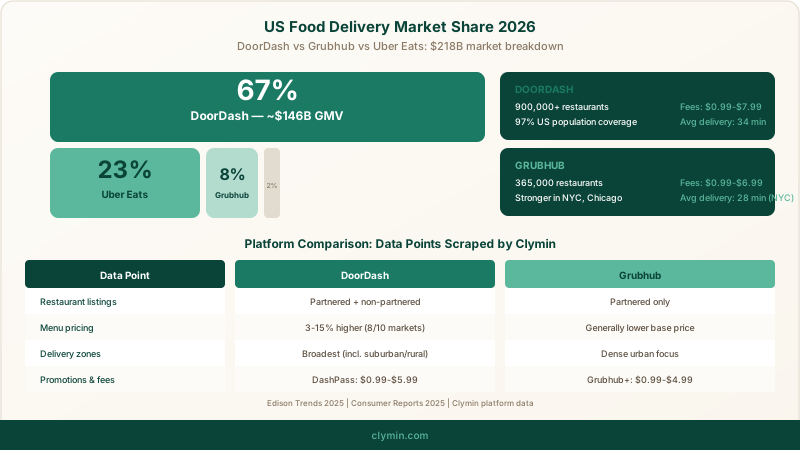
The US food delivery market reached $218 billion in gross merchandise value during 2025, according to Edison Trends data. DoorDash's 67% share translates to approximately $146 billion in order volume. Grubhub's 8% represents roughly $17 billion, still a substantial business despite its decline from the 30%+ share it held in 2019.
Understanding how these shares distribute geographically matters more than national numbers for most business decisions. A restaurant choosing between platforms needs to know which delivers more orders in their specific neighborhood. An investor evaluating Grubhub's value needs to understand where it remains competitive.
Clymin scrapes both platforms across all US markets, providing the ground-level data that national market share reports cannot capture.
Restaurant Coverage Comparison
Restaurant coverage, the number and type of restaurants available on each platform, is the primary driver of market share and consumer preference.
DoorDash restaurant coverage spans 900,000+ restaurants across the US, including both partnered restaurants (with direct integration agreements) and non-partnered listings where DoorDash places orders on behalf of customers. This "marketplace" approach maximizes selection but creates operational complexity.
Grubhub restaurant coverage focuses primarily on partnered restaurants with approximately 365,000 listings. Grubhub's higher partnership penetration means restaurants on its platform generally have tighter integration, dedicated tablets, and optimized menus for delivery.
Clymin tracks coverage changes daily across both platforms. New restaurant additions, removals, and status changes provide leading indicators of platform strategy shifts. When DoorDash adds 50 restaurants in a zip code overnight, it signals a market expansion push that competitors should note.
Pricing and Fee Structure Analysis
Scraping menu pricing and fee structures from both platforms reveals competitive positioning:
Delivery fees vary significantly. DoorDash charges $0.99-$5.99 for DashPass members and $2.99-$7.99 for non-members. Grubhub's fees range from $0.99-$4.99 for Grubhub+ members and $1.99-$6.99 for standard orders. These fees change by market, time of day, and demand level.
Menu pricing often differs for the same restaurant across platforms. A 2025 Consumer Reports study found that identical menu items cost 3-15% more on DoorDash compared to Grubhub for the same restaurant in 8 of 10 markets tested. These differences reflect commission structures, promotional subsidies, and restaurant pricing strategies.
Service fees and small order fees add additional cost layers that affect consumer choice. Clymin captures all fee components to calculate true order costs across platforms.
Promotional discounts including percentage-off deals, free delivery offers, and platform-specific coupons shift effective pricing daily. Clymin monitors promotional activity to understand how each platform uses discounts to drive order volume.
Delivery Zone and Speed Comparison
DoorDash maintains the broadest delivery zone coverage, reaching 97% of the US population including suburban and rural areas where Grubhub has limited or no presence. DoorDash's expansion into non-restaurant delivery (convenience, grocery, alcohol) extends its driver network into areas where food-only platforms struggle to maintain coverage.
Grubhub concentrates delivery zones in dense urban and suburban areas where order density supports efficient driver economics. This focus results in faster delivery times in core markets, Grubhub's average delivery time in New York City is 28 minutes compared to DoorDash's 34 minutes, according to 2025 platform data scraped by Clymin.
Delivery zone boundary data reveals where each platform is expanding or contracting. Clymin maps zone changes over time to identify market entry and exit patterns.
How Clymin Collects Food Delivery Market Data
Clymin's extraction pipeline for food delivery platforms captures:
Restaurant-level data: Name, cuisine type, address, operating hours, rating, review count, delivery radius, menu items, pricing, and promotional offers. Updated daily for active restaurants across both platforms.
Fee and pricing data: Delivery fees, service fees, small order fees, and dynamic pricing changes captured hourly during peak ordering periods. This data reveals platform pricing strategies and seasonal adjustments.
Geographic coverage data: Delivery zone boundaries, available restaurant counts by zip code, and coverage gap analysis between platforms. Updated weekly to track expansion patterns.
Promotional activity: Active promotions, discount codes, loyalty program offers, and platform-subsidized deals scraped daily. Promotional spending patterns indicate competitive intensity in specific markets.
Both DoorDash and Grubhub implement anti-scraping measures including rate limiting, geographic restrictions, and dynamic rendering. Clymin's AI-powered extraction agents handle these challenges through residential proxy networks, adaptive browser rendering, and continuous monitoring that detects and adapts to platform changes.
Use Cases for Comparative Market Share Data
Restaurant chains use Clymin's comparative data to optimize their multi-platform strategy: which platform to prioritize in each market, how to price menus across platforms, and where exclusive promotions generate the highest incremental order volume.
Food delivery startups entering specific markets use coverage gap data to identify underserved restaurants and neighborhoods where a new platform could differentiate.
Investors and analysts tracking the food delivery sector use Clymin's data for market share validation, competitive trend analysis, and investment thesis development.
CPG brands selling through delivery platforms use restaurant and menu data to understand distribution reach, pricing trends, and promotional effectiveness across platforms.
Beyond DoorDash and Grubhub
Comprehensive food delivery intelligence requires data from the full platform ecosystem. Clymin also extracts from Uber Eats (23% market share), Postmates (now part of Uber), regional platforms like Slice (pizza-focused) and Caviar (now DoorDash), and emerging players targeting specific niches or markets.
Multi-platform extraction through a single managed service eliminates the complexity of building and maintaining separate scrapers for each platform.
Get Food Delivery Market Intelligence
Clymin configures food delivery platform data extraction within 5-7 business days, covering DoorDash, Grubhub, Uber Eats, and additional platforms across your target markets.
Contact the team at contact@clymin.com or book a meeting to discuss your food delivery data requirements.