What Determines Food Delivery Data Scraping Cost?
Two things move food delivery cost more than anything else: how many menus you cover and how often you refresh them. A one-city, single-platform daily pull sits at the low end, while nationwide, multi-app, intraday coverage sits at the high end. Five factors decide where a given project lands.
The main cost drivers for food delivery data scraping:
- Restaurant count. More restaurants tracked means more menus and more records.
- Platform count. Each platform (DoorDash, Uber Eats, Grubhub, Swiggy, Zomato) adds coverage and its own defenses.
- City coverage. Delivery data is local, so each additional city multiplies the restaurants observed.
- Refresh frequency. Daily is cheaper than intraday; live availability tracking costs the most.
- App-only fields. Live ETAs, availability, and coverage often require harder, costlier app extraction.
Because these compound, the honest way to price food delivery data is against your real platforms and cities, which is what a pilot reveals. For the full playbook, see our guide on web scraping for food delivery.
How Providers Price Food Delivery Data
Most food delivery quotes come in one of three shapes: per record delivered, per request, or a monthly retainer sized to volume and frequency. Per-record is the clearest, because one record is one menu item at one restaurant on one platform at one moment, so cost tracks directly with the restaurants, platforms, and cities you add.
The per-record rate varies with source difficulty and frequency. A simple daily menu pull carries a low rate; high-frequency availability tracking across mobile apps carries a higher one because it costs more to collect reliably. For the adjacent grocery channel, see grocery delivery app data extraction.
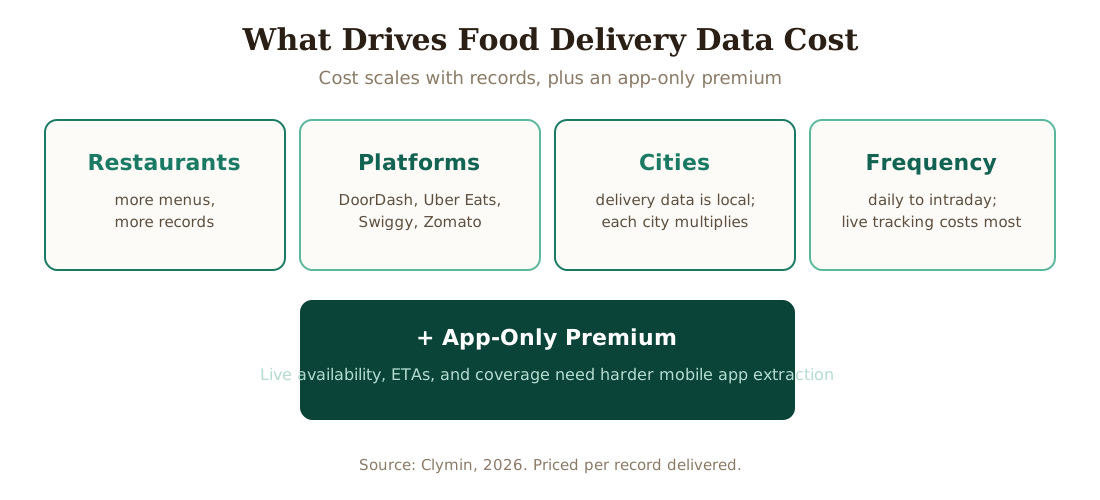 Food delivery cost scales with records: restaurants times items times platforms times frequency, plus an app-only premium.
Why App-Only Data Raises the Cost
Much of the highest-value food delivery data is app-only. Live availability, delivery ETAs, and coverage often exist only inside native iOS and Android apps, not the website. App-level extraction captures them, but it is harder than web scraping and breaks more often, which raises the per-record rate for those fields.
According to Imperva's 2024 Bad Bot Report, automated traffic made up nearly half of all internet traffic in 2023, and high-value delivery platforms respond with strong defenses. That collection difficulty, not the analysis, is what buyers are really paying for.
Food Delivery Data ROI: A Delivery Startup Example
The right way to judge cost is against the value the data creates. Consider a delivery startup tracking competitor menus, prices, and promotions across two platforms in five cities to inform its own pricing and offers. According to Statista's 2025 data, online food delivery is a multi-hundred-billion-dollar global market still growing at double digits, so small competitive advantages compound quickly.
If continuous menu and promotion data lets the startup time offers better and avoid mispricing on even a slice of orders, the margin gained dwarfs the cost of the data feed. That is why food delivery buyers focus on cost per record and total value, not the headline data spend: the data is a small input to a large decision.
In-House vs Managed Cost for Food Delivery Data
Building food delivery scraping in-house looks cheaper until you count the full bill: engineers, proxy and mobile-app infrastructure, and the constant maintenance of scrapers that break every time a delivery app redesigns. Delivery apps ship changes often, so that maintenance line never goes away. According to Grand View Research's 2024 analysis, the web scraping software market topped $1 billion in 2023 with double-digit annual growth, a sign that the real spend in this space is the engineers who keep pipelines alive, not the software licenses.
A managed service folds infrastructure, anti-bot handling, and maintenance into one per-record price. For the full build-versus-buy math, see managed web scraping versus building in-house.
How Clymin Prices Food Delivery Data Scraping
Clymin prices food delivery data scraping on one metric: cost per record delivered. There are no setup fees, no monthly platform fees, and no customization charges. Anti-bot handling, app extraction, maintenance, and cleansing are included, so the per-record rate is the whole cost.
That rate reflects the real drivers, restaurant and platform count, city coverage, frequency, and app difficulty, rather than a headline subscription. Clymin runs a free pilot on your platforms and cities first, so the quote is based on your actual data. For the commercial overview, see the food delivery data scraping service.
Ready to Get a Food Delivery Data Quote?
Tell us your platforms, cities, and restaurants, and Clymin will run a free pilot and quote a per-record price on your real data before you commit. Email contact@clymin.com or start a free pilot, one metric, cost per record delivered, no setup fees.