
Why Heads of Growth Need Cross-Platform Delivery Performance Tracking
Food delivery competition in 2026 hinges on operational execution measured in minutes and fractions of a star rating. A Head of Growth managing expansion across multiple metro areas cannot rely on internal dashboards alone, competitive benchmarking requires visibility into rival platforms' delivery times, pricing patterns, and coverage boundaries.
According to Statista's 2025 Online Food Delivery report, the United States food delivery market reached $96.5 billion in revenue, with three-platform overlap in over 85% of urban zip codes. Winning market share in this environment demands real-time performance comparisons that manual spot-checking cannot deliver at scale.
McKinsey's 2024 last-mile delivery research found that a one-minute reduction in average delivery time correlates with a 0.5% increase in order volume per zone. For a platform processing 50,000 daily orders across 30 metro zones, shaving two minutes off delivery time in underperforming areas translates to 500 additional daily orders, compounding to over 180,000 incremental orders per year.
What Delivery KPIs Does Clymin Track Across Platforms?
Clymin's delivery app performance monitoring captures six core KPI categories that growth teams use to benchmark competitive positioning and identify operational advantages.
Delivery time by zone and cuisine category forms the foundation of competitive benchmarking. Clymin's AI agents record estimated and actual delivery times across grid-level zones, broken down by restaurant category, time of day, and day of week. Growth teams see exactly where competitors deliver faster, and where their own platform holds a speed advantage worth promoting to consumers.
Surge pricing frequency and multiplier tracking reveals how competitors manage demand spikes. Clymin logs every surge pricing event including activation time, multiplier level, duration, and geographic scope. Platforms that surge less frequently or at lower multipliers during peak hours gain a quantifiable consumer value advantage that growth teams can highlight in marketing campaigns.
Driver availability and estimated wait times expose the labor supply dynamics behind delivery speed. When a competitor's estimated delivery time jumps from 25 minutes to 45 minutes in a specific zone, the root cause is often driver supply rather than restaurant prep time. Clymin tracks these patterns so operations teams can deploy driver incentives precisely where and when competitors face supply shortages.
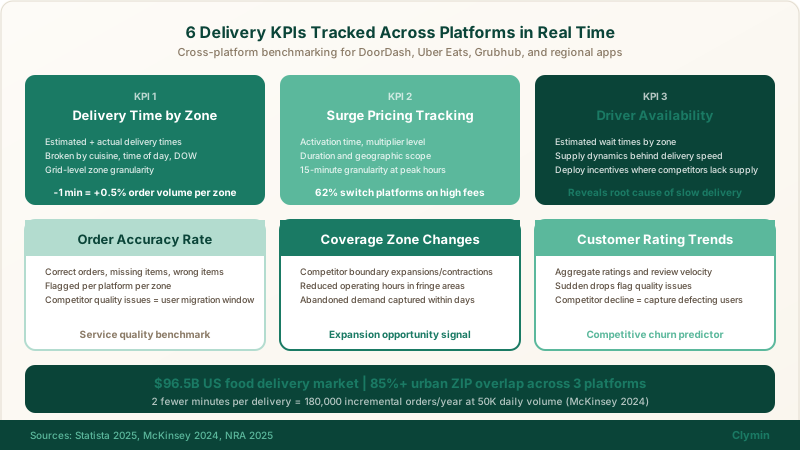
Cross-platform delivery KPI dashboard: delivery times, surge pricing, driver availability, order accuracy, coverage zones, and ratings tracked in real time.
How Delivery Time Monitoring Drives Zone Expansion Decisions
Zone expansion represents one of the highest-stakes decisions a food delivery growth team makes. Launching in a new zone requires driver recruitment, restaurant onboarding, and marketing spend, all wasted if the competitive landscape was misjudged. Clymin's delivery time monitoring across platforms provides the intelligence layer that de-risks these investments.
Growth teams using Clymin's data identify expansion targets by filtering for zones where competitor average delivery times exceed 40 minutes consistently. Long delivery times signal either insufficient driver supply or low restaurant density, both conditions that a well-prepared market entrant can exploit. Clymin's food delivery data scraping service captures the restaurant-level data needed to validate whether supply-side infrastructure supports a profitable launch.
Coverage zone monitoring also reveals competitor retreats. When a rival platform's coverage boundary contracts, dropping outlying zip codes or reducing operating hours in fringe areas, Clymin flags the change within one monitoring cycle. Growth teams that act on these signals within days capture abandoned consumer demand before competitors re-enter.
For platforms weighing DoorDash versus Grubhub positioning in specific markets, Clymin's market share data analysis provides the order volume and restaurant count context that pairs with delivery time benchmarks for complete competitive intelligence.
Surge Pricing Intelligence and Customer Rating Benchmarks
Surge pricing strategy directly impacts both revenue per order and long-term customer retention. According to the National Restaurant Association's 2025 industry report, 62% of food delivery consumers say they have switched platforms specifically because of high delivery fees or surge charges. Monitoring competitor surge behavior gives growth teams the data to calibrate pricing that maximizes revenue without driving users to rivals.
Clymin tracks surge pricing events at 15-minute granularity during peak hours, logging the exact multiplier, geographic scope, and duration for each competitor platform. Growth teams use these logs to build predictive models, identifying which weather conditions, sporting events, or holidays trigger competitor surges, and position their own platform as the lower-cost option during high-demand periods.
Customer rating trends complete the performance picture. Clymin monitors aggregate ratings and review velocity across platforms, flagging sudden drops that indicate service quality issues competitors may be experiencing. A competitor's rating decline in a specific zone often precedes consumer migration, giving growth teams a window to capture defecting users through targeted promotions.
Sarah T., Marketing Manager at a Clymin E-Commerce client, noted: "Clymin's data insights helped us boost revenue by 20% through real-time market trend and competitor pricing analysis." Food delivery growth teams apply the same competitive data advantage to optimize platform positioning and capture market share.
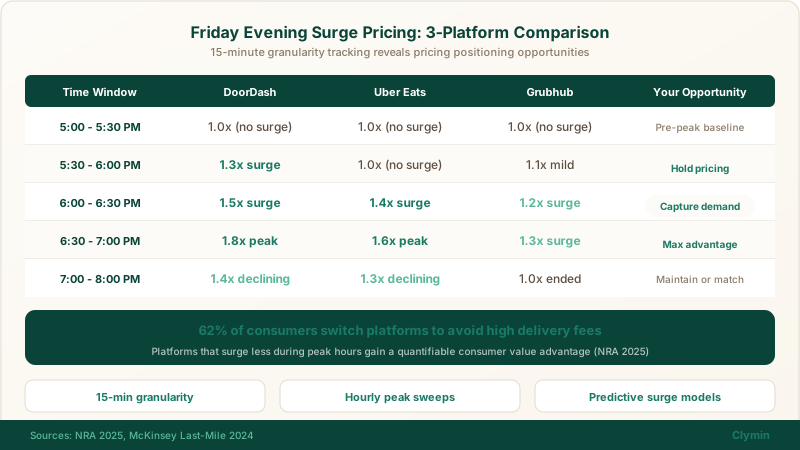
Friday evening surge pricing patterns across three major platforms, timing and multiplier data enables strategic pricing positioning.
How Clymin Monitors Delivery Apps Without Technical Overhead
Clymin's AI-agentic scraping approach handles the complexity of extracting structured performance data from delivery platforms that frequently update their interfaces and anti-scraping defenses. Growth teams receive clean, normalized KPI dashboards, not raw HTML or inconsistent data dumps.
For teams evaluating whether to build delivery monitoring in-house, Clymin's analysis of managed scraping versus DIY approaches breaks down the engineering hours, maintenance burden, and data quality tradeoffs. Most growth teams find that the 12+ months needed to build reliable cross-platform monitoring internally costs more than outsourcing to Clymin's managed service, which deploys production-quality monitoring within weeks.
Clymin delivers monitoring data through REST APIs, scheduled CSV/JSON exports, or direct cloud storage integration (S3, GCS), configured to match each client's analytics stack. With ISO 27001 certification, AICPA SOC compliance, and GDPR readiness, Clymin meets the data security requirements of enterprise food delivery platforms operating across regulated markets.
Start Monitoring Delivery App Performance Today
Clymin has helped 40+ customers across hundreds of projects transform competitive data into measurable business advantages over a decade of operation. Food delivery growth teams gain cross-platform visibility into the KPIs that drive zone expansion, pricing strategy, and operational optimization.
Contact Clymin at contact@clymin.com to schedule a free consultation, or book a meeting directly. Visit clymin.com/contact to get started.