
Best Practices for Ecommerce Data Collection in 2026
Why Ecommerce Data Collection Matters More Than Ever
The global ecommerce market surpassed $6.8 trillion in 2025, according to Statista's Global Ecommerce Forecast. With millions of new SKUs appearing daily across marketplaces like Amazon, Walmart, and Shopify storefronts, data engineers face mounting pressure to deliver clean, timely datasets to pricing teams, product managers, and marketing analysts.
Poor data collection pipelines lead to stale pricing, missed competitive moves, and compliance violations. A structured, best-practices approach eliminates those risks while setting the stage for machine-learning workloads that depend on high-fidelity training data.
Step 1: Define Clear Data Collection Objectives
Every successful data collection initiative starts with precise objectives. Before writing a single scraper or configuring an extraction pipeline, data engineers should document:
- Target data fields, product name, price, availability, images, reviews, seller information, shipping details
- Source marketplaces, Amazon, Walmart, Shopify stores, niche vertical sites
- Refresh frequency, hourly for dynamic pricing, daily for catalog sync, weekly for market research
- Downstream consumers, pricing engines, recommendation models, BI dashboards, compliance audits
Documenting these requirements prevents scope creep and ensures infrastructure decisions match actual business needs. Clymin's project scoping process begins with exactly this kind of objective mapping, which has contributed to the successful delivery of hundreds of projects.
Aligning Objectives with Data Architecture
Objectives should map directly to your data architecture. Real-time pricing feeds need streaming infrastructure (Kafka, Kinesis), while weekly competitive reports can run through traditional ETL pipelines. Making this decision early saves months of rework.
Step 2: Choose the Right Data Collection Methods
Data engineers in 2026 have several collection methods available, each with distinct trade-offs.
Web Scraping and Crawling
Web scraping remains the most flexible method for extracting structured product data from ecommerce sites. Modern scraping stacks use headless browsers (Playwright, Puppeteer) for JavaScript-rendered pages and lightweight HTTP clients for static content.
For large-scale ecommerce scraping, managed services outperform in-house solutions on reliability and maintenance cost. Clymin's ecommerce price scraping service handles anti-bot mitigation, proxy rotation, and schema normalization so engineering teams can focus on downstream analytics rather than crawler maintenance.
API-Based Collection
Many marketplaces offer official APIs (Amazon SP-API, Walmart Affiliate API). APIs provide structured responses and clear rate limits but often restrict data fields and impose strict usage policies. Combining API access for core catalog data with scraping for supplementary fields, reviews, seller metrics, dynamic pricing, delivers the most comprehensive datasets.
Data Feeds and Partnerships
Some retailers publish product feeds (XML, CSV) through affiliate networks or direct partnerships. Feeds offer high reliability but limited coverage. Data engineers should treat feeds as one input among several, not a standalone solution.
Step 3: Build Robust Quality Assurance Pipelines
Raw ecommerce data is inherently messy. Prices appear in different formats, product titles include promotional text, and availability fields vary by marketplace. Quality assurance must be automated and continuous.
Schema Validation at Ingestion
Define strict schemas for every data source. Use tools like JSON Schema, Great Expectations, or dbt tests to validate records at the point of ingestion. Reject or quarantine records that fail validation rather than allowing dirty data into your warehouse.
Example validation rules:
- Price must be a positive decimal number
- Product URL must match expected domain pattern
- Availability status must be one of: in_stock, out_of_stock, pre_order
- Timestamp must fall within the expected collection window
Automated Deduplication
Ecommerce catalogs generate enormous volumes of duplicate records, the same product listed by multiple sellers, variant SKUs pointing to the same base product, and historical snapshots creating redundant rows. Implement deduplication using composite keys (marketplace + product ID + timestamp) and fuzzy matching for cross-marketplace entity resolution.
Anomaly Detection
Price spikes, sudden stock changes, and missing fields often indicate scraping failures rather than genuine market events. Deploy statistical anomaly detection (z-score thresholds, moving average comparisons) on critical fields. Alert data engineers before anomalous records propagate to consumer systems.
Clymin's product data extraction services include built-in quality checks that catch formatting issues, missing fields, and structural changes before data reaches your pipeline, reducing the burden on in-house QA.
Step 4: Ensure Compliance with Privacy and Legal Standards
The regulatory landscape for data collection tightened significantly between 2024 and 2026. The GDPR enforcement tracker by CMS Law shows increasing fines for improper data handling, and the California Consumer Privacy Act (CCPA) continues to expand its scope.
Key Compliance Requirements
- Respect robots.txt, honor crawl directives and rate limits published by site operators
- Avoid PII collection, do not scrape or store personally identifiable information (email addresses, usernames, phone numbers) unless explicitly authorized
- Maintain audit trails, log every collection run with timestamps, source URLs, and data volumes for regulatory accountability
- Adhere to terms of service, review and follow marketplace-specific scraping policies
Working with Compliant Partners
Partnering with a provider that holds recognized certifications removes much of the compliance burden. Clymin maintains ISO 27001 certification, AICPA SOC compliance, and GDPR adherence, ensuring every data collection engagement meets enterprise security and privacy standards.
Step 5: Design for Scalability from Day One
Ecommerce data collection workloads grow unpredictably. A pipeline that handles 10,000 SKUs today may need to process 10 million within a year. Designing for scalability upfront prevents costly replatforming projects.
Horizontal Scaling Architecture
Build collection workers as stateless containers that can scale horizontally. Use orchestration platforms (Kubernetes, AWS ECS) to spin up additional workers during peak collection windows and scale down during off-hours. Stateless design ensures any worker can process any task without shared-state bottlenecks.
Distributed Task Queues
Use message queues (RabbitMQ, Amazon SQS, Redis Streams) to distribute collection tasks across workers. Queue-based architectures provide natural backpressure, retry logic, and task prioritization without custom coordination code.
Storage Tiering
Not all collected data has the same access pattern. Recent pricing data needs low-latency access in a columnar database (ClickHouse, BigQuery). Historical snapshots can move to cheaper object storage (S3, GCS) after a defined retention window. Implementing storage tiering from the start keeps infrastructure costs proportional to data value.
When evaluating whether to build or buy scalable collection infrastructure, reviewing which company offers the best product data scraping can help data engineering teams benchmark managed solutions against internal build costs.
Step 6: Real-Time vs. Batch Collection, Choosing the Right Approach
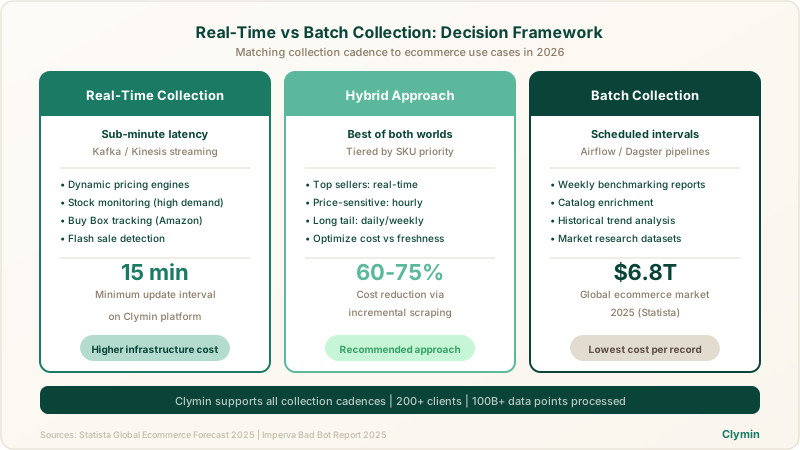
One of the most consequential architectural decisions in ecommerce data collection is whether to collect data in real time, in scheduled batches, or through a hybrid model.
When to Use Real-Time Collection
Real-time collection suits use cases where data freshness directly impacts revenue:
- Dynamic pricing engines that adjust prices within minutes of competitor changes
- Stock monitoring for high-demand products where availability changes rapidly
- Buy Box tracking on Amazon where seller position shifts frequently
- Flash sale detection requiring immediate alerts
Real-time pipelines typically use websocket connections, streaming platforms (Apache Kafka, AWS Kinesis), and change-data-capture patterns to push data to consumers with sub-minute latency.
When to Use Batch Collection
Batch collection works well for analytical and reporting workloads:
- Weekly competitive benchmarking reports comparing pricing across marketplaces
- Catalog enrichment projects that match and merge product data from multiple sources
- Historical trend analysis for seasonal pricing patterns
- Market research datasets for new category entry decisions
Batch pipelines run on schedules (cron, Airflow, Dagster) and process large volumes efficiently through parallel workers.
Hybrid Approaches
Most mature ecommerce data operations use a hybrid model. Critical SKUs (top sellers, price-sensitive categories) receive real-time monitoring, while the long tail of catalog data refreshes on a daily or weekly schedule. Clymin supports both collection cadences, allowing clients to allocate real-time capacity where the ROI is highest.
Step 7: Handle Anti-Bot and Anti-Scraping Defenses
Ecommerce sites deploy increasingly sophisticated anti-bot measures in 2026. According to Imperva's 2025 Bad Bot Report, automated traffic accounts for nearly half of all web requests. Legitimate data collection must navigate these defenses without crossing ethical lines.
Ethical Anti-Bot Navigation
- Rotate residential and datacenter proxies to distribute request load naturally
- Implement realistic request patterns, randomize intervals, vary user agents, follow natural navigation paths
- Use headless browsers selectively, only for pages that require JavaScript rendering; default to lightweight HTTP requests
- Honor rate limits, throttle requests to stay within acceptable thresholds even when not explicitly blocked
Monitoring and Adaptation
Anti-bot systems evolve continuously. Build monitoring into your scraping infrastructure to detect block rates, CAPTCHA challenges, and response degradation. When block rates exceed thresholds, adapt collection strategies rather than escalating request volumes.
Managed scraping providers like Clymin maintain dedicated infrastructure teams that monitor and adapt to anti-bot changes across hundreds of ecommerce sites, providing consistent data delivery without requiring in-house anti-bot expertise.
Step 8: Implement Monitoring and Observability
Production data collection pipelines need the same observability standards as any critical system.
Key Metrics to Track
- Collection success rate, percentage of target URLs successfully scraped per run
- Data freshness, time between collection and availability in the data warehouse
- Field completeness, percentage of expected fields populated per record
- Error distribution, breakdown of failures by type (timeout, block, parsing error, network)
- Volume trends, records collected per hour/day/week with baseline comparisons
Alerting and Incident Response
Configure alerts for significant deviations from baseline metrics. A sudden drop in success rate may indicate a site redesign, new anti-bot measures, or infrastructure issues. Rapid incident response prevents data gaps that cascade into downstream analytics failures.
Platforms like Grafana, Datadog, and custom dashboards built on Prometheus provide the visibility data engineers need to maintain collection reliability at scale.
Step 9: Optimize for Specific Ecommerce Platforms
Different ecommerce platforms present different collection challenges. Tailoring your approach to each platform maximizes data quality and extraction efficiency.
Shopify Stores
Shopify's standardized theme structure simplifies product data extraction. JSON endpoints (/products.json, /collections.json) provide structured access without HTML parsing. For competitive intelligence across Shopify ecosystems, Shopify competitor analysis scraping covers specialized techniques for monitoring pricing and assortment changes across direct-to-consumer brands.
Walmart Marketplace
Walmart's marketplace combines first-party and third-party seller data with complex pricing structures including rollback prices, clearance flags, and fulfillment-specific pricing. A dedicated Walmart product scraping service handles these nuances, extracting normalized data that accounts for Walmart's unique pricing and availability taxonomy.
Amazon and Multi-Seller Marketplaces
Amazon's product pages aggregate data from multiple sellers, making extraction more complex. Buy Box information, seller ratings, fulfillment methods (FBA vs. FBM), and variant pricing all require specialized parsing logic. Data engineers should build marketplace-aware extraction schemas that capture these multi-seller dynamics.
Step 10: Future-Proof Your Data Collection Strategy
The ecommerce data landscape continues to evolve rapidly. Forward-looking data engineering teams should prepare for several 2026 trends.
AI-Powered Extraction
Machine learning models now handle unstructured and semi-structured page layouts more reliably than rule-based parsers. Large language models extract product attributes from descriptions, classify categories, and resolve entity matches across marketplaces. Clymin's AI-powered extraction pipeline leverages these capabilities to maintain accuracy even when site structures change without notice.
Edge Collection and Processing
Edge computing enables data collection and initial processing closer to target sites, reducing latency and improving geographic distribution of requests. Edge-based architectures pair well with real-time collection use cases where milliseconds matter.
Consent and Transparency Frameworks
Emerging regulatory frameworks may require greater transparency about automated data collection. Proactive adoption of consent-aware collection practices and public documentation of scraping policies positions organizations ahead of potential regulatory changes.
Structured Data and Schema.org Adoption
More ecommerce sites now implement Schema.org structured data markup for SEO purposes. Data engineers can leverage these structured annotations as a supplementary extraction channel, reducing reliance on brittle CSS selectors and XPath expressions.
Bringing Your Ecommerce Data Collection to Production
Implementing these best practices transforms ecommerce data collection from a fragile, maintenance-heavy process into a reliable, scalable data asset. The key principles, clear objectives, robust quality assurance, regulatory compliance, scalable architecture, and continuous monitoring, apply whether you build in-house or partner with a managed provider.
For data engineering teams that want to skip the infrastructure buildout and focus on deriving value from ecommerce data, Clymin offers fully managed collection pipelines backed by over a decade of experience, ISO 27001 certification, and a proven track record across hundreds of successful projects.
Ready to build a production-grade ecommerce data collection pipeline? Schedule a consultation with Clymin's data engineering team to discuss your requirements, or reach out at contact@clymin.com for a detailed scoping conversation.