
Product Information and Catalog Data
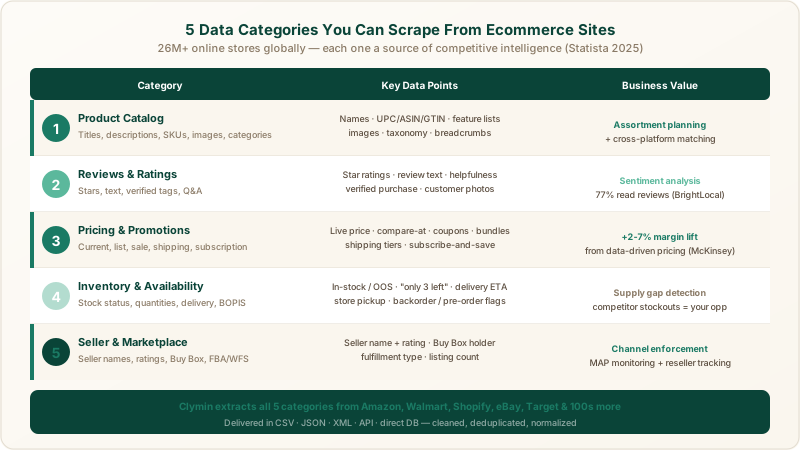
The most commonly scraped ecommerce data type is product catalog information. Every online store maintains structured product listings that contain valuable competitive intelligence when extracted systematically.
Key product data points available for extraction include:
- Product titles and descriptions, full product names, short descriptions, and detailed feature lists
- Pricing data, current prices, original prices, discount percentages, bulk pricing tiers, and currency variations
- Product identifiers, SKUs, UPCs, ASINs, GTINs, and internal product IDs used for cross-platform matching
- Images and media, primary product images, gallery images, 360-degree views, and video URLs
- Category and taxonomy data, breadcrumb paths, category assignments, and tag classifications
According to Statista's Global Ecommerce Report, the number of online stores worldwide exceeded 26 million in 2025, making manual catalog tracking impossible for any business analyst working across competitive landscapes. Automated extraction is the only viable path to comprehensive product intelligence.
Clymin's AI-agentic scraping technology adapts to each store's unique page structure, extracting product data even from heavily JavaScript-rendered storefronts that static scrapers cannot handle. For a deeper look at how pricing data extraction works at scale, see our ecommerce price scraping service.
Customer Reviews and Ratings
Yes, you can scrape product reviews from ecommerce sites, and review data is among the most valuable datasets for competitive analysis and product development.
Extractable review data points include:
- Star ratings, individual review scores and aggregate product ratings
- Review text, full written reviews with sentiment-rich language
- Reviewer metadata, usernames, review dates, verified purchase badges, and helpfulness votes
- Review images, customer-uploaded photos attached to reviews
- Q&A sections, customer questions and seller or community answers
A 2024 analysis by BrightLocal found that 77% of consumers regularly read online reviews when browsing for products. For business analysts, review data feeds directly into sentiment analysis, product gap identification, and competitive positioning strategies.
Clymin extracts review data from platforms including Amazon, Walmart, Best Buy, and thousands of independent Shopify stores. The structured output is ready for integration with natural language processing pipelines or business intelligence dashboards.
Pricing and Promotional Data
Dynamic pricing has become standard across ecommerce in 2026. Extracting pricing data goes beyond capturing a single number, a complete pricing dataset includes multiple dimensions that reveal competitor strategies.
Pricing data types available for scraping:
- Current selling price, the live price displayed to shoppers
- Original or list price, the reference price used to show discounts
- Promotional tags, sale badges, lightning deal indicators, coupon codes, and bundle discounts
- Shipping costs, standard, expedited, and free shipping thresholds
- Subscription pricing, subscribe-and-save discounts and recurring delivery pricing
- Regional price variations, pricing differences across geographies or localized storefronts
According to McKinsey's pricing research, companies using data-driven pricing strategies achieve 2% to 7% higher margins compared to those relying on manual price checks. Business analysts who track competitor pricing data systematically gain a direct advantage in margin optimization.
For a step-by-step approach to building an automated pricing intelligence workflow, read our guide on how to monitor competitor prices automatically.
Inventory and Availability Data
Stock levels and availability signals provide actionable intelligence that many competitors overlook. Ecommerce sites expose inventory data in several ways that can be systematically extracted.
Scrape-able inventory data includes:
- In-stock and out-of-stock status, binary availability indicators
- Stock quantity indicators, "Only 3 left" or "Limited stock" messaging
- Delivery estimates, estimated shipping dates and fulfillment timelines
- Store pickup availability, buy-online-pickup-in-store (BOPIS) status by location
- Backorder and pre-order flags, upcoming availability and waitlist indicators
Tracking inventory data over time reveals supply chain patterns, demand cycles, and restocking frequencies that inform procurement and merchandising decisions. Business analysts working in competitive intelligence use this data to identify when competitors face supply constraints, creating windows for strategic pricing adjustments.
Seller and Marketplace Data
On multi-seller marketplaces like Amazon, eBay, and Walmart Marketplace, seller-level data adds another layer of competitive insight beyond product-level information.
Extractable seller data includes:
- Seller names and profiles, business names, locations, and storefront URLs
- Seller ratings and feedback scores, aggregate seller performance metrics
- Buy Box ownership, which seller currently holds the Buy Box on a given product
- Fulfillment method, whether a product is fulfilled by the marketplace (FBA, WFS) or the seller directly
- Number of active listings, seller catalog size and category coverage
Understanding seller dynamics helps business analysts identify new market entrants, track third-party seller proliferation on key products, and monitor unauthorized resellers.
Structured Data Delivery With Clymin
Raw scraped data has limited value without proper structuring and normalization. Clymin delivers all ecommerce data in clean, analysis-ready formats, CSV, JSON, XML, or direct database feeds, so business analysts can skip the data wrangling phase entirely.
With 40+ customers served and over a decade of experience in managed data extraction, Clymin handles the full pipeline: source identification, scraper configuration, anti-bot management, data cleansing, and scheduled delivery. The AI-agentic approach means scrapers adapt automatically when ecommerce sites change their layouts, eliminating the maintenance burden that breaks in-house scraping projects.
Ready to Extract Ecommerce Data at Scale?
Business analysts who need reliable, structured ecommerce data can schedule a free consultation with the Clymin team to scope their requirements. Reach out at contact@clymin.com or book a call to discuss your data extraction needs and get a custom project plan.