
Price Comparison Sites Live or Die on Their Data
For a comparison site, the data is the product. Users come to trust that the prices are current, the coverage is broad, and the same item is matched correctly across sellers. Miss on any of those and the site loses credibility in a single visit. According to Statista's 2025 data, global retail ecommerce sales are projected to exceed $8 trillion by 2027, which means more retailers, more SKUs, and more price changes to keep up with every year.
The operational challenge scales fast. Listing a few hundred retailers across many categories means millions of products whose prices and availability shift daily. Sourcing and maintaining that data is the core cost of running an aggregator, and it is exactly the work Clymin removes.
What Data a Price Comparison Site Needs
A trustworthy comparison depends on more than a price. It needs enough structured detail to identify the product, show it well, and route the user to the right seller.
The data a comparison site depends on:
- Product catalogs across every listed retailer, with titles and categories.
- Current prices including discounts, shipping, and currency where relevant.
- Availability so out-of-stock items are handled correctly.
- Specifications and attributes for filtering and matching.
- Images and product content for a clean listing.
- Seller details to route the click to the right retailer.
Clymin extracts all of these and normalizes them into one consistent schema. For the underlying product-data capability, see product data extraction services.
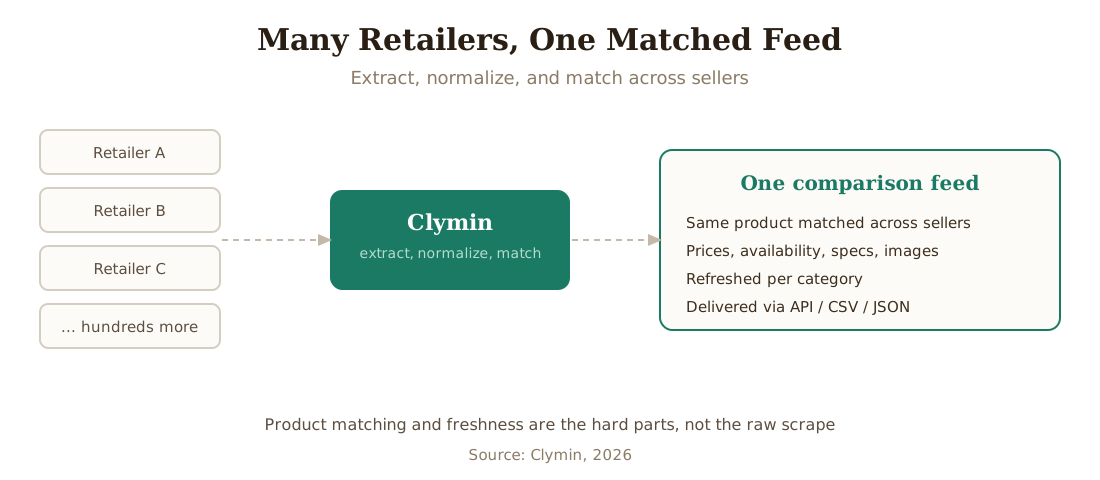 A comparison feed pulls product, price, and availability from many retailers, then normalizes and matches items into one consistent dataset.
The Hard Part: Product Matching and Freshness
Two problems separate a useful comparison site from a broken one, and neither is the raw scraping. The first is product matching: recognizing that a listing on one retailer and a listing on another are the same item. Matching uses identifiers like GTIN, UPC, and MPN, plus brand, model, and attribute comparison where identifiers are missing. Poor matching produces duplicate or mismatched entries that users spot immediately.
The second is freshness. Retail prices and stock change through the day, so a feed that lags shows prices that no longer exist. According to Imperva's 2024 Bad Bot Report, automated traffic made up nearly half of all internet traffic in 2023, and retailers defend accordingly, which makes reliable, repeated collection harder than a one-time pull. Clymin handles both, normalizing and matching products and refreshing the feed on the cadence each category needs.
Affiliate Feeds vs Scraping: Why Aggregators Use Both
Many comparison sites start with retailer affiliate feeds, and they are worth using where they exist because they are sanctioned and already structured. The problem is coverage. Plenty of retailers offer no feed, feeds often omit fields you need such as real-time stock, full specifications, or images, and feed formats vary widely, so gaps and inconsistencies appear exactly where users compare.
Web scraping fills those gaps. It reaches retailers without a feed, captures the fields feeds leave out, and can refresh faster than a daily feed drop. Most mature aggregators run a hybrid: affiliate feeds where available, managed scraping for the rest. Clymin supplies the scraped portion and normalizes it to match your feed data, so the two sources read as one clean dataset rather than two systems your team has to reconcile.
Coverage and Scale
A comparison site competes on breadth as much as accuracy. Users expect the retailers and products they care about to be present, which pushes aggregators to add sources continuously. Each new retailer has its own structure and defenses, so coverage that is easy to promise is hard to sustain.
Clymin maintains extraction across large numbers of retailers and categories, adapting as sites change, so coverage grows without your team building a new scraper for every source. For teams that also want the raw price-tracking layer, see competitor price monitoring, and for how the feed lands in your stack, see deliver scraped data to your data warehouse.
Scale also means handling breadth without linear cost growth. Adding the hundredth retailer should not cost what the first ten did. A managed provider spreads infrastructure, matching logic, and monitoring across every source, so coverage compounds instead of each new site becoming its own project with its own maintenance backlog.
Variants, Currency, and Shipping: The Details That Decide Accuracy
Cross-seller price accuracy lives in details that are easy to get wrong. The same product often appears in variants, by size, color, or pack quantity, that must stay distinct so a single unit is never compared against a bulk pack. Currency and locale matter when retailers span regions, because a price is only comparable once it is converted and labeled consistently.
Shipping and fees change the real cost too. A lower sticker price with high shipping can lose to a higher one with free delivery, so a trustworthy comparison normalizes total landed cost where the data allows. Clymin captures variant attributes, currency, and shipping signals during extraction and normalizes them into the feed, so your site compares like for like rather than surfacing misleading matches.
De-duplication is the flip side of matching. The same listing can surface through category pages, search results, and direct URLs, and counting it once keeps prices and offer counts honest. Clymin de-duplicates within and across sources before delivery. As of 2026, shoppers expect this level of accuracy by default, and getting it wrong is the fastest way to lose their trust.
How Clymin Fits In
Clymin is a managed data extraction service operating from offices in San Francisco and Hyderabad, serving customers across the United States, India, and globally. With 12+ years on the hardest sources, 100 billion-plus records delivered, and 99.9% pipeline uptime, Clymin supplies the product and price feed that comparison sites depend on, matched and refreshed.
You define the retailers, categories, and cadence. Clymin extracts, normalizes, matches, and delivers the feed via API, cloud storage, or direct database delivery in JSON, CSV, or XML, billed on one metric: cost per record delivered, with no setup or platform fees.
Ready to Power Your Comparison Site?
Tell us the retailers and categories you want to cover, and Clymin will run a free pilot and deliver a sample matched feed before you pay anything. Email contact@clymin.com or start a free pilot, one metric, cost per record delivered, no setup fees.