
Why Traditional Credit Data Falls Short in 2026
Traditional credit risk assessment relies heavily on bureau scores, financial statements, and payment histories. These sources share a critical weakness: they are backward-looking. By the time a borrower's credit score drops or a quarterly filing reveals losses, the financial distress has already been underway for months.
According to Moody's Analytics 2025 Credit Risk Report, 43% of corporate defaults in 2024 showed no significant credit score deterioration until 60 days before the default event. For lenders, this gap between reality and reported data translates directly into unexpected losses.
The fintech lending sector has recognized this limitation. A 2025 survey by the Alternative Credit Council found that 67% of institutional lenders now incorporate at least one alternative data source into their credit decisioning workflows, up from 41% in 2022.
What Alternative Data Sources Strengthen Credit Risk Models?
Web scraping for credit risk assessment targets specific publicly available data sources that provide leading indicators of borrower financial health. Each source offers a distinct signal that traditional bureau data cannot capture.
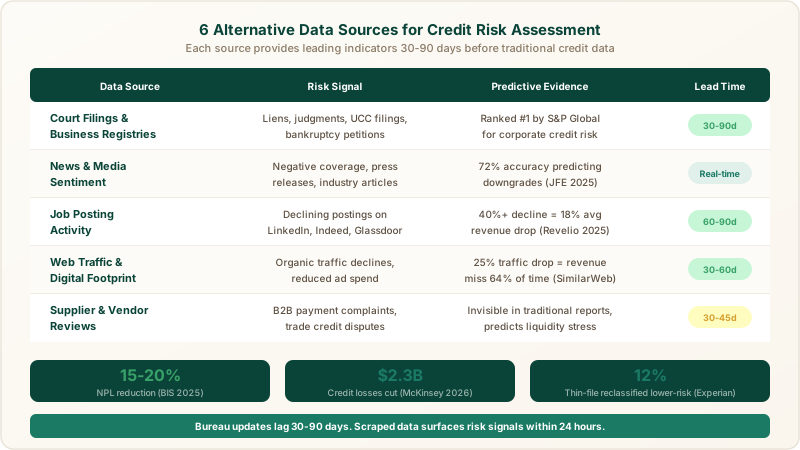
Business Registry and Court Filings. Scraping state-level business registries and federal court databases (PACER) reveals liens, judgments, UCC filings, and bankruptcy petitions. These records often surface 30-90 days before credit bureaus update their files. Clymin extracts and structures these filings daily across all 50 US states.
News and Media Sentiment. Real-time extraction of news articles, press releases, and industry publications provides sentiment signals tied to specific companies or sectors. A 2025 study published in the Journal of Financial Economics found that negative media sentiment predicted credit downgrades with 72% accuracy when measured over a rolling 30-day window.
Job Posting Activity. Declining job postings on platforms like LinkedIn, Indeed, and Glassdoor serve as an early indicator of revenue contraction. Companies that reduced job postings by more than 40% over a 90-day period experienced revenue declines averaging 18% in the following quarter, according to Revelio Labs' 2025 Workforce Intelligence Report.
Six alternative data sources that strengthen credit risk models through web scraping
Web Traffic and Digital Footprint. Declining website traffic, reduced ad spending, and shrinking social media engagement correlate with revenue slowdowns. SimilarWeb's 2025 Digital Intelligence Benchmark found that a 25% drop in organic web traffic preceded quarterly revenue misses 64% of the time for mid-market companies.
Supplier and Vendor Reviews. Scraping B2B review platforms and trade credit forums surfaces payment complaints and supplier disputes that indicate cash flow stress. These signals are invisible in traditional credit reports but highly predictive of liquidity problems.
How Does Web Scraping Improve Default Prediction Accuracy?
Financial institutions that integrate scraped alternative data into credit risk models consistently outperform those relying on traditional data alone. The improvement comes from capturing real-time behavioral signals that financial statements report only quarterly.
Evidence supporting this:
- The Bank for International Settlements' 2025 study on fintech lending found that models using alternative data reduced non-performing loan rates by 15-20% compared to traditional-data-only models
- McKinsey's 2026 Global Banking Annual Review reported that banks using alternative data in SME lending cut credit losses by $2.3 billion collectively in 2025
- Experian's 2025 Alternative Data Impact Study showed that adding web-scraped data to traditional bureau scores reclassified 12% of "thin-file" applicants into lower-risk categories, expanding lending capacity without increasing default rates
The key is data freshness. Credit bureau updates lag by 30-90 days. Scraped data from court filings, news feeds, and business registries can surface risk signals within 24 hours of a public event. For lenders managing portfolios of thousands of borrowers, this speed advantage compounds into materially lower default rates.
How to Build a Web Scraping Pipeline for Credit Risk
Building an effective credit risk data pipeline requires extracting from dozens of heterogeneous sources, each with different structures, update frequencies, and anti-scraping protections. Here is a practical framework for financial institutions evaluating this approach.
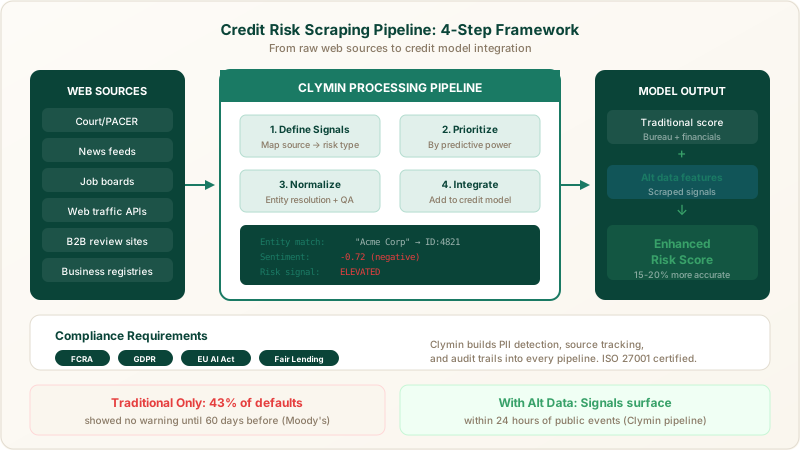
Define Your Signal Universe
Map each data source to a specific risk signal. Court filings indicate legal risk. Job postings indicate growth trajectory. News sentiment indicates reputational risk. Avoid collecting data without a clear hypothesis for how it predicts creditworthiness.
Prioritize by Predictive Power
Not all alternative data sources contribute equally. A 2025 analysis by S&P Global Market Intelligence ranked court filing data and news sentiment as the two highest-value alternative data categories for corporate credit risk, followed by web traffic and employment data.
Normalize and Structure
Raw scraped data is useless without normalization. Entity resolution (matching scraped records to specific borrowers), date standardization, and sentiment scoring must happen before data enters the credit model. Clymin's AI-agentic scraping approach handles extraction, cleansing, and structuring in a single managed pipeline, eliminating the engineering overhead of building custom parsers for each source.
Integrate With Existing Models
Alternative data works best as a supplement to traditional credit scores, not a replacement. Most institutions add scraped signals as additional features in gradient-boosted tree models or logistic regression frameworks alongside bureau data.
Architecture of a web scraping pipeline for credit risk assessment
What Compliance Requirements Apply to Scraped Credit Data?
Regulatory compliance is non-negotiable when using web-scraped data for credit decisions. Financial institutions must navigate multiple overlapping frameworks depending on geography and use case.
The Fair Credit Reporting Act (FCRA) in the United States governs data used in consumer credit decisions. Scraped data used to deny credit to individuals must meet FCRA accuracy and dispute-resolution standards. Corporate and commercial lending faces fewer FCRA constraints but still requires adherence to fair lending principles.
GDPR applies when scraping data about EU-based entities or individuals. The 2024 EU AI Act adds additional requirements for AI systems used in creditworthiness assessments, classifying them as "high-risk" applications that require transparency and auditability.
Clymin builds compliance safeguards directly into extraction pipelines, including PII detection and filtering, source-level consent tracking, and audit trails for every data point collected. With hundreds of projects delivered and ISO 27001 certification, Clymin maintains the security and compliance standards that financial institutions require. For a broader view of how managed scraping compares to traditional data terminals, see our comparison of web scraping vs. Bloomberg Terminal approaches.
How Clymin Helps Financial Institutions Access Alternative Credit Data
Clymin provides financial analysts and quantitative researchers with structured, ready-to-use alternative data extracted from court filings, business registries, news sources, and company websites. Rather than building and maintaining dozens of custom scrapers that break when source sites update their layouts, Clymin's fully managed service delivers clean datasets on daily, weekly, or custom schedules.
With over a decade of experience and over 100 billion data points extracted, Clymin brings enterprise-grade reliability to financial data extraction. Data is delivered via REST API, CSV, JSON, or direct database integration, ready to plug into credit risk models and analytics platforms. Explore our 2026 comparison of alternative data providers to see how managed scraping stacks up against other data sources in the financial services ecosystem.