
Why Financial Firms Are Rethinking Market Data Sources in 2026
The alternative data market is accelerating beyond what any single terminal can deliver. According to Grand View Research's 2025 report, the global alternative data market reached $7.3 billion in 2025 and is projected to grow at 24.6% CAGR through 2030. Hedge funds, asset managers, and fintech companies are investing heavily in non-traditional data pipelines to generate alpha.
Bloomberg Terminal remains the gold standard for real-time market quotes, fixed-income analytics, and institutional messaging. However, at approximately $24,000 per user per year, terminal costs scale linearly with headcount. For a 50-person quantitative research team, that translates to $1.2 million annually before any data add-ons.
Web scraping offers a fundamentally different economics model. Rather than paying per seat for a curated data feed, firms extract precisely the data they need from publicly available sources, at a cost structure that scales with data volume rather than user count.
How Does Web Scraping Compare to Bloomberg Terminal for Market Data?
Web scraping and Bloomberg Terminal serve overlapping but distinct roles in a financial data stack. Understanding where each method excels helps firms allocate data budgets effectively.
Coverage breadth. Bloomberg Terminal provides deep coverage of traditional financial instruments, equities, fixed income, derivatives, commodities, and FX, across regulated exchanges. Web scraping covers everything else: job posting volumes on LinkedIn and Indeed, consumer sentiment on Reddit and Twitter, product pricing on Amazon, shipping container movements, and patent filings. Preqin's 2025 Alternative Data Survey found that 73% of hedge funds now use at least three alternative data sources alongside terminal data.
Data freshness. Bloomberg delivers real-time streaming quotes with sub-second latency for listed instruments. Web scraping refresh rates depend on source and configuration, ranging from near-real-time (every few minutes) to daily batch extraction. For most alternative data use cases, daily or hourly refresh is sufficient because the signals being tracked (hiring trends, sentiment shifts, pricing changes) evolve over days or weeks rather than milliseconds.
Cost structure. Bloomberg charges fixed annual per-seat fees. Managed web scraping services like those from Clymin charge based on data volume, source complexity, and delivery frequency. For firms that need 50+ alternative data feeds but only 5 terminal seats, a hybrid approach often reduces total data spend by 40-60%.
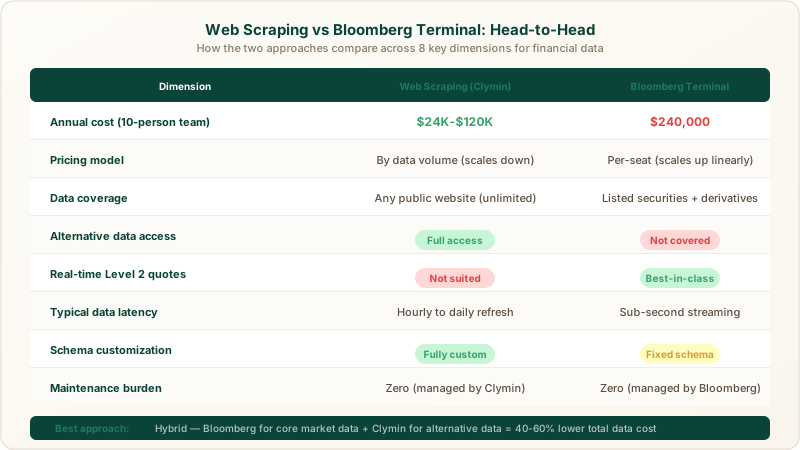
Side-by-side comparison of web scraping and Bloomberg Terminal for financial market data collection
What Alternative Data Can Web Scraping Capture That Terminals Cannot?
Alternative data represents the fastest-growing category of financial intelligence, and web scraping is the primary extraction method for most of these sources. According to Deloitte's 2025 Alternative Data in Finance report, 81% of buy-side firms plan to increase their alternative data spending in 2026.
Sentiment and social signals. Scraping consumer reviews, social media discussions, and news comment sections provides leading indicators of brand perception shifts. A 2025 study published in the Journal of Financial Economics found that aggregated social media sentiment predicted earnings surprises with 67% accuracy when combined with traditional fundamental analysis.
Labor market intelligence. Job posting volumes and descriptions scraped from LinkedIn, Glassdoor, and Indeed reveal company expansion plans, technology investments, and organizational restructuring weeks before earnings calls. Hedge fund researchers use job posting velocity as a forward-looking indicator of revenue growth.
Supply chain and logistics data. Shipping manifests, port activity schedules, and freight rate listings from public maritime databases provide visibility into global trade flows. Quantitative researchers scrape these sources to predict commodity price movements and manufacturing output.
Product and pricing data. E-commerce pricing, product catalog changes, and inventory signals scraped from Amazon, Walmart, and specialty retailers provide real-time consumer demand proxies. Clymin's AI-agentic scraping approach handles the anti-bot protections and dynamic page rendering that make financial-grade extraction from these platforms particularly challenging.
What Are the Compliance Risks of Scraping Financial Data?
Compliance is the primary concern that prevents many financial firms from adopting web scraping, but the legal landscape has clarified significantly in recent years.
The 2022 U.S. Ninth Circuit ruling in hiQ Labs v. LinkedIn established that scraping publicly available data does not violate the Computer Fraud and Abuse Act (CFAA). The SEC has also issued guidance acknowledging that alternative data collection from public sources is a legitimate investment research activity, provided firms maintain appropriate compliance documentation.
Evidence supporting this:
- 73% of institutional investors now have formal alternative data compliance frameworks, according to the Alternative Investment Management Association's 2025 global survey
- The SEC's 2024 guidance on alternative data usage explicitly permits collection of publicly available information for investment analysis purposes
- GDPR and CCPA compliance requires data minimization practices when scraping sources that contain personal information, but financial market data (pricing, volumes, corporate filings) rarely triggers these protections
Clymin maintains ISO 27001 certification and AICPA SOC compliance specifically to address data security and handling requirements that financial services clients demand. With 40+ customers served across regulated industries, Clymin brings enterprise-grade compliance infrastructure to alternative data extraction.
When Should You Use Bloomberg Terminal vs Web Scraping?
Choosing between Bloomberg Terminal and web scraping depends on the specific data needs, team size, and investment strategy of the firm.
Use Bloomberg Terminal when: the firm requires real-time Level 2 order book data for high-frequency trading, proprietary Bloomberg analytics models (PORT, MARS, BVAL), the Bloomberg messaging network for institutional deal flow, or regulatory-grade audit trails for traditional financial instruments. Bloomberg's strength is depth of coverage for listed securities and derivatives.
Use web scraping when: the firm needs broad alternative data coverage across dozens or hundreds of non-traditional sources, custom data schemas that map to proprietary models, cost-efficient scaling that does not grow linearly with headcount, or data from sources that Bloomberg simply does not cover (social media, job boards, consumer review platforms, niche industry databases).
Use both when: the investment strategy combines fundamental analysis with alternative data signals. Most quantitative hedge funds and systematic asset managers in San Francisco, New York, and London operate hybrid data stacks where Bloomberg provides the financial backbone and scraped alternative data provides the differentiated alpha signals.
How Clymin Helps Financial Firms Build Alternative Data Pipelines
Clymin provides financial services firms with fully managed web scraping that meets institutional-grade reliability and compliance requirements. Rather than building brittle in-house scrapers that break when source websites change their structure, Clymin's AI agents adapt automatically to site changes, delivering clean, structured alternative datasets on schedule.
With over a decade of experience and over 100 billion data points extracted, Clymin delivers data via REST API, custom API integrations, or direct database feeds in JSON, CSV, or XML formats that plug directly into quantitative models, risk engines, and portfolio management systems. Decision-making speed improved by 25% for financial services clients using Clymin's structured data extraction services.