Why Alternative Data Matters More in 2026 Than Ever Before
Alternative data, any dataset outside traditional financial statements, SEC filings, and market price feeds, has shifted from experimental edge to institutional requirement. According to Grand View Research's 2025 Alternative Data Market Report, the global market grew 28% year-over-year to reach $13.6 billion in 2025 and is forecast to hit $17.4 billion by end of 2026.
The driving force is alpha decay. Strategies built on traditional data alone are producing diminishing returns as more firms compete on the same signals. A 2025 Greenwich Associates survey found that 85% of systematic hedge funds now allocate budget to at least two alternative data categories, up from 62% in 2022.
For financial analysts and quantitative researchers in San Francisco, New York, and London, the challenge is no longer whether to use alternative data but which providers deliver the best signal-to-noise ratio for the cost.
What Are the Main Categories of Alternative Data Providers?
Alternative data providers fall into six primary categories, each with distinct strengths, limitations, and price ranges.
Web Scraping and Crawling Services. Providers like Clymin extract structured data from public websites, job postings, product prices, app store reviews, real estate listings, and company directories. Web scraping is the most flexible category because it can target virtually any public data source. According to Opimas Research, web-scraped data accounts for roughly 35% of all alternative data spending in financial services as of 2025.
Satellite and Geospatial Imagery. Firms like Orbital Insight, Planet Labs, and Descartes Labs analyze satellite images to count cars in retail parking lots, measure oil tank fill levels, and track agricultural output. These datasets are expensive, typically $100,000 to $500,000+ annually, but provide signals unavailable from any other source.
Transaction and Credit Card Data. Bloomberg Second Measure, Earnest Analytics, and Envestnet Yodlee aggregate anonymized consumer transaction records to estimate company revenue before earnings reports. Transaction data is among the highest-signal alternative data categories for equity long/short strategies.
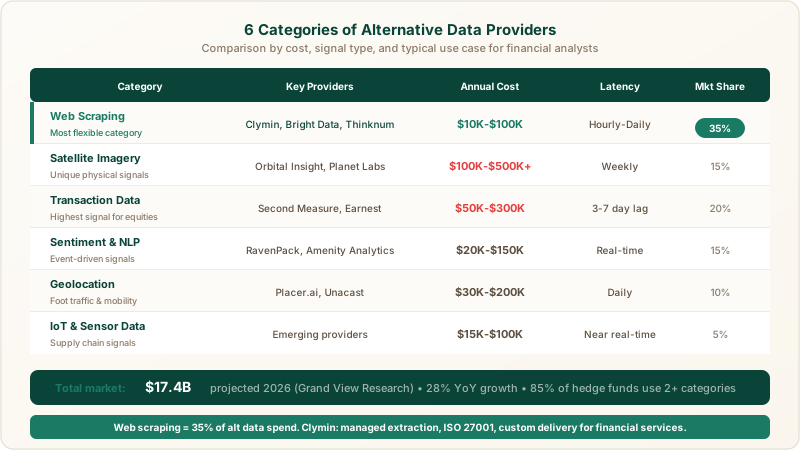
Sentiment and NLP Analytics. RavenPack, Thinknum, and Amenity Analytics process news articles, social media posts, and earnings call transcripts to generate sentiment scores. These feeds are useful for event-driven strategies and risk monitoring.
Geolocation and Foot Traffic. Placer.ai, SafeGraph (now part of Dewey), and Unacast track anonymized mobile device movement to measure foot traffic at retail locations, airports, and commercial properties.
IoT and Sensor Data. Emerging providers aggregate data from connected devices, shipping containers, and industrial sensors to track supply chain activity and manufacturing output in near-real time.
How Do You Compare Alternative Data Providers Head-to-Head?
Evaluating alternative data providers requires assessing five key dimensions that directly impact investment performance.
Signal Quality and Exclusivity. The most valuable datasets are those with proven alpha correlation that few competitors access. Ask every provider: how many clients currently use this exact dataset? Datasets available to 500+ hedge funds have significantly diminished alpha potential compared to custom-extracted feeds.
Latency and Delivery Frequency. Some strategies require daily updates; others need tick-level real-time feeds. Web scraping services like Clymin can deliver data on hourly, daily, or custom schedules depending on the source and use case. Satellite data typically refreshes weekly or biweekly. Transaction data often arrives with a 3-7 day lag.
Evidence supporting this:
- According to Deloitte's 2025 Alternative Data Survey, 47% of buy-side firms cite data latency as their top evaluation criterion when selecting providers
- Opimas estimates that funds using daily-frequency alternative data outperform those using weekly data by 1.2-1.8% annually in back-tested equity strategies
- A 2025 JP Morgan quantitative research note found that signal decay in web-scraped pricing data begins within 48 hours, making daily or sub-daily delivery critical
Compliance and Data Provenance. Regulatory scrutiny on alternative data is increasing. The SEC issued updated guidance in late 2025 on material nonpublic information risks from alternative data sources. Every provider should document data lineage, consent mechanisms, and PII handling. Clymin maintains ISO 27001 certification and AICPA SOC compliance, ensuring that data extraction meets enterprise security standards.
Which Alternative Data Sources Work Best for Each Strategy Type?
Different investment strategies demand different data types. Matching the right provider to your strategy avoids wasted spend and maximizes signal relevance.
Equity Long/Short Funds benefit most from transaction data (revenue estimation), web-scraped job postings (hiring momentum), and app download metrics (consumer demand signals). A quant researcher at a mid-cap equity fund should prioritize providers offering company-level granularity with at least weekly frequency.
Macro and Global Funds need satellite imagery for commodity supply tracking, geolocation data for economic activity indicators, and web-scraped government data for policy monitoring. These funds typically require multi-country coverage, which is where managed scraping services with global infrastructure, like Clymin, which has delivered hundreds of data extraction projects across industries, add significant value.
Alternative data provider comparison across cost, latency, and signal strength dimensions
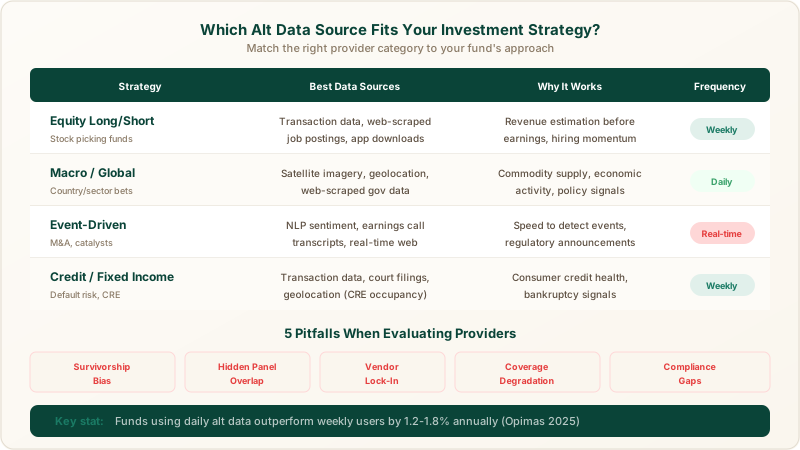
Event-Driven Funds rely on NLP sentiment from news and social media, earnings call transcript analysis, and real-time web monitoring for M&A signals or regulatory announcements. Speed is critical here, providers offering sub-hourly updates have a material edge.
Credit and Fixed Income strategies use transaction data for consumer credit health, web-scraped court filings for bankruptcy monitoring, and geolocation data for commercial real estate occupancy rates.
What Should You Watch Out for When Evaluating Providers?
Five common pitfalls catch financial analysts off guard when selecting alternative data vendors.
Survivorship Bias in Back-Tests. Many providers present back-tested performance that excludes delisted companies or failed products. Always request out-of-sample validation and ask whether the historical dataset includes entities that no longer exist.
Hidden Overlap. Multiple providers may source from the same underlying data (for example, the same credit card panel). Paying for three "unique" transaction datasets that share 70% of the same panel is a waste of budget. Request panel composition details before committing.
Vendor Lock-In. Some providers deliver data through proprietary platforms that make switching expensive. Prioritize vendors that deliver in standard formats, JSON, CSV, or via REST API, and allow you to own the extracted data. Clymin delivers all datasets in structured JSON, CSV, or through custom API integration, ensuring full data portability.
Inconsistent Coverage Over Time. Web sources change, apps update, and data gaps appear. A provider that scraped 95% of a target universe last year may only cover 80% this year without ongoing maintenance. Managed services that handle source monitoring and maintenance, rather than one-time data pulls, protect against coverage degradation.
Compliance Gaps. Not all alternative data is legally safe to use. Providers that scrape behind login walls, access private APIs without authorization, or collect PII without consent create regulatory risk for your fund. Always verify that your provider operates within legal boundaries and maintains certifications like ISO 27001 and SOC compliance.
How Clymin Fits Into the Alternative Data Landscape
Clymin serves the web scraping and structured data extraction segment of the alternative data market. For financial analysts and hedge funds seeking custom datasets from public web sources, pricing data, job postings, product catalogs, company directories, review sentiment, and regulatory filings, Clymin's fully managed service eliminates the need to build and maintain internal scraping infrastructure.
With over a decade of experience and over 100 billion data points extracted, Clymin handles the technical complexity of anti-blocking, source monitoring, and data cleansing so quantitative researchers can focus on signal development rather than data engineering. Financial services clients report that decision-making speed improved by 25% after switching to Clymin's structured data delivery.