Quick Comparison: Web Scraping API vs Managed Service
Both options assume you have decided to buy rather than build from scratch. The difference is how much work stays on your side after the purchase. The table below maps the split.
| Factor | Web Scraping API | Managed Service |
|---|---|---|
| What you get | An endpoint to call | Delivered, structured data |
| Parsing and structuring | Your team | Included |
| Scheduling and monitoring | Your team | Included |
| Anti-bot maintenance | Shared, falls back to you | Included |
| Engineering required | Significant | None |
| Pricing metric | Per request or call | Cost per record delivered |
| Best for | Teams that want control | Teams that want outcomes |
If you are still deciding what an API is at this layer, start with our explainer on what a web scraping API is.
What a Web Scraping API Gives You
A web scraping API handles the network plumbing of a single request: proxy routing, headless rendering, and returning a response. It is fast to start with and gives engineers granular control over how each request behaves. That control is the real benefit for teams building their own data product.
The trade-off is everything around the request. Parsing raw responses into clean records, scheduling runs, validating output, and fixing extraction when a site changes all stay on your team. To compare specific options, see our guide to the best web scraping API.
What a Managed Service Gives You
A managed service removes the pipeline entirely. You define the sources, fields, frequency, and format, and clean records arrive on schedule. Setup, anti-bot handling, source-change maintenance, and cleansing are all included, billed under one metric: cost per record delivered.
The trade-off is request-level control: you specify outcomes rather than tuning individual requests. For most teams whose goal is using data rather than collecting it, that is the right trade. For the category overview, see what managed web scraping is.
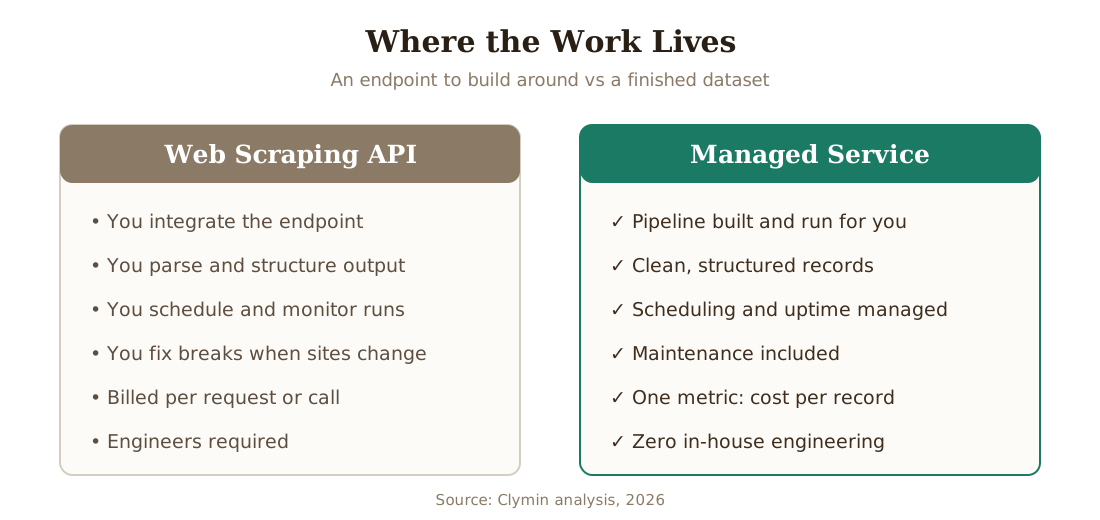 A web scraping API hands you an endpoint to build around; a managed service hands you the finished dataset.
Total Cost of Ownership: The Deciding Factor
List price favors the API; total cost of ownership often favors the managed service. The true cost of an API is the request fees plus the engineering time to integrate, parse, schedule, and repair it, plus the cost of late or broken data.
Evidence that the hidden work is large:
- According to Grand View Research's 2024 analysis, the web scraping software market exceeded $1 billion in 2023 and is growing at a double-digit annual rate, reflecting how much engineering effort data collection now consumes.
- According to the 2023 Anaconda State of Data Science report, data professionals spend roughly a third of their time on data preparation and cleaning rather than analysis.
- According to Imperva's 2024 Bad Bot Report, automated traffic made up nearly half of all internet traffic in 2023, so sites deploy defenses that break self-run scrapers and add maintenance.
When that work is included rather than billed in engineer-hours, the managed model usually wins for any extraction that runs continuously. For the build-it-yourself version of this math, see managed web scraping versus building in-house.
When to Choose Each
Choose a web scraping API when scraping is a core competency, you have engineers to run it, and you need granular control over individual requests. Teams building a data product on raw infrastructure often prefer this.
Choose a managed service when the goal is the data, not the plumbing, when you lack dedicated scraping engineers, or when source changes and anti-bot defenses would otherwise consume engineering time. The decision is about ownership, not capability.
How Clymin Fits In
Clymin is a managed data extraction service operating from offices in San Francisco and Hyderabad, serving customers in the United States, India, and globally. Rather than selling an API you run, Clymin delivers the finished dataset, with 12+ years on the hardest sources, 100 billion-plus records delivered, and 99.9% pipeline uptime.
As of 2026, the choice is simple: if you want to assemble and own the pipeline, an API gives you the parts; if you want clean data delivered without managing anything, see how the managed model works on Clymin's main data extraction service.
Ready to Compare on Your Own Data?
See the difference on your sources, not a spec sheet. Clymin will run a free pilot, deliver clean records on your schedule, and you decide. Email contact@clymin.com or start a free pilot, one metric, cost per record delivered, no setup fees.