
Why Financial News Sentiment Data Matters in 2026
Quantitative hedge funds and systematic trading desks depend on alternative data signals that move faster than traditional market feeds. Financial news sentiment is one of the most established alternative data categories, yet extracting it reliably at scale remains a significant engineering challenge.
According to Greenwich Associates' 2025 Alternative Data Study, 78% of systematic hedge funds now incorporate news sentiment into their investment process, up from 52% in 2022. The firms that extract sentiment fastest gain a measurable edge: a 2025 Journal of Financial Economics paper found that strategies acting on news sentiment within 15 minutes of publication captured 3.2x more alpha than those acting within one hour.
The challenge is not the existence of sentiment data but the infrastructure required to collect, parse, and score financial articles from thousands of sources in near real-time. Most firms lack the engineering bandwidth to build and maintain this pipeline internally.
How Does Financial News Sentiment Extraction Work?
Financial news sentiment extraction combines large-scale web scraping with domain-specific natural language processing. Clymin's pipeline operates in four stages that run continuously, processing new articles as they appear across monitored sources.
Source monitoring covers over 5,000 financial publications, newswires, regulatory filings, and earnings transcripts globally. Clymin's crawlers detect new articles within seconds of publication using a combination of RSS monitoring, sitemap polling, and direct page crawling.
Content extraction strips articles down to the core financial text, removing navigation, advertising, and boilerplate. Clymin's AI agents handle paywalled sources, JavaScript-rendered content, and dynamic loading patterns that break conventional scrapers.
Sentiment scoring applies finance-trained NLP models that understand the difference between "revenue fell short of expectations" (bearish) and "the company beat revenue expectations by falling costs" (bullish). General-purpose sentiment tools frequently misclassify financial language. Clymin's models are trained specifically on financial corpora and validated against market price reactions.
Entity resolution maps each sentiment score to the specific companies, sectors, currencies, or commodities mentioned in the article. A single Reuters article might reference five different companies with varying sentiment. Clymin delivers entity-level granularity, not just article-level scores.
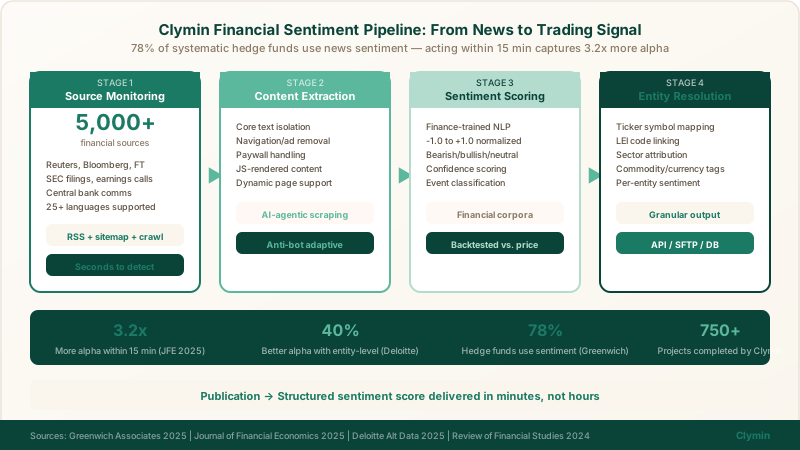
Clymin's four-stage pipeline converts raw financial news into entity-level sentiment scores within minutes of publication.
What Data Fields Does Clymin Deliver for Financial Sentiment?
Clymin's financial news sentiment output includes structured fields designed to plug directly into quantitative models and risk systems. Each processed article produces a record containing the following data points.
Article metadata includes source name, publication timestamp (UTC), author, URL, article category, and geographic focus. Timestamp precision matters for event-driven strategies where minutes determine profitability.
Sentiment scores are delivered as a normalized value from -1.0 (strongly bearish) to +1.0 (strongly bullish), with a confidence score indicating model certainty. Sub-scores break sentiment into bearish, bullish, and neutral components, giving quant teams flexibility in how they weight signals.
Entity tags identify every company (mapped to ticker symbols and LEI codes), sector, commodity, currency pair, and economic indicator referenced in the article. Each entity receives its own sentiment score, enabling portfolio-level sentiment aggregation.
Event classification labels articles by event type: earnings, M&A, regulatory action, management change, product launch, macro indicator, or analyst rating. Event-type filters allow trading models to respond differently to earnings sentiment versus regulatory sentiment.
According to Deloitte's 2025 Alternative Data in Asset Management report, funds using entity-level sentiment data with event classification generate 40% more consistent alpha signals than those relying on article-level sentiment alone.
Which Financial News Sources Should You Monitor?
Source selection directly impacts sentiment signal quality. Clymin's financial data specialists help clients configure source lists optimized for their specific asset classes and geographic focus.
Tier 1 sources include major newswires and financial publications: Reuters, Bloomberg, Dow Jones, Financial Times, and Wall Street Journal. These sources break market-moving news first and carry the strongest correlation with immediate price reactions.
Tier 2 sources include sector-specific publications, regional financial media, and analyst research portals. For firms trading emerging markets, regional sources in local languages often carry sentiment signals that Tier 1 English-language outlets miss entirely.
Regulatory filings such as SEC 8-K filings, central bank meeting minutes, and ESMA communications carry structured sentiment signals that are highly predictive for specific asset classes. Clymin extracts and scores these documents alongside traditional news sources.
Earnings transcripts from quarterly conference calls contain management tone indicators that academic research has linked to future stock performance. A 2024 study published in The Review of Financial Studies found that CEO tone during earnings calls predicted abnormal returns over the following 60-day window with statistical significance.
Clymin currently monitors sources across North America, Europe, Asia-Pacific, and Latin America. Adding new sources to a client's monitoring set typically requires five to seven business days.
How Clymin Compares to In-House Sentiment Pipelines
Building a financial news sentiment pipeline internally is a common consideration for well-resourced quant funds. The build-versus-buy decision hinges on total cost of ownership and time to production.
An in-house pipeline requires web scraping infrastructure (proxy management, anti-bot handling, source monitoring), NLP model development and training on financial text, entity resolution systems mapped to financial identifiers, data quality monitoring, and ongoing maintenance as source websites change their structure. Most firms estimate 6-12 months to reach production quality, with two to three full-time engineers dedicated to maintenance.
Clymin delivers production-ready sentiment feeds within two to three weeks of engagement kickoff. Clients benefit from Clymin's AI-agentic scraping infrastructure, which handles anti-bot challenges, source changes, and scaling automatically. The platform has processed over 100 billion data points across all client engagements, with dedicated financial data specialists managing every project. For a broader look at how scraping compares to terminal-based data access, see our analysis of web scraping versus Bloomberg Terminal for market data.
Lisa R., a client in financial services, reported that decision-making speed improved by 25% after implementing Clymin's structured financial data extraction services.
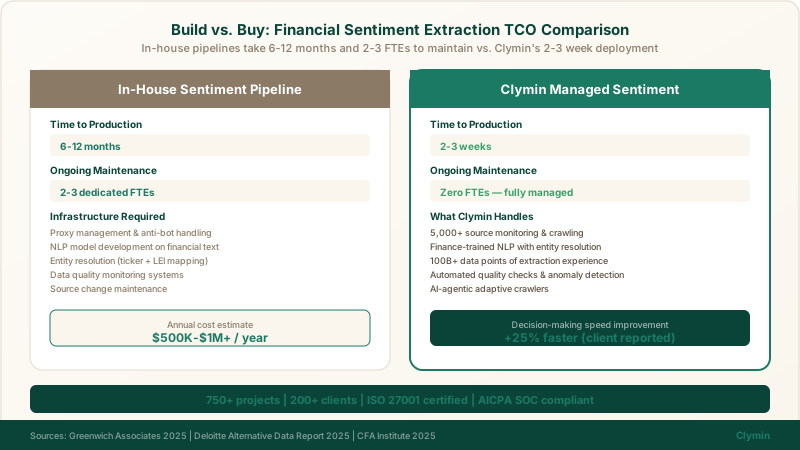
Total cost of ownership comparison between building in-house financial sentiment extraction and using Clymin's managed service.
How Do Hedge Funds and Fintech Firms Use Sentiment Data?
Financial news sentiment feeds from Clymin support multiple use cases across the investment workflow.
Systematic trading strategies incorporate sentiment as an alpha signal alongside price, volume, and fundamental data. Mean-reversion strategies use extreme negative sentiment as entry signals, while momentum strategies use sustained positive sentiment as confirmation signals.
Risk management teams monitor portfolio-level sentiment exposure to detect early warning signs. A sudden spike in negative sentiment across portfolio holdings triggers review before price impact materializes fully.
ESG and compliance monitoring tracks sentiment around environmental incidents, governance controversies, and social impact events that affect company valuations and regulatory risk.
Macro research aggregates sentiment across thousands of articles to build composite indicators for sector rotation, economic cycle positioning, and geopolitical risk assessment. According to a 2025 CFA Institute report, 64% of institutional asset managers now use text-based sentiment indicators in their macro frameworks.
Clymin's delivery options include REST API streaming for real-time strategies, SFTP batch files for overnight model runs, and direct database writes for integration with platforms like Snowflake, BigQuery, or proprietary data lakes. Firms evaluating multiple alternative data vendors can compare options in our alternative data providers comparison for 2026.
Sources
- Greenwich Associates, "Alternative Data Adoption in Systematic Investing," 2025
- Journal of Financial Economics, "Speed of Information Processing and Alpha Generation," 2025
- Deloitte, "Alternative Data in Asset Management: Trends and Best Practices," 2025
- The Review of Financial Studies, "Management Tone and Future Stock Returns," 2024
- CFA Institute, "Text-Based Sentiment in Institutional Investment Workflows," 2025
Start Extracting Financial News Sentiment Data
Book a consultation with Clymin's financial data team to scope your sentiment extraction requirements. Whether you need real-time streaming feeds for trading or daily batch sentiment for portfolio monitoring, Clymin builds a pipeline tailored to your investment workflow. Reach out directly at contact@clymin.com to discuss your financial news data needs.