What Rental Data Does Clymin Extract?
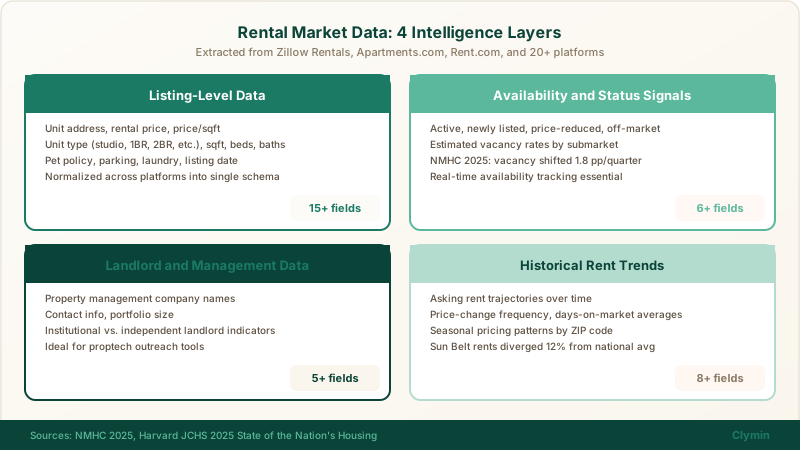
Clymin's AI-powered extraction agents capture every meaningful data field from rental platforms across the United States:
Listing-level data: Unit address, rental price, price per square foot, unit type (studio, 1BR, 2BR, etc.), square footage, bedrooms, bathrooms, pet policy, parking availability, laundry type, and listing date. Each record is normalized across platforms so data from Zillow Rentals and Apartments.com aligns in a single consistent schema.
Availability and status signals: Active listings, newly listed, price-reduced, off-market removals, and estimated vacancy rates by submarket. According to a 2025 NMHC survey, vacancy rates in U.S. multifamily markets shifted by an average of 1.8 percentage points quarter-over-quarter, making real-time availability tracking essential for accurate market assessments.
Landlord and management data: Property management company names, contact information, portfolio size, and management style indicators (institutional vs. independent landlord). This layer is particularly valuable for proptech platforms building landlord outreach tools and for consultants conducting competitive market studies.
Historical rent trends: Asking rent trajectories over time, price-change frequency, days-on-market averages, and seasonal pricing patterns by ZIP code and metro area. The Harvard Joint Center for Housing Studies' 2025 State of the Nation's Housing report found that asking rents in Sun Belt metros diverged from national averages by as much as 12%, evidence that granular, market-specific data drives better decisions than aggregated indices.
Why Rental Market Intelligence Requires Automated Extraction
Manual rental data collection cannot keep pace with market velocity. A single analyst monitoring ten cities across six platforms can realistically refresh data every two to four weeks, far too slow for dynamic rental markets where listings turn over in days.
Automated rental listing scraping solves the coverage and freshness problem simultaneously. Clymin's extraction agents run continuously, capturing new listings within hours of publication and detecting price changes the same day they occur. Real estate consultants using Clymin have reported a 35% improvement in data collection efficiency, as Emily W., a Real Estate Consultant, noted: "Data collection efficiency improved by 35% with Clymin's automated property listing extraction."
Platform fragmentation compounds the manual data problem. Rental inventory is split across Zillow Rentals, Apartments.com, Rent.com, Craigslist, Facebook Marketplace, and dozens of regional listing sites. No single platform holds a complete view of any metro's rental supply. Clymin aggregates across all relevant sources, deduplicates records, and delivers a unified rental dataset, the only practical way to achieve full-market coverage at scale.
Geospatial Rental Market Intelligence
Location-enriched rental data unlocks a category of analysis that flat listing data cannot support. Clymin layers geospatial context onto every rental record, including:
- Neighborhood and submarket boundaries: ZIP code, census tract, and custom polygon mapping for investor-defined submarkets
- Proximity scores: Distance to transit, employment centers, schools, grocery anchors, and healthcare facilities
- Demographic overlays: Median household income, renter vs. owner-occupancy rates, population growth trends by census tract
- School district ratings: Niche and GreatSchools scores matched to property addresses
Geospatial real estate data extraction enables rent gap analysis, identifying submarkets where rental demand signals outpace current listing supply. According to CoStar Group's Q4 2025 multifamily report, markets showing strong job growth but below-average new supply additions are experiencing the fastest rent appreciation in 2026. Clymin gives analysts the data infrastructure to identify these opportunities before they become widely known.
For consultants working across multiple metro areas, geospatial enrichment is the difference between delivering a table of rents and delivering an actionable market opportunity map.
Platforms Clymin Covers for Rental Data
| Platform | Data Type | Update Frequency |
|---|---|---|
| Zillow Rentals | Listings, Rent Zestimates, price history | Daily |
| Apartments.com | Listings, amenities, management contacts | Daily |
| Rent.com | Listings, renter reviews, availability | Daily |
| Trulia Rentals | Listings, neighborhood data | Daily |
| Craigslist | Listings, landlord contacts | Daily |
| Facebook Marketplace | Listings, pricing trends | Daily |
| Zumper | Listings, market reports | Daily |
| HotPads | Listings, map-based data | Daily |
| Rentberry | Listings, lease terms | Weekly |
| Regional MLS rental feeds | Broker-listed rentals | Daily |
Additional platforms are onboarded within 5-10 business days based on client market coverage requirements.
How Clymin's Rental Data Extraction Works
Clymin uses AI agents that learn and adapt, not static scrapers that break when a platform updates its layout. For full details on the extraction architecture, see the AI-agentic scraping approach and process overview.
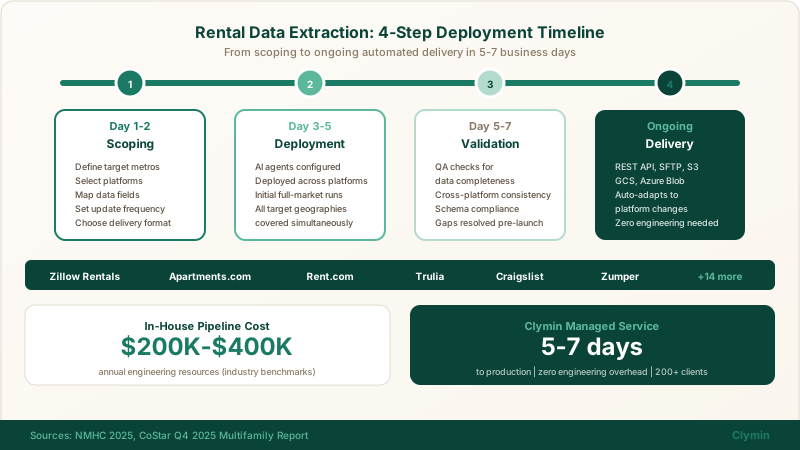
Step 1, Scoping (Day 1-2): Define your target metros, platforms, data fields, update frequency, and delivery format. Clymin's team recommends configurations based on your specific use case, whether that is investment underwriting, proptech product data, or market research reporting.
Step 2, Deployment (Day 3-5): Extraction agents are configured and deployed across your specified platforms. Initial full-market data runs complete for all target geographies.
Step 3, Validation (Day 5-7): Quality assurance checks verify data completeness, cross-platform consistency, and schema compliance. Any gaps are resolved before production delivery begins.
Step 4, Ongoing delivery: Rental data flows through your chosen delivery channel, REST API, scheduled file drops, or direct database integration, at your configured refresh frequency. Clymin monitors extraction health and adapts to platform changes automatically. No engineering involvement required from your team.
Rental Data Delivery Options
REST API: Query rental data programmatically with filters for city, ZIP code, unit type, price range, listing date, and availability status. Ideal for proptech applications, automated valuation models, and real-time market dashboards.
Scheduled file delivery: Receive CSV, JSON, or Parquet files via SFTP at daily, weekly, or custom intervals. Ideal for data warehouse ingestion, BI tool integration, and periodic market reporting.
Cloud storage delivery: Direct delivery to AWS S3, Google Cloud Storage, or Azure Blob Storage for teams with existing cloud data infrastructure.
Dashboard access: Browser-based interface for exploring rental data by market, running ad-hoc rent comps, and exporting custom datasets without engineering support.
How Rental Market Data Drives Real Results
Real estate consultants use Clymin's rental data to produce rent comparable analyses in hours rather than days, replacing manual listing searches with structured, complete datasets. Investment analysts use rental price trends and vacancy signals to underwrite acquisitions and stress-test yield assumptions against live market conditions.
Proptech companies building rent estimation tools, tenant matching platforms, or landlord analytics products use Clymin as their data infrastructure layer, eliminating the cost and complexity of building and maintaining proprietary scrapers. Building rental data pipelines in-house typically requires $200,000-$400,000 annually in engineering resources, according to industry benchmarks, a cost Clymin replaces with a managed service contract.
For a deeper look at how rental platform data compares by source quality, explore our Trulia vs. Zillow data comparison for market analysis and the broader real estate data scraping service overview.
If your workflow involves scraping listings across multiple rental sites, the guide to scraping property listings from multiple sites covers platform coverage strategies and data normalization approaches in detail.
Start Extracting Rental Market Data
Clymin configures rental market data extraction within 5-7 business days. The fully managed service covers all platforms, all engineering, and all ongoing maintenance, your team focuses on analysis and decisions, not data pipelines.
Get a Free Consultation to discuss your rental data requirements, or reach out directly at contact@clymin.com. Clymin's team will scope your coverage needs and recommend the right configuration for your markets and use case.