
Why Multi-Site Property Scraping Is Hard to Get Right in 2026
Real estate data is structurally fragmented. No single platform holds a complete picture of any local market. Zillow covers consumer listings, Realtor.com pulls from NAR-affiliated MLS feeds, Redfin adds brokerage-direct inventory, and hundreds of regional portals carry listings that never surface on national sites.
Each platform presents its data differently. Zillow renders listing details via client-side JavaScript. Realtor.com uses paginated search APIs that throttle aggressive crawlers. Regional MLS portals often require session cookies and apply aggressive IP-based rate limiting. A scraper built for one source breaks on another.
According to a 2025 Statista report, the global real estate data market is projected to exceed $8.5 billion by 2027, driven by proptech firms, institutional investors, and data-driven agencies demanding granular, multi-source property datasets. The appetite for aggregated listing data is growing faster than the tooling most teams have in place to collect it.
The gap between what analysts need, a unified, deduplicated, daily-refreshed property feed, and what static scrapers can reliably deliver is where most in-house data projects stall.
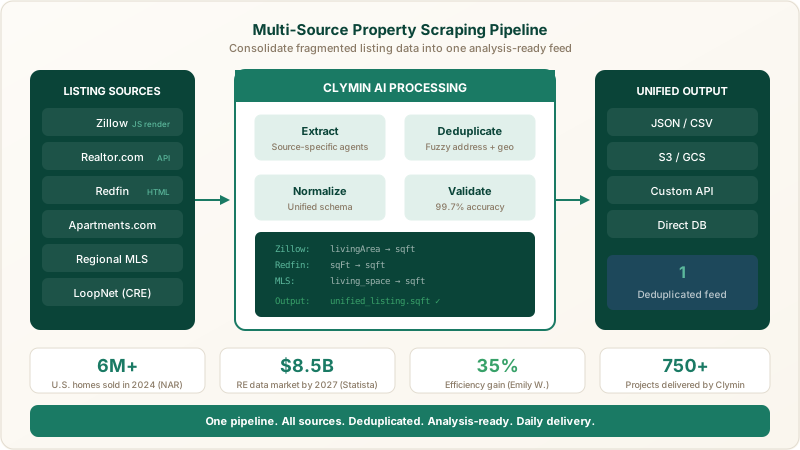
How a multi-source property scraping pipeline consolidates fragmented listing data into one analysis-ready feed.
What Does a Multi-Site Property Scraping Pipeline Actually Look Like?
A production-grade property scraping pipeline is not a single script, it is a coordinated system of source-specific extractors, a deduplication layer, a schema normalizer, and a delivery mechanism. Each component requires distinct engineering.
Source-specific extractors handle the unique rendering and access patterns of each platform. Zillow listings require a headless browser (Playwright or Puppeteer) to execute JavaScript before data is accessible. Realtor.com's search API returns paginated JSON that must be iterated with correct session headers. Regional portals may require custom HTML parsers tuned to their specific DOM structures.
Deduplication is non-trivial across sources. The same property can appear on Zillow, Redfin, and a local broker site simultaneously, often with different listing prices, slightly different addresses, and different photo sets. Effective deduplication uses fuzzy address matching combined with geolocation data (latitude/longitude) to collapse duplicates before the dataset is written to storage.
Schema normalization maps each source's field names to a unified schema. Zillow calls it livingArea; Redfin uses sqFt; a regional site might use living_space_sqft. Without a normalization layer, downstream analysts spend more time cleaning data than analyzing it.
According to the National Association of Realtors (NAR), over 6 million existing homes were sold in the United States in 2024. Tracking active inventory, price reductions, and days-on-market across that volume of transactions requires automated pipelines, manual collection at this scale is operationally impossible.
How to Handle Anti-Bot Defenses on Real Estate Sites
Anti-scraping defenses on major listing platforms have grown substantially more sophisticated since 2023. Understanding the specific defense layer on each target site is prerequisite to building a reliable extractor.
Rotating residential proxies are the baseline defense against IP-based blocking. Datacenter IPs are blocked by Zillow and Realtor.com within minutes. Residential proxy pools rotate through ISP-assigned addresses, making scraper traffic appear as organic user traffic. Pool size and rotation frequency must be calibrated per site to stay within detection thresholds.
JavaScript rendering is required for any listing page that loads property details via React or Vue client-side frameworks. Headless Chrome instances managed by Playwright handle this, but spinning up browser contexts at scale introduces significant infrastructure overhead, memory, concurrency limits, and session management all require explicit engineering.
Adaptive request pacing, varying the delay between requests based on response codes and latency signals, is critical for long-running crawls. A 429 (Too Many Requests) response should trigger exponential backoff. A 403 with no Retry-After header often signals IP-level blocking and requires proxy rotation before continuing.
According to Cloudflare's 2024 Bot Management Report, over 30% of all internet traffic originates from automated bots, and real estate platforms are among the most aggressively protected consumer-facing web properties. Teams building in-house scrapers consistently underestimate the ongoing maintenance burden as sites update their defenses.
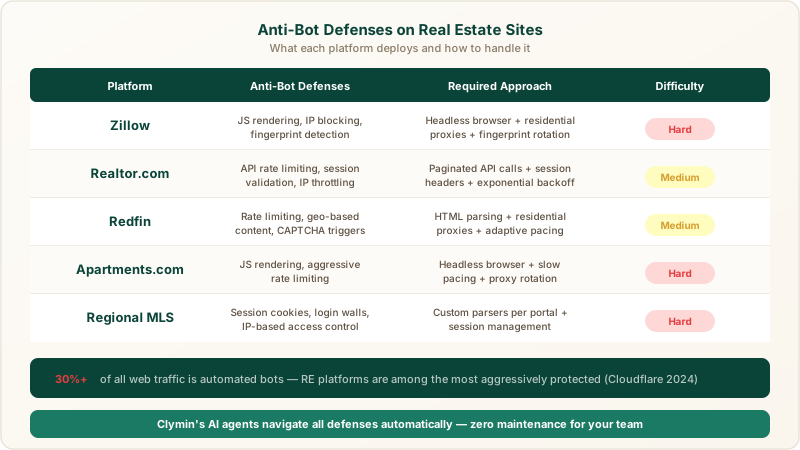
The four-layer approach to bypassing anti-bot defenses on major real estate listing platforms.
Which Real Estate Sites Are Worth Scraping, and Which to Avoid?
Prioritizing sources is as important as the technical implementation. Not every listing site offers data density that justifies the extraction complexity.
High-value sources for U.S. markets: Zillow (largest consumer inventory, rich price history), Realtor.com (NAR MLS-aligned data, accurate listing status), Redfin (brokerage-direct listings with same-day updates), LoopNet (commercial property), Apartments.com (rental inventory). These five sources, combined, cover the vast majority of active U.S. listings.
Regional MLS aggregators are essential for completeness. Bright MLS (Mid-Atlantic), CRMLS (California), MRED (Illinois), and NWMLS (Pacific Northwest) each hold inventory that may not fully propagate to national portals. Accessing these requires either direct relationships or specialized extraction strategies per aggregator.
Sites to approach cautiously include those with explicit anti-scraping clauses in their Terms of Service combined with litigation history. CoStar, for example, has pursued legal action against data aggregators. For sources with restrictive ToS, evaluating licensed data partnerships or official API programs is the lower-risk path.
For a detailed comparison of the trade-offs between scraping listing sites and accessing MLS data through official channels, see MLS data vs. web scraping for property data.
How Clymin Helps Real Estate Teams Aggregate Listing Data
Clymin's managed scraping service removes the infrastructure and maintenance burden from real estate data teams entirely. Rather than building and maintaining source-specific extractors in-house, clients define their target sources and required data fields, Clymin's AI agents handle the rest, from initial setup through ongoing adaptation as sites update their structures.
Clymin has delivered hundreds of data extraction projects across 40+ customers, with real estate accounting for a growing share of that portfolio. Emily W., a Real Estate Consultant working with Clymin, reported: "Data collection efficiency improved by 35% with Clymin's automated property listing extraction." Data is delivered in your preferred format, JSON, CSV, cloud storage, or direct database integration, on a schedule that matches your analysis cadence. For a deeper look at how the AI-agentic approach differs from static scrapers, see our AI-agentic scraping methodology.
Explore Clymin's dedicated real estate data scraping service to see source coverage, typical delivery schedules, and how multi-site property pipelines are configured for different market segments.
Ready to Aggregate Property Listing Data Across Sources?
Building and maintaining a multi-site property scraping pipeline in-house is a significant engineering investment, and one that compounds as sources change their structures and defenses. Clymin's team handles every layer of that pipeline, from initial source configuration through ongoing maintenance and structured data delivery.
Reach out to the Clymin team at contact@clymin.com or book a free consultation to discuss your target sources, required data fields, and delivery schedule. With over a decade of extraction experience and 100B+ data points delivered, Clymin is equipped to handle the complexity of multi-site real estate data at any scale.