
Platform Relationship and Data Differences
Zillow Group acquired Trulia in 2015 for $3.5 billion. Despite common ownership, the platforms maintain distinct user interfaces, data presentations, and feature sets. They share underlying listing data but supplement it differently, creating unique analytical value in each platform that justifies extracting from both.
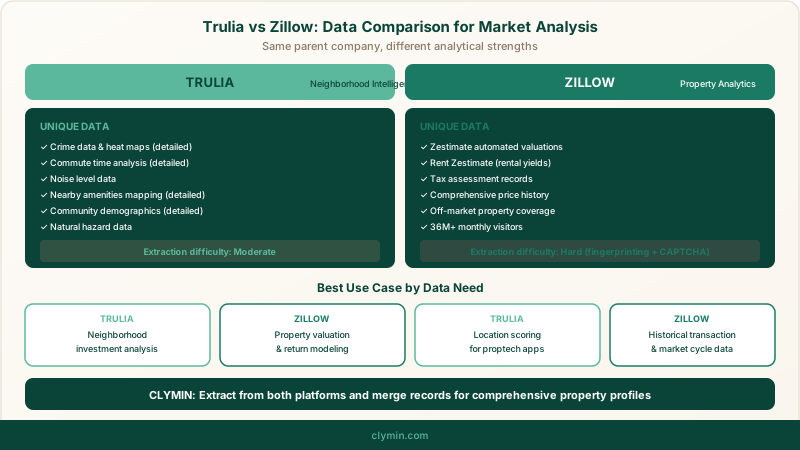
Zillow serves as the primary consumer property platform with 36+ million monthly unique visitors. Its data strength lies in property-level analytics: the Zestimate automated valuation model, comprehensive price history, tax assessment records, and mortgage calculators. Zillow positions itself as the starting point for property valuation research.
Trulia differentiates through neighborhood intelligence. Its crime maps, commute time calculators, school boundary overlays, and demographic breakdowns provide context that property-level data alone cannot capture. For market analysis that needs to understand where people want to live (not just what properties cost), Trulia adds essential context.
Data Coverage Comparison
| Data Category | Trulia | Zillow |
|---|---|---|
| Active sale listings | ✅ | ✅ |
| Property valuations | ❌ | ✅ (Zestimate) |
| Price history | ✅ (basic) | ✅ (comprehensive) |
| Tax assessment data | ❌ | ✅ |
| Crime data/heat maps | ✅ (detailed) | ❌ |
| Commute time analysis | ✅ (detailed) | ✅ (basic) |
| School boundaries | ✅ | ✅ |
| Neighborhood demographics | ✅ (detailed) | ✅ (basic) |
| Rental listings | ✅ | ✅ (more extensive) |
| Rent estimates | ❌ | ✅ (Rent Zestimate) |
| Nearby amenities | ✅ (detailed mapping) | ✅ (basic) |
| Natural hazard data | ✅ | ✅ (newer addition) |
| Noise level data | ✅ | ❌ |
| Property photos | ✅ | ✅ |
| Walk Score | ✅ | ✅ |
When Trulia Data Adds Unique Value
Neighborhood investment analysis benefits significantly from Trulia's crime and demographic data. Crime trends correlate with property value trajectories, declining crime rates in a neighborhood often precede price appreciation. Trulia's historical crime data enables this predictive analysis.
Location scoring models for proptech applications gain accuracy from Trulia's commute time calculations, amenity proximity mapping, and noise level data. These factors influence property desirability in ways that price history alone cannot capture.
Rental market positioning uses Trulia's neighborhood profiles to understand why certain areas command premium rents. The combination of walkability, transit access, dining options, and safety data explains rental price variations that property characteristics alone do not.
Market demographic research for developers and investors benefits from Trulia's community demographic profiles. Understanding age distributions, income levels, and household composition in target neighborhoods informs development decisions and investment thesis validation.
When Zillow Data Is Essential
Property valuation analysis requires Zillow's Zestimate model and historical valuation data. Tracking how Zestimates change over time across a market reveals price trends before they appear in transaction data.
Investment return modeling needs Zillow's Rent Zestimate alongside purchase price estimates. The ratio of Rent Zestimate to Zestimate provides a gross yield indicator for rental investment analysis across thousands of properties simultaneously.
Tax assessment comparison enables identification of properties with significant gaps between assessed value and market value, potential appeal opportunities or undervaluation indicators.
Historical transaction data on Zillow extends deeper than Trulia, capturing multiple sale events, price reductions during listing periods, and days-on-market patterns essential for market cycle analysis.
Technical Extraction Considerations
Zillow implements sophisticated anti-scraping technology including browser fingerprinting, behavioral analysis, and dynamic page structure variation. Extraction requires advanced browser emulation with realistic interaction patterns, residential proxy rotation, and adaptive parsing that handles HTML changes without breaking.
Trulia uses standard anti-bot measures including rate limiting and JavaScript rendering requirements. Extraction is technically less challenging than Zillow but still requires proper browser rendering infrastructure to capture dynamically loaded content like crime maps and neighborhood analytics.
Clymin's extraction agents handle both platforms through the same managed infrastructure used across 30+ real estate data sources. Platform-specific adapters maintain extraction reliability as each site evolves, with Clymin's engineering team addressing any access changes within hours rather than weeks.
Combining Both Sources for Comprehensive Analysis
The highest-value approach extracts from both platforms and enriches records with source-specific data:
Step 1: Extract active listings from both platforms for your target market. Use Zillow listing data as the primary property record (more comprehensive fields).
Step 2: Match Trulia records to Zillow records using address normalization. Append Trulia's unique fields, crime scores, commute data, noise levels, and neighborhood demographics, to each property record.
Step 3: Add Zillow-exclusive fields, Zestimate, Rent Zestimate, tax data, and price history, to complete the enriched property profile.
Step 4: Deliver the merged, normalized dataset through Clymin's API or file delivery. Each record includes clear source attribution for every data field.
Clymin's real-estate data scraping service handles this multi-source extraction and merging automatically. Clients receive a single comprehensive dataset without managing multiple extraction pipelines.
Cost Analysis
DIY extraction from both platforms requires engineering teams comfortable with advanced anti-detection (for Zillow), browser rendering infrastructure, proxy management, and data normalization logic. Budget $250,000-400,000 annually in engineering and infrastructure costs.
Clymin's managed service delivers data from both platforms (plus additional sources) at a fraction of DIY cost. No engineering hires needed, no infrastructure to maintain, and 99%+ extraction reliability guaranteed by a team of 50+ specialized engineers.
Get Combined Trulia and Zillow Data
Clymin configures multi-platform real estate data extraction within 5-7 business days, delivering normalized property data enriched with neighborhood intelligence from both Trulia and Zillow.
Contact the team at contact@clymin.com or book a meeting to discuss your market analysis data requirements.