
Why Quick Commerce Data Is Harder to Track Than Traditional Retail
Quick commerce, the sub-30-minute delivery model pioneered by Gopuff, Getir, and Gorillas, operates with a level of data volatility that traditional retail and even standard e-commerce cannot match. Product availability, pricing, and delivery estimates change multiple times per day based on dark store inventory, rider availability, and demand surges.
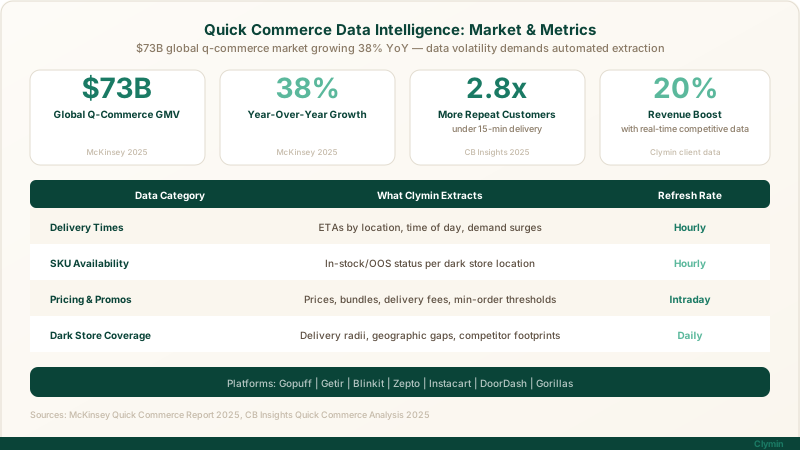
According to McKinsey's 2025 Quick Commerce Report, the global q-commerce market grew 38% year-over-year, reaching $73 billion in GMV. Yet competitive intelligence in this sector remains primitive. Platforms do not publish comprehensive catalog or pricing data, and the hyperlocal nature of dark store operations means product availability varies block by block.
For quick commerce operators benchmarking against rivals, CPG brands monitoring product distribution, and investors evaluating market dynamics, manual data collection is impractical. A single operator may have hundreds of dark stores, each with a different assortment, pricing, and service radius, requiring automated extraction at scale.
What Quick Commerce Data Does Clymin Extract?
Clymin's AI-agentic scraping technology adapts to the varied interfaces of quick commerce apps and websites, extracting operational data that static tools miss when platforms update their layouts or introduce new features.
Delivery time intelligence captures estimated delivery windows by location, time of day, and order type. Clymin monitors how delivery promises fluctuate across peak hours, weather events, and demand surges, providing the operational benchmarking data that q-commerce teams use to evaluate fulfillment performance against competitors.
SKU availability and assortment data tracks which products are listed, in stock, or out of stock at each dark store location. For CPG brands, this data reveals distribution gaps, identifying stores where their products are absent while competitor products are available.
Pricing and promotional dynamics covers product prices, bundle offers, minimum order thresholds, delivery fees, and promotional discounts. Clymin captures price changes as they happen, documenting the intraday pricing strategies that quick commerce platforms use to manage demand and margins.
Dark store coverage mapping identifies which geographic areas each platform serves, the boundaries of each dark store's delivery radius, and gaps in coverage. Operators planning expansion use this data to identify underserved neighborhoods and competitive white spaces.
For teams already leveraging quick commerce competitive intelligence data, Clymin's extraction service provides the raw, structured data feeds that power deeper analytical workflows.
How Quick Commerce Operators Use Competitive Intelligence Data
Quick commerce is a market where small operational advantages compound rapidly. A 5-minute delivery time improvement, a 3% pricing advantage, or better SKU availability in a high-demand neighborhood can shift meaningful market share within weeks.
Delivery time benchmarking allows operators to compare their fulfillment performance against competitors at a granular level, by neighborhood, time of day, and product category. According to CB Insights' 2025 Quick Commerce Analysis, operators that maintain delivery times below 15 minutes retain 2.8x more repeat customers than those averaging 20-30 minutes.
Clymin's structured delivery time data enables this comparison across every competitor and every geography an operator serves. Product managers can identify specific dark stores underperforming relative to the competitive benchmark and investigate operational causes.
Assortment gap analysis compares product catalogs across competitors to identify SKU categories where a platform's offering is thinner than rivals. For CPG brands, the same data reveals availability coverage, showing where their products appear versus where competitor products dominate shelf space.
Pricing strategy monitoring tracks how competitors adjust prices throughout the day and in response to promotional events. Clymin's historical pricing data reveals patterns, such as competitors dropping prices on staple items during dinner rush hours, that inform dynamic pricing strategies.
Dark Store Coverage and Expansion Intelligence
Dark store network planning is one of the most capital-intensive decisions in quick commerce. Opening a new dark store requires confidence that sufficient demand exists, that competitor coverage is weak enough to capture share, and that the delivery radius supports the operational economics.
Clymin maps competitor dark store coverage areas by extracting delivery availability data across grid patterns of addresses. The resulting coverage maps reveal which neighborhoods have strong multi-platform competition, which have only one or two players, and which remain entirely unserved.
Operators use Clymin's coverage data alongside internal demand signals to prioritize expansion targets. Rather than relying on broad market estimates, expansion teams work with precise, current competitive coverage data that reflects actual dark store footprints.
For delivery app performance monitoring across the broader food delivery ecosystem, Clymin provides comparable extraction capabilities covering platforms from Uber Eats and DoorDash to Blinkit and Zepto.
Sarah T., Marketing Manager at an e-commerce client, noted that real-time market trend and competitor pricing analysis helped boost revenue by 20%. Quick commerce operators achieve similar results when Clymin's competitive data replaces manual monitoring with automated, structured intelligence feeds.
Quick Commerce Data for CPG Brands and Investors
Quick commerce data is not only valuable for platform operators. CPG brands and investors are among the fastest-growing segments of Clymin's q-commerce data client base.
CPG trade spend optimization requires visibility into which dark stores carry a brand's products, whether those products are priced correctly, and how promotional activity compares to competitors. Clymin delivers store-level SKU and pricing data that trade marketing teams use to hold distributors accountable and allocate promotional budgets to locations with the highest impact potential.
Investor due diligence increasingly depends on alternative data that reveals operational performance beyond what platforms disclose publicly. Delivery time trends, geographic coverage growth, assortment depth, and pricing stability all serve as proxies for operational health. Clymin provides these datasets to venture capital and private equity firms evaluating quick commerce investments.
Ready to Build Your Quick Commerce Intelligence Pipeline?
Clymin's managed service handles the technical complexity of extracting data from fast-changing quick commerce platforms. With 40+ customers served and hundreds of projects delivered across retail, e-commerce, and food delivery verticals, Clymin brings proven data extraction expertise to the specific challenges of quick commerce intelligence.
Contact us at contact@clymin.com or get a free consultation to discuss your quick commerce data requirements.