
Why Q-Commerce Strategy Teams Struggle Without Structured Data
Quick commerce operates on 10- to 30-minute delivery windows, meaning competitive conditions shift faster than any human team can manually track. A competitor launching a new dark store, adjusting delivery fees, or expanding into an adjacent zone changes the competitive landscape within hours, not weeks.
According to Statista's 2025 Q-Commerce Market Report, the global quick commerce market reached $79 billion in revenue and is projected to exceed $119 billion by 2028. Growth at this pace attracts aggressive competition, and the companies that win market share are the ones operating with real-time competitive visibility.
Bain & Company's 2025 analysis of instant delivery economics found that q-commerce operators with access to granular competitive data achieve 22% higher order density per dark store compared to those relying on periodic manual checks. The difference comes down to zone-level pricing optimization, targeted assortment decisions, and faster expansion timing.
Manual monitoring creates blind spots at every level. A strategy director reviewing competitor apps by hand might catch headline delivery fees, but will miss zone-specific surge pricing, SKU-level availability gaps, and the gradual expansion of a rival's coverage footprint across 50+ zones simultaneously.
What Quick Commerce Competitive Intelligence Data Reveals
Quick commerce competitive intelligence data goes far beyond simple price comparisons. Clymin extracts and structures four critical data categories that together provide a complete operational picture of the competitive landscape.
Delivery time benchmarks capture promised and actual delivery windows across zones, time slots, and order types. Tracking how competitors perform during peak hours versus off-peak hours reveals capacity constraints and fulfillment efficiency differences that inform your own operations planning.
SKU availability and assortment depth monitoring tracks which products competitors stock, where they stock them, and how frequently items go out of stock. A competitor consistently out of stock on high-demand essentials in a specific zone signals a fulfillment weakness your team can exploit.
Zone coverage and expansion tracking maps exactly where competitors deliver, how those boundaries shift over time, and where new dark stores open. Clymin cross-references delivery availability with address-level testing to produce accurate coverage maps updated daily.
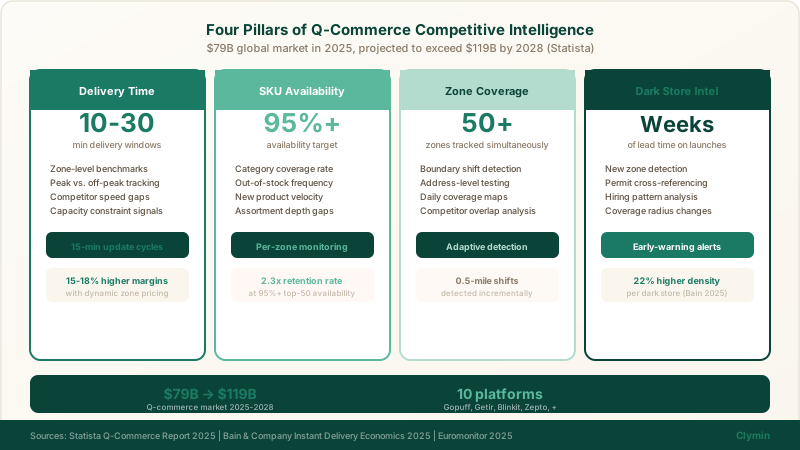
Four critical data categories that drive q-commerce competitive advantage in 2026.
Dark store expansion intelligence combines multiple signals, new delivery zones appearing, coverage radius changes, public permit filings, and hiring patterns, to alert your strategy team before a competitor fully launches in a new market. Early warning on expansion moves gives your team weeks of lead time to prepare a response.
How Delivery Time and Surge Pricing Data Drives Zone-Level Decisions
Delivery time data is the single most valuable competitive metric in quick commerce. Customers choose platforms based on speed, and a 5-minute difference in promised delivery time can shift order volume dramatically within a zone.
Clymin collects delivery time promises at the zone and time-slot level across every tracked competitor. Strategy teams use this data to identify zones where their delivery times lag competitors and prioritize operational improvements. Equally important, zones where your platform outperforms competitors on speed become candidates for increased marketing spend.
Surge pricing patterns reveal how competitors manage demand spikes. Some q-commerce operators raise delivery fees during peak hours, while others restrict availability or increase minimum order values. Clymin captures all three response mechanisms, giving your pricing team a complete picture of competitor demand management strategies.
According to McKinsey's 2025 Last-Mile Delivery Report, q-commerce platforms that dynamically adjust pricing based on zone-level competitive data achieve 15-18% higher contribution margins per order. Static pricing leaves significant margin on the table in zones where competitors charge more, and erodes volume in zones where competitors undercut.
Sarah T., Marketing Manager at an e-commerce client, shared that "Clymin's data insights helped us boost revenue by 20% through real-time market trend and competitor pricing analysis." The same principle applies to q-commerce: real-time competitive data directly translates to revenue optimization at the zone level.
Tracking SKU Availability and Assortment Gaps Across Competitors
Assortment intelligence reveals which competitors are winning or losing on product availability, a critical factor in customer retention for quick commerce. Clymin monitors SKU-level availability across platforms and zones, flagging gaps your merchandising team can capitalize on.
A detailed comparison of food delivery platform data strategies shows how the largest players differentiate through assortment breadth and availability consistency. Q-commerce operators face an even more concentrated version of this challenge, because dark store inventory is limited and every out-of-stock item pushes a customer to a rival app.
Clymin's q-commerce analytics track three assortment metrics that matter most:
- Category coverage rate: percentage of top-100 essentials available per zone per competitor
- Out-of-stock frequency: how often high-demand items disappear and how quickly they return
- New product velocity: how fast competitors add trending items to their assortment
Euromonitor International's 2025 Quick Commerce Benchmark found that platforms maintaining 95%+ availability on top-50 essentials retain customers at 2.3x the rate of platforms averaging below 90% availability. Clymin tracks this metric at the zone level for every monitored competitor, giving your merchandising team actionable targets.
For teams evaluating whether to build internal scraping tools or use a managed service, a comparison of managed food delivery scraping versus DIY approaches breaks down the cost, accuracy, and maintenance trade-offs specific to high-frequency q-commerce data collection.
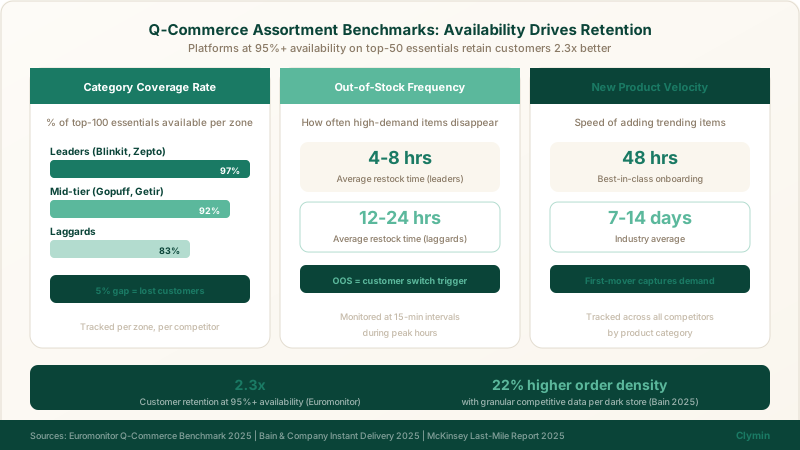
Assortment benchmarks across leading q-commerce platforms, availability consistency separates market leaders from laggards.
Dark Store Expansion Tracking and Coverage Intelligence
Dark store location strategy determines which zones a q-commerce operator can profitably serve. Clymin provides expansion intelligence by monitoring coverage zone changes, new delivery address availability, and public indicators of upcoming launches.
Clymin's AI-agentic scraping approach enables adaptive monitoring that detects subtle coverage boundary shifts, a competitor's delivery radius expanding by 0.5 miles in a specific direction, or a previously unserved ZIP code suddenly showing delivery availability. Static scrapers miss these incremental changes because they only check predefined data points.
Expansion tracking feeds directly into your real estate and operations planning. Knowing that a competitor filed permits for three new dark store locations in a target market gives your expansion team weeks of lead time to secure competing sites or accelerate planned launches.
Clymin has delivered hundreds of data extraction projects across e-commerce, food delivery, and quick commerce segments, with data infrastructure capable of monitoring thousands of zones simultaneously. The platform processes over 100 billion data points, maintaining the collection frequency and accuracy that q-commerce intelligence demands.
Ready to Gain Q-Commerce Competitive Advantage?
Competitive intelligence data separates the q-commerce operators who react from those who anticipate. Clymin delivers the delivery time benchmarks, SKU availability tracking, zone coverage maps, and dark store expansion alerts your strategy team needs to make faster, sharper decisions.
Contact the Clymin team at contact@clymin.com to discuss your q-commerce data requirements, or schedule a free consultation to see how structured competitive intelligence data can strengthen your market position in 2026.